

13 Photodynamic Therapy
457
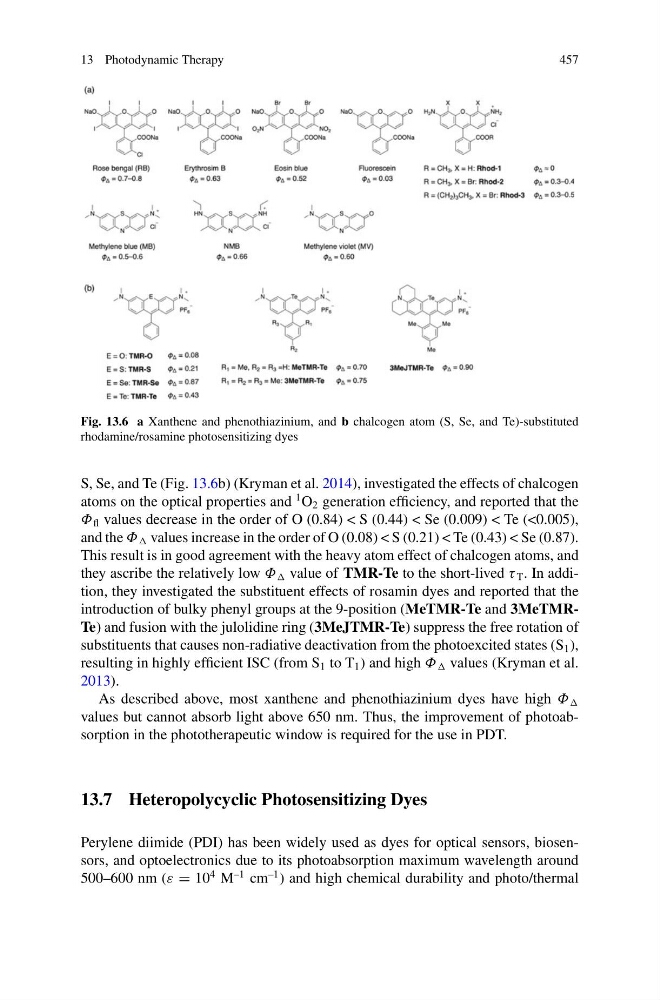
Fig. 13.6 a Xanthene and phenothiazinium, and b chalcogen atom (S, Se, and Te)-substituted
rhodamine/rosamine photosensitizing dyes
S, Se, and Te (Fig. 13.6b) (Kryman et al. 2014), investigated the effects of chalcogen
atoms on the optical properties and
1 O 2 generation efficiency, and reported that the
Φ fl values decrease in the order of O (0.84) < S (0.44) < Se (0.009) < Te (<0.005),
and the Φ values increase in the order of O (0.08) < S (0.21) < Te (0.43) < Se (0.87).
This result is in good agreement with the heavy atom effect of chalcogen atoms, and
they ascribe the relatively low Φ value of TMR-Te to the short-lived τ T . In addition, they investigated the substituent effects of rosamin dyes and reported that the
introduction of bulky phenyl groups at the 9-position (MeTMR-Te and 3MeTMRTe) and fusion with the julolidine ring (3MeJTMR-Te) suppress the free rotation of
substituents that causes non-radiative deactivation from the photoexcited states (S 1 ),
resulting in highly efficient ISC (from S 1 to T 1 ) and high Φ values (Kryman et al.
2013).
As described above, most xanthene and phenothiazinium dyes have high Φ
values but cannot absorb light above 650 nm. Thus, the improvement of photoabsorption in the phototherapeutic window is required for the use in PDT.
13.7 Heteropolycyclic Photosensitizing Dyes
Perylene diimide (PDI) has been widely used as dyes for optical sensors, biosensors, and optoelectronics due to its photoabsorption maximum wavelength around
500–600 nm (ε = 10
4 M
–1 cm
–1 ) and high chemical durability and photo/thermal
457
Fig. 13.6 a Xanthene and phenothiazinium, and b chalcogen atom (S, Se, and Te)-substituted
rhodamine/rosamine photosensitizing dyes
S, Se, and Te (Fig. 13.6b) (Kryman et al. 2014), investigated the effects of chalcogen
atoms on the optical properties and
1 O 2 generation efficiency, and reported that the
Φ fl values decrease in the order of O (0.84) < S (0.44) < Se (0.009) < Te (<0.005),
and the Φ values increase in the order of O (0.08) < S (0.21) < Te (0.43) < Se (0.87).
This result is in good agreement with the heavy atom effect of chalcogen atoms, and
they ascribe the relatively low Φ value of TMR-Te to the short-lived τ T . In addition, they investigated the substituent effects of rosamin dyes and reported that the
introduction of bulky phenyl groups at the 9-position (MeTMR-Te and 3MeTMRTe) and fusion with the julolidine ring (3MeJTMR-Te) suppress the free rotation of
substituents that causes non-radiative deactivation from the photoexcited states (S 1 ),
resulting in highly efficient ISC (from S 1 to T 1 ) and high Φ values (Kryman et al.
2013).
As described above, most xanthene and phenothiazinium dyes have high Φ
values but cannot absorb light above 650 nm. Thus, the improvement of photoabsorption in the phototherapeutic window is required for the use in PDT.
13.7 Heteropolycyclic Photosensitizing Dyes
Perylene diimide (PDI) has been widely used as dyes for optical sensors, biosensors, and optoelectronics due to its photoabsorption maximum wavelength around
500–600 nm (ε = 10
4 M
–1 cm
–1 ) and high chemical durability and photo/thermal