

386
Y. Niko and S. Watanabe
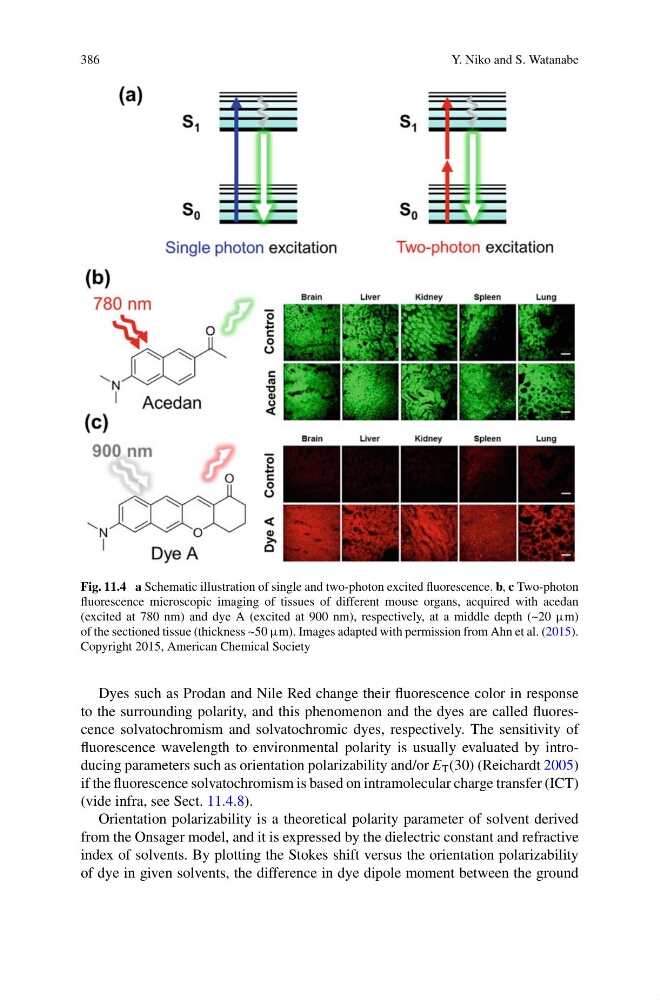
Fig. 11.4 a Schematic illustration of single and two-photon excited fluorescence. b, c Two-photon
fluorescence microscopic imaging of tissues of different mouse organs, acquired with acedan
(excited at 780 nm) and dye A (excited at 900 nm), respectively, at a middle depth (~20 μm)
of the sectioned tissue (thickness ~50 μm). Images adapted with permission from Ahn et al. (2015).
Copyright 2015, American Chemical Society
Dyes such as Prodan and Nile Red change their fluorescence color in response
to the surrounding polarity, and this phenomenon and the dyes are called fluorescence solvatochromism and solvatochromic dyes, respectively. The sensitivity of
fluorescence wavelength to environmental polarity is usually evaluated by introducing parameters such as orientation polarizability and/or E T (30) (Reichardt 2005)
if the fluorescence solvatochromism is based on intramolecular charge transfer (ICT)
(vide infra, see Sect. 11.4.8).
Orientation polarizability is a theoretical polarity parameter of solvent derived
from the Onsager model, and it is expressed by the dielectric constant and refractive
index of solvents. By plotting the Stokes shift versus the orientation polarizability
of dye in given solvents, the difference in dye dipole moment between the ground
Y. Niko and S. Watanabe
Fig. 11.4 a Schematic illustration of single and two-photon excited fluorescence. b, c Two-photon
fluorescence microscopic imaging of tissues of different mouse organs, acquired with acedan
(excited at 780 nm) and dye A (excited at 900 nm), respectively, at a middle depth (~20 μm)
of the sectioned tissue (thickness ~50 μm). Images adapted with permission from Ahn et al. (2015).
Copyright 2015, American Chemical Society
Dyes such as Prodan and Nile Red change their fluorescence color in response
to the surrounding polarity, and this phenomenon and the dyes are called fluorescence solvatochromism and solvatochromic dyes, respectively. The sensitivity of
fluorescence wavelength to environmental polarity is usually evaluated by introducing parameters such as orientation polarizability and/or E T (30) (Reichardt 2005)
if the fluorescence solvatochromism is based on intramolecular charge transfer (ICT)
(vide infra, see Sect. 11.4.8).
Orientation polarizability is a theoretical polarity parameter of solvent derived
from the Onsager model, and it is expressed by the dielectric constant and refractive
index of solvents. By plotting the Stokes shift versus the orientation polarizability
of dye in given solvents, the difference in dye dipole moment between the ground