

364
Y. Morisaki
10.5 Synthesis of Enantiopure
Bis-(Para)-Pseudo-Ortho-Tetrasubstituted
[2.2]Paracyclophane and Syntheses of Optically Active
π-Stacked Molecules
In 2016, a new type of enantiopure 4,7,12,15-tetrasubstituted [2.2]paracyclophane
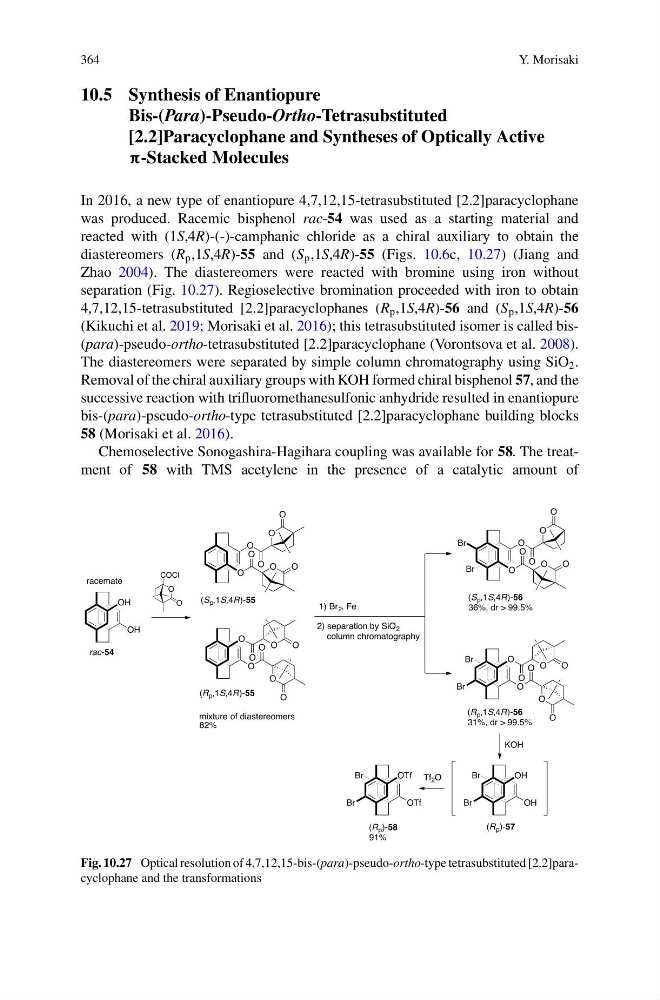
was produced. Racemic bisphenol rac-54 was used as a starting material and
reacted with (1S,4R)-(-)-camphanic chloride as a chiral auxiliary to obtain the
diastereomers (R p ,1S,4R)-55 and (S p ,1S,4R)-55 (Figs. 10.6c, 10.27) (Jiang and
Zhao 2004). The diastereomers were reacted with bromine using iron without
separation (Fig. 10.27). Regioselective bromination proceeded with iron to obtain
4,7,12,15-tetrasubstituted [2.2]paracyclophanes (R p ,1S,4R)-56 and (S p ,1S,4R)-56
(Kikuchi et al. 2019; Morisaki et al. 2016); this tetrasubstituted isomer is called bis(para)-pseudo-ortho-tetrasubstituted [2.2]paracyclophane (Vorontsova et al. 2008).
The diastereomers were separated by simple column chromatography using SiO 2 .
Removal of the chiral auxiliary groups with KOH formed chiral bisphenol 57, and the
successive reaction with trifluoromethanesulfonic anhydride resulted in enantiopure
bis-(para)-pseudo-ortho-type tetrasubstituted [2.2]paracyclophane building blocks
58 (Morisaki et al. 2016).
Chemoselective Sonogashira-Hagihara coupling was available for 58. The treatment of 58 with TMS acetylene in the presence of a catalytic amount of
Fig. 10.27 Optical resolution of 4,7,12,15-bis-(para)-pseudo-ortho-type tetrasubstituted [2.2]paracyclophane and the transformations
Y. Morisaki
10.5 Synthesis of Enantiopure
Bis-(Para)-Pseudo-Ortho-Tetrasubstituted
[2.2]Paracyclophane and Syntheses of Optically Active
π-Stacked Molecules
In 2016, a new type of enantiopure 4,7,12,15-tetrasubstituted [2.2]paracyclophane
was produced. Racemic bisphenol rac-54 was used as a starting material and
reacted with (1S,4R)-(-)-camphanic chloride as a chiral auxiliary to obtain the
diastereomers (R p ,1S,4R)-55 and (S p ,1S,4R)-55 (Figs. 10.6c, 10.27) (Jiang and
Zhao 2004). The diastereomers were reacted with bromine using iron without
separation (Fig. 10.27). Regioselective bromination proceeded with iron to obtain
4,7,12,15-tetrasubstituted [2.2]paracyclophanes (R p ,1S,4R)-56 and (S p ,1S,4R)-56
(Kikuchi et al. 2019; Morisaki et al. 2016); this tetrasubstituted isomer is called bis(para)-pseudo-ortho-tetrasubstituted [2.2]paracyclophane (Vorontsova et al. 2008).
The diastereomers were separated by simple column chromatography using SiO 2 .
Removal of the chiral auxiliary groups with KOH formed chiral bisphenol 57, and the
successive reaction with trifluoromethanesulfonic anhydride resulted in enantiopure
bis-(para)-pseudo-ortho-type tetrasubstituted [2.2]paracyclophane building blocks
58 (Morisaki et al. 2016).
Chemoselective Sonogashira-Hagihara coupling was available for 58. The treatment of 58 with TMS acetylene in the presence of a catalytic amount of
Fig. 10.27 Optical resolution of 4,7,12,15-bis-(para)-pseudo-ortho-type tetrasubstituted [2.2]paracyclophane and the transformations