

362
Y. Morisaki
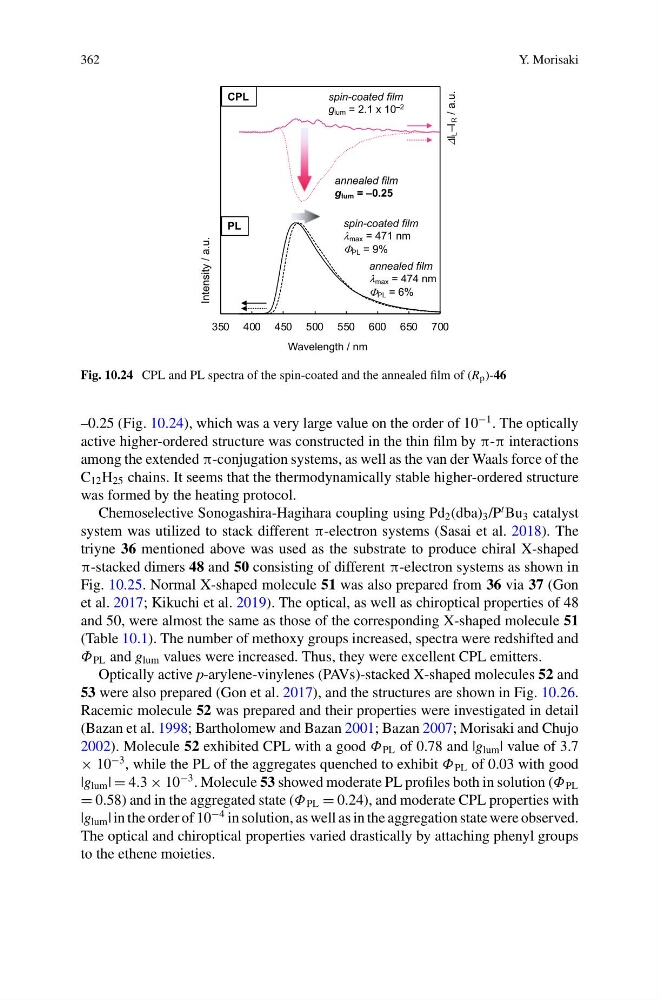
Fig. 10.24 CPL and PL spectra of the spin-coated and the annealed film of (R p )-46
–0.25 (Fig. 10.24), which was a very large value on the order of 10
−1 . The optically
active higher-ordered structure was constructed in the thin film by π-π interactions
among the extended π-conjugation systems, as well as the van der Waals force of the
C 12 H 25 chains. It seems that the thermodynamically stable higher-ordered structure
was formed by the heating protocol.
Chemoselective Sonogashira-Hagihara coupling using Pd 2 (dba) 3 /P
t Bu 3 catalyst
system was utilized to stack different π-electron systems (Sasai et al. 2018). The
triyne 36 mentioned above was used as the substrate to produce chiral X-shaped
π-stacked dimers 48 and 50 consisting of different π-electron systems as shown in
Fig. 10.25. Normal X-shaped molecule 51 was also prepared from 36 via 37 (Gon
et al. 2017; Kikuchi et al. 2019). The optical, as well as chiroptical properties of 48
and 50, were almost the same as those of the corresponding X-shaped molecule 51
(Table 10.1). The number of methoxy groups increased, spectra were redshifted and
Φ PL and g lum values were increased. Thus, they were excellent CPL emitters.
Optically active p-arylene-vinylenes (PAVs)-stacked X-shaped molecules 52 and
53 were also prepared (Gon et al. 2017), and the structures are shown in Fig. 10.26.
Racemic molecule 52 was prepared and their properties were investigated in detail
(Bazan et al. 1998; Bartholomew and Bazan 2001; Bazan 2007; Morisaki and Chujo
2002). Molecule 52 exhibited CPL with a good Φ PL of 0.78 and |g lum | value of 3.7
× 10
−3 , while the PL of the aggregates quenched to exhibit Φ PL of 0.03 with good
|g lum | = 4.3 × 10
−3 . Molecule 53 showed moderate PL profiles both in solution (Φ PL
= 0.58) and in the aggregated state (Φ PL = 0.24), and moderate CPL properties with
|g lum | in the order of 10
−4 in solution, as well as in the aggregation state were observed.
The optical and chiroptical properties varied drastically by attaching phenyl groups
to the ethene moieties.
Y. Morisaki
Fig. 10.24 CPL and PL spectra of the spin-coated and the annealed film of (R p )-46
–0.25 (Fig. 10.24), which was a very large value on the order of 10
−1 . The optically
active higher-ordered structure was constructed in the thin film by π-π interactions
among the extended π-conjugation systems, as well as the van der Waals force of the
C 12 H 25 chains. It seems that the thermodynamically stable higher-ordered structure
was formed by the heating protocol.
Chemoselective Sonogashira-Hagihara coupling using Pd 2 (dba) 3 /P
t Bu 3 catalyst
system was utilized to stack different π-electron systems (Sasai et al. 2018). The
triyne 36 mentioned above was used as the substrate to produce chiral X-shaped
π-stacked dimers 48 and 50 consisting of different π-electron systems as shown in
Fig. 10.25. Normal X-shaped molecule 51 was also prepared from 36 via 37 (Gon
et al. 2017; Kikuchi et al. 2019). The optical, as well as chiroptical properties of 48
and 50, were almost the same as those of the corresponding X-shaped molecule 51
(Table 10.1). The number of methoxy groups increased, spectra were redshifted and
Φ PL and g lum values were increased. Thus, they were excellent CPL emitters.
Optically active p-arylene-vinylenes (PAVs)-stacked X-shaped molecules 52 and
53 were also prepared (Gon et al. 2017), and the structures are shown in Fig. 10.26.
Racemic molecule 52 was prepared and their properties were investigated in detail
(Bazan et al. 1998; Bartholomew and Bazan 2001; Bazan 2007; Morisaki and Chujo
2002). Molecule 52 exhibited CPL with a good Φ PL of 0.78 and |g lum | value of 3.7
× 10
−3 , while the PL of the aggregates quenched to exhibit Φ PL of 0.03 with good
|g lum | = 4.3 × 10
−3 . Molecule 53 showed moderate PL profiles both in solution (Φ PL
= 0.58) and in the aggregated state (Φ PL = 0.24), and moderate CPL properties with
|g lum | in the order of 10
−4 in solution, as well as in the aggregation state were observed.
The optical and chiroptical properties varied drastically by attaching phenyl groups
to the ethene moieties.