

10 Circularly Polarized Luminescence (CPL) Based on Planar …
359
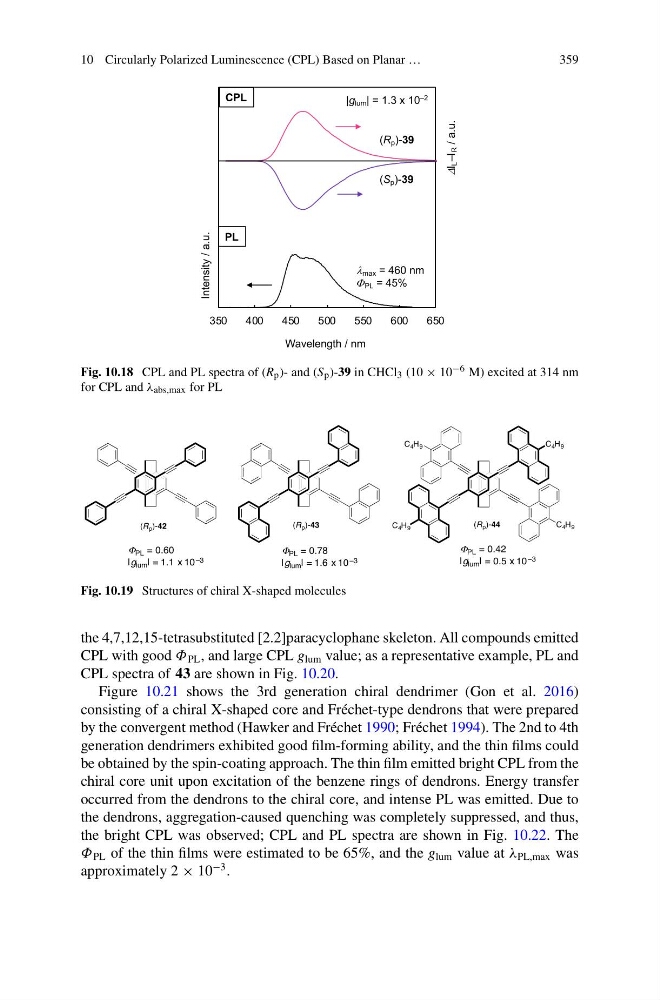
Fig. 10.18 CPL and PL spectra of (R p )- and (S p )-39 in CHCl 3 (10 × 10 −6 M) excited at 314 nm
for CPL and λ abs,max for PL
Fig. 10.19 Structures of chiral X-shaped molecules
the 4,7,12,15-tetrasubstituted [2.2]paracyclophane skeleton. All compounds emitted
CPL with good Φ PL , and large CPL g lum value; as a representative example, PL and
CPL spectra of 43 are shown in Fig. 10.20.
Figure 10.21 shows the 3rd generation chiral dendrimer (Gon et al. 2016)
consisting of a chiral X-shaped core and Fréchet-type dendrons that were prepared
by the convergent method (Hawker and Fréchet 1990; Fréchet 1994). The 2nd to 4th
generation dendrimers exhibited good film-forming ability, and the thin films could
be obtained by the spin-coating approach. The thin film emitted bright CPL from the
chiral core unit upon excitation of the benzene rings of dendrons. Energy transfer
occurred from the dendrons to the chiral core, and intense PL was emitted. Due to
the dendrons, aggregation-caused quenching was completely suppressed, and thus,
the bright CPL was observed; CPL and PL spectra are shown in Fig. 10.22. The
Φ PL of the thin films were estimated to be 65%, and the g lum value at λ PL,max was
approximately 2 × 10
−3 .
359
Fig. 10.18 CPL and PL spectra of (R p )- and (S p )-39 in CHCl 3 (10 × 10 −6 M) excited at 314 nm
for CPL and λ abs,max for PL
Fig. 10.19 Structures of chiral X-shaped molecules
the 4,7,12,15-tetrasubstituted [2.2]paracyclophane skeleton. All compounds emitted
CPL with good Φ PL , and large CPL g lum value; as a representative example, PL and
CPL spectra of 43 are shown in Fig. 10.20.
Figure 10.21 shows the 3rd generation chiral dendrimer (Gon et al. 2016)
consisting of a chiral X-shaped core and Fréchet-type dendrons that were prepared
by the convergent method (Hawker and Fréchet 1990; Fréchet 1994). The 2nd to 4th
generation dendrimers exhibited good film-forming ability, and the thin films could
be obtained by the spin-coating approach. The thin film emitted bright CPL from the
chiral core unit upon excitation of the benzene rings of dendrons. Energy transfer
occurred from the dendrons to the chiral core, and intense PL was emitted. Due to
the dendrons, aggregation-caused quenching was completely suppressed, and thus,
the bright CPL was observed; CPL and PL spectra are shown in Fig. 10.22. The
Φ PL of the thin films were estimated to be 65%, and the g lum value at λ PL,max was
approximately 2 × 10
−3 .