

356
Y. Morisaki
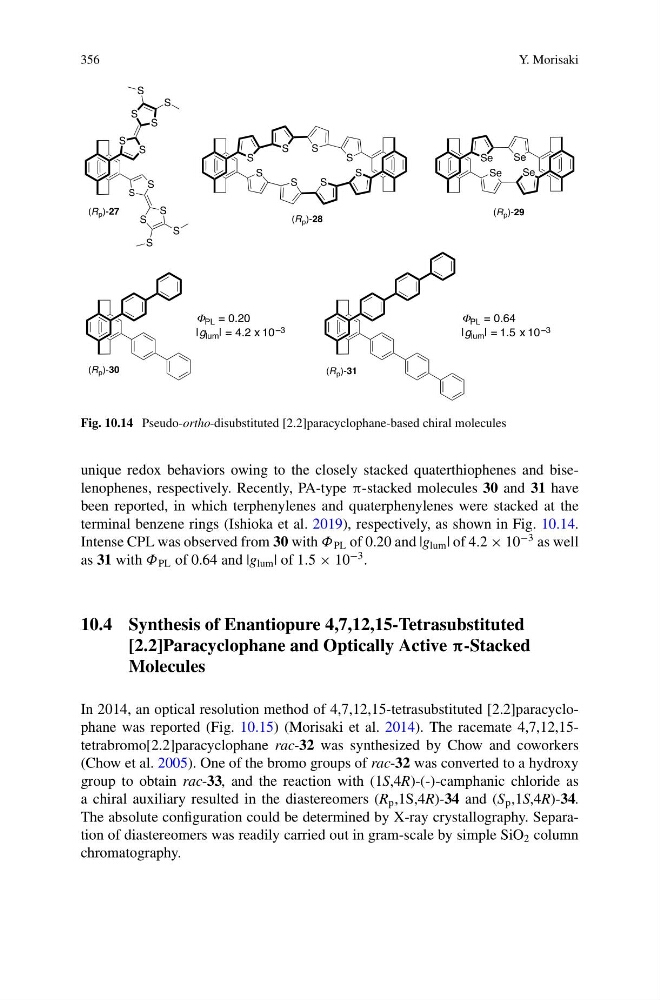
Fig. 10.14 Pseudo-ortho-disubstituted [2.2]paracyclophane-based chiral molecules
unique redox behaviors owing to the closely stacked quaterthiophenes and biselenophenes, respectively. Recently, PA-type π-stacked molecules 30 and 31 have
been reported, in which terphenylenes and quaterphenylenes were stacked at the
terminal benzene rings (Ishioka et al. 2019), respectively, as shown in Fig. 10.14.
Intense CPL was observed from 30 with Φ PL of 0.20 and |g lum | of 4.2 × 10
−3 as well
as 31 with Φ PL of 0.64 and |g lum | of 1.5 × 10
−3 .
10.4 Synthesis of Enantiopure 4,7,12,15-Tetrasubstituted
[2.2]Paracyclophane and Optically Active π-Stacked
Molecules
In 2014, an optical resolution method of 4,7,12,15-tetrasubstituted [2.2]paracyclophane was reported (Fig. 10.15) (Morisaki et al. 2014). The racemate 4,7,12,15tetrabromo[2.2]paracyclophane rac-32 was synthesized by Chow and coworkers
(Chow et al. 2005). One of the bromo groups of rac-32 was converted to a hydroxy
group to obtain rac-33, and the reaction with (1S,4R)-(-)-camphanic chloride as
a chiral auxiliary resulted in the diastereomers (R p ,1S,4R)-34 and (S p ,1S,4R)-34.
The absolute configuration could be determined by X-ray crystallography. Separation of diastereomers was readily carried out in gram-scale by simple SiO 2 column
chromatography.
Y. Morisaki
Fig. 10.14 Pseudo-ortho-disubstituted [2.2]paracyclophane-based chiral molecules
unique redox behaviors owing to the closely stacked quaterthiophenes and biselenophenes, respectively. Recently, PA-type π-stacked molecules 30 and 31 have
been reported, in which terphenylenes and quaterphenylenes were stacked at the
terminal benzene rings (Ishioka et al. 2019), respectively, as shown in Fig. 10.14.
Intense CPL was observed from 30 with Φ PL of 0.20 and |g lum | of 4.2 × 10
−3 as well
as 31 with Φ PL of 0.64 and |g lum | of 1.5 × 10
−3 .
10.4 Synthesis of Enantiopure 4,7,12,15-Tetrasubstituted
[2.2]Paracyclophane and Optically Active π-Stacked
Molecules
In 2014, an optical resolution method of 4,7,12,15-tetrasubstituted [2.2]paracyclophane was reported (Fig. 10.15) (Morisaki et al. 2014). The racemate 4,7,12,15tetrabromo[2.2]paracyclophane rac-32 was synthesized by Chow and coworkers
(Chow et al. 2005). One of the bromo groups of rac-32 was converted to a hydroxy
group to obtain rac-33, and the reaction with (1S,4R)-(-)-camphanic chloride as
a chiral auxiliary resulted in the diastereomers (R p ,1S,4R)-34 and (S p ,1S,4R)-34.
The absolute configuration could be determined by X-ray crystallography. Separation of diastereomers was readily carried out in gram-scale by simple SiO 2 column
chromatography.