

354
Y. Morisaki
In contrast, the g lum values of 20–22 increased depending on the number of
stacked π-electron systems. It is speculated that some sort of chirality is induced
in addition to the optically active V-shaped structure of the cyclophane moiety in
the excited state. The comparison of linear trimer 21 with cyclic trimer 23 gave
the answer to this question. The g abs values of 21 and 23 were different, and their
g lum values were identical. The cyclic structure is a fixed chiral triangle structure
(fixed optically active second-ordered structure), whereas the linear π-stacked structure adopts various conformations in the ground state. Thus, chiralities of both the
second-ordered structure (chiral triangle structure) and the V-shaped structure affect
the larger g abs value of 23 (3.7 × 10
−3 ) more than that of 21 (3.0 × 10
−3 ). On the
other hand, the g lum values of 21 and 23 were identical, indicating that 21 and 23
adopt a similar structure in the excited state. PAEs, poly(p-arylenevinylene)s (PAVs),
and poly(p-arylene)s (PAs) are known to form planar structures in the excited states,
because of the contribution of the quinoid moiety in the excited state. Considering
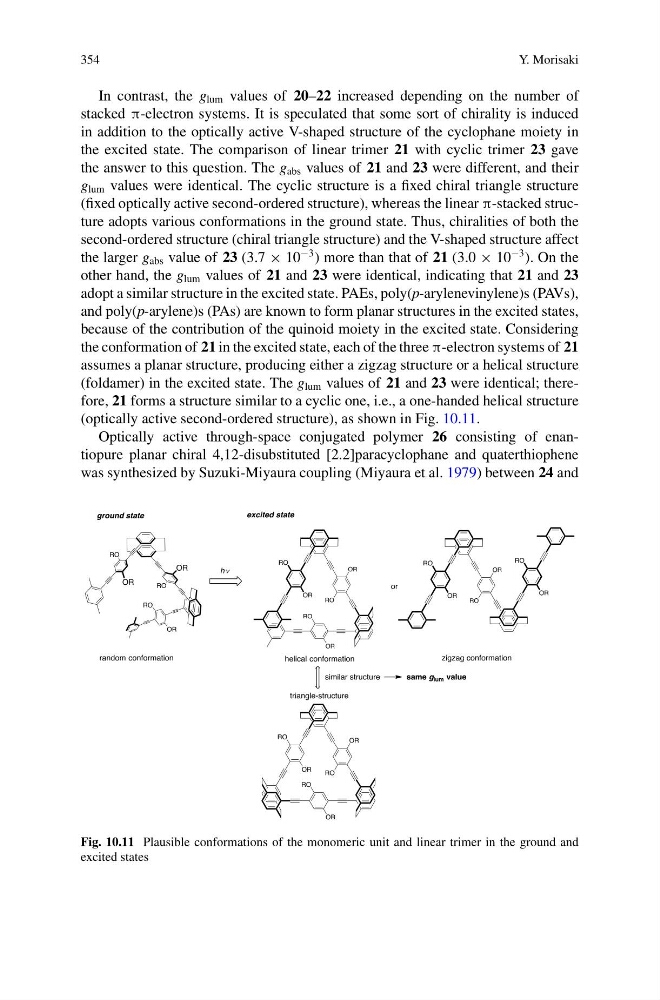
the conformation of 21 in the excited state, each of the three π-electron systems of 21
assumes a planar structure, producing either a zigzag structure or a helical structure
(foldamer) in the excited state. The g lum values of 21 and 23 were identical; therefore, 21 forms a structure similar to a cyclic one, i.e., a one-handed helical structure
(optically active second-ordered structure), as shown in Fig. 10.11.
Optically active through-space conjugated polymer 26 consisting of enantiopure planar chiral 4,12-disubstituted [2.2]paracyclophane and quaterthiophene
was synthesized by Suzuki-Miyaura coupling (Miyaura et al. 1979) between 24 and
Fig. 10.11 Plausible conformations of the monomeric unit and linear trimer in the ground and
excited states
Y. Morisaki
In contrast, the g lum values of 20–22 increased depending on the number of
stacked π-electron systems. It is speculated that some sort of chirality is induced
in addition to the optically active V-shaped structure of the cyclophane moiety in
the excited state. The comparison of linear trimer 21 with cyclic trimer 23 gave
the answer to this question. The g abs values of 21 and 23 were different, and their
g lum values were identical. The cyclic structure is a fixed chiral triangle structure
(fixed optically active second-ordered structure), whereas the linear π-stacked structure adopts various conformations in the ground state. Thus, chiralities of both the
second-ordered structure (chiral triangle structure) and the V-shaped structure affect
the larger g abs value of 23 (3.7 × 10
−3 ) more than that of 21 (3.0 × 10
−3 ). On the
other hand, the g lum values of 21 and 23 were identical, indicating that 21 and 23
adopt a similar structure in the excited state. PAEs, poly(p-arylenevinylene)s (PAVs),
and poly(p-arylene)s (PAs) are known to form planar structures in the excited states,
because of the contribution of the quinoid moiety in the excited state. Considering
the conformation of 21 in the excited state, each of the three π-electron systems of 21
assumes a planar structure, producing either a zigzag structure or a helical structure
(foldamer) in the excited state. The g lum values of 21 and 23 were identical; therefore, 21 forms a structure similar to a cyclic one, i.e., a one-handed helical structure
(optically active second-ordered structure), as shown in Fig. 10.11.
Optically active through-space conjugated polymer 26 consisting of enantiopure planar chiral 4,12-disubstituted [2.2]paracyclophane and quaterthiophene
was synthesized by Suzuki-Miyaura coupling (Miyaura et al. 1979) between 24 and
Fig. 10.11 Plausible conformations of the monomeric unit and linear trimer in the ground and
excited states