

344
Y. Morisaki
ground states, respectively, but these phenomena cannot be always observed even if
the molecules possess a chiral source.
CPL is evaluated by the anisotropic factor (dissymmetric factor), referred to as
g lum value (by Berova et al. 2000; Riehl and Richardson 1986; Riehl and Muller
2012), which can be calculated as the following Eq. (10.1):
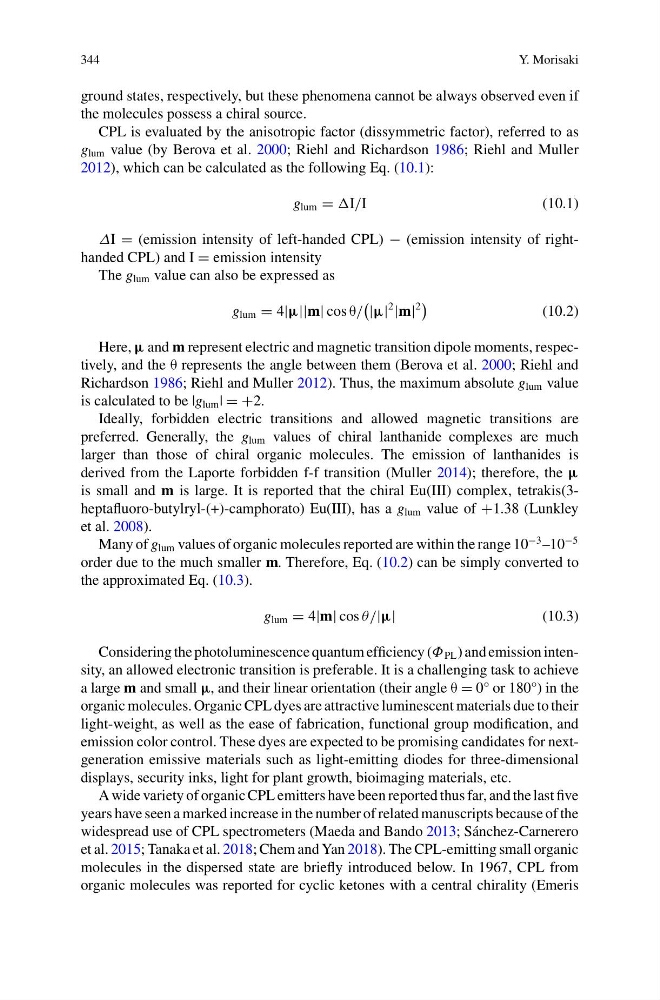
g lum = I/I
(10.1)
ΔI = (emission intensity of left-handed CPL) − (emission intensity of righthanded CPL) and I = emission intensity
The g lum value can also be expressed as
g lum = 4|μ||m| cos θ/
|μ|
2
|m|
2
(10.2)
Here, μ and m represent electric and magnetic transition dipole moments, respectively, and the θ represents the angle between them (Berova et al. 2000; Riehl and
Richardson 1986; Riehl and Muller 2012). Thus, the maximum absolute g lum value
is calculated to be |g lum | = +2.
Ideally, forbidden electric transitions and allowed magnetic transitions are
preferred. Generally, the g lum values of chiral lanthanide complexes are much
larger than those of chiral organic molecules. The emission of lanthanides is
derived from the Laporte forbidden f-f transition (Muller 2014); therefore, the μ
is small and m is large. It is reported that the chiral Eu(III) complex, tetrakis(3heptafluoro-butylryl-(+)-camphorato) Eu(III), has a g lum value of +1.38 (Lunkley
et al. 2008).
Many of g lum values of organic molecules reported are within the range 10
−3 –10
−5
order due to the much smaller m. Therefore, Eq. (10.2) can be simply converted to
the approximated Eq. (10.3).
g lum = 4|m| cos θ/|μ|
(10.3)
Considering the photoluminescence quantum efficiency (Φ PL ) and emission intensity, an allowed electronic transition is preferable. It is a challenging task to achieve
a large m and small μ, and their linear orientation (their angle θ = 0° or 180°) in the
organic molecules. Organic CPL dyes are attractive luminescent materials due to their
light-weight, as well as the ease of fabrication, functional group modification, and
emission color control. These dyes are expected to be promising candidates for nextgeneration emissive materials such as light-emitting diodes for three-dimensional
displays, security inks, light for plant growth, bioimaging materials, etc.
A wide variety of organic CPL emitters have been reported thus far, and the last five
years have seen a marked increase in the number of related manuscripts because of the
widespread use of CPL spectrometers (Maeda and Bando 2013; Sánchez-Carnerero
et al. 2015; Tanaka et al. 2018; Chem and Yan 2018). The CPL-emitting small organic
molecules in the dispersed state are briefly introduced below. In 1967, CPL from
organic molecules was reported for cyclic ketones with a central chirality (Emeris
Y. Morisaki
ground states, respectively, but these phenomena cannot be always observed even if
the molecules possess a chiral source.
CPL is evaluated by the anisotropic factor (dissymmetric factor), referred to as
g lum value (by Berova et al. 2000; Riehl and Richardson 1986; Riehl and Muller
2012), which can be calculated as the following Eq. (10.1):
g lum = I/I
(10.1)
ΔI = (emission intensity of left-handed CPL) − (emission intensity of righthanded CPL) and I = emission intensity
The g lum value can also be expressed as
g lum = 4|μ||m| cos θ/
|μ|
2
|m|
2
(10.2)
Here, μ and m represent electric and magnetic transition dipole moments, respectively, and the θ represents the angle between them (Berova et al. 2000; Riehl and
Richardson 1986; Riehl and Muller 2012). Thus, the maximum absolute g lum value
is calculated to be |g lum | = +2.
Ideally, forbidden electric transitions and allowed magnetic transitions are
preferred. Generally, the g lum values of chiral lanthanide complexes are much
larger than those of chiral organic molecules. The emission of lanthanides is
derived from the Laporte forbidden f-f transition (Muller 2014); therefore, the μ
is small and m is large. It is reported that the chiral Eu(III) complex, tetrakis(3heptafluoro-butylryl-(+)-camphorato) Eu(III), has a g lum value of +1.38 (Lunkley
et al. 2008).
Many of g lum values of organic molecules reported are within the range 10
−3 –10
−5
order due to the much smaller m. Therefore, Eq. (10.2) can be simply converted to
the approximated Eq. (10.3).
g lum = 4|m| cos θ/|μ|
(10.3)
Considering the photoluminescence quantum efficiency (Φ PL ) and emission intensity, an allowed electronic transition is preferable. It is a challenging task to achieve
a large m and small μ, and their linear orientation (their angle θ = 0° or 180°) in the
organic molecules. Organic CPL dyes are attractive luminescent materials due to their
light-weight, as well as the ease of fabrication, functional group modification, and
emission color control. These dyes are expected to be promising candidates for nextgeneration emissive materials such as light-emitting diodes for three-dimensional
displays, security inks, light for plant growth, bioimaging materials, etc.
A wide variety of organic CPL emitters have been reported thus far, and the last five
years have seen a marked increase in the number of related manuscripts because of the
widespread use of CPL spectrometers (Maeda and Bando 2013; Sánchez-Carnerero
et al. 2015; Tanaka et al. 2018; Chem and Yan 2018). The CPL-emitting small organic
molecules in the dispersed state are briefly introduced below. In 1967, CPL from
organic molecules was reported for cyclic ketones with a central chirality (Emeris