

9 Molecular Designs for Solid-State Luminescent Properties …
335
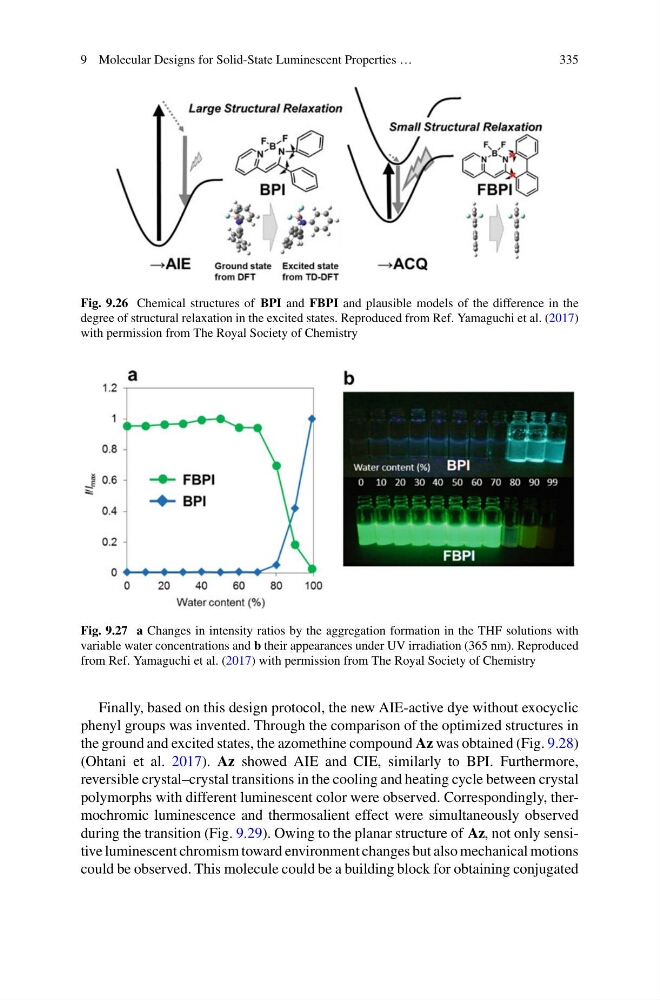
Fig. 9.26 Chemical structures of BPI and FBPI and plausible models of the difference in the
degree of structural relaxation in the excited states. Reproduced from Ref. Yamaguchi et al. (2017)
with permission from The Royal Society of Chemistry
Fig. 9.27 a Changes in intensity ratios by the aggregation formation in the THF solutions with
variable water concentrations and b their appearances under UV irradiation (365 nm). Reproduced
from Ref. Yamaguchi et al. (2017) with permission from The Royal Society of Chemistry
Finally, based on this design protocol, the new AIE-active dye without exocyclic
phenyl groups was invented. Through the comparison of the optimized structures in
the ground and excited states, the azomethine compound Az was obtained (Fig. 9.28)
(Ohtani et al. 2017). Az showed AIE and CIE, similarly to BPI. Furthermore,
reversible crystal–crystal transitions in the cooling and heating cycle between crystal
polymorphs with different luminescent color were observed. Correspondingly, thermochromic luminescence and thermosalient effect were simultaneously observed
during the transition (Fig. 9.29). Owing to the planar structure of Az, not only sensitive luminescent chromism toward environment changes but also mechanical motions
could be observed. This molecule could be a building block for obtaining conjugated
335
Fig. 9.26 Chemical structures of BPI and FBPI and plausible models of the difference in the
degree of structural relaxation in the excited states. Reproduced from Ref. Yamaguchi et al. (2017)
with permission from The Royal Society of Chemistry
Fig. 9.27 a Changes in intensity ratios by the aggregation formation in the THF solutions with
variable water concentrations and b their appearances under UV irradiation (365 nm). Reproduced
from Ref. Yamaguchi et al. (2017) with permission from The Royal Society of Chemistry
Finally, based on this design protocol, the new AIE-active dye without exocyclic
phenyl groups was invented. Through the comparison of the optimized structures in
the ground and excited states, the azomethine compound Az was obtained (Fig. 9.28)
(Ohtani et al. 2017). Az showed AIE and CIE, similarly to BPI. Furthermore,
reversible crystal–crystal transitions in the cooling and heating cycle between crystal
polymorphs with different luminescent color were observed. Correspondingly, thermochromic luminescence and thermosalient effect were simultaneously observed
during the transition (Fig. 9.29). Owing to the planar structure of Az, not only sensitive luminescent chromism toward environment changes but also mechanical motions
could be observed. This molecule could be a building block for obtaining conjugated