

286
T. Ishi-i
8.2.2 Red- and Near-IR-Light-Emitting Two-Photon
Absorption Dyes
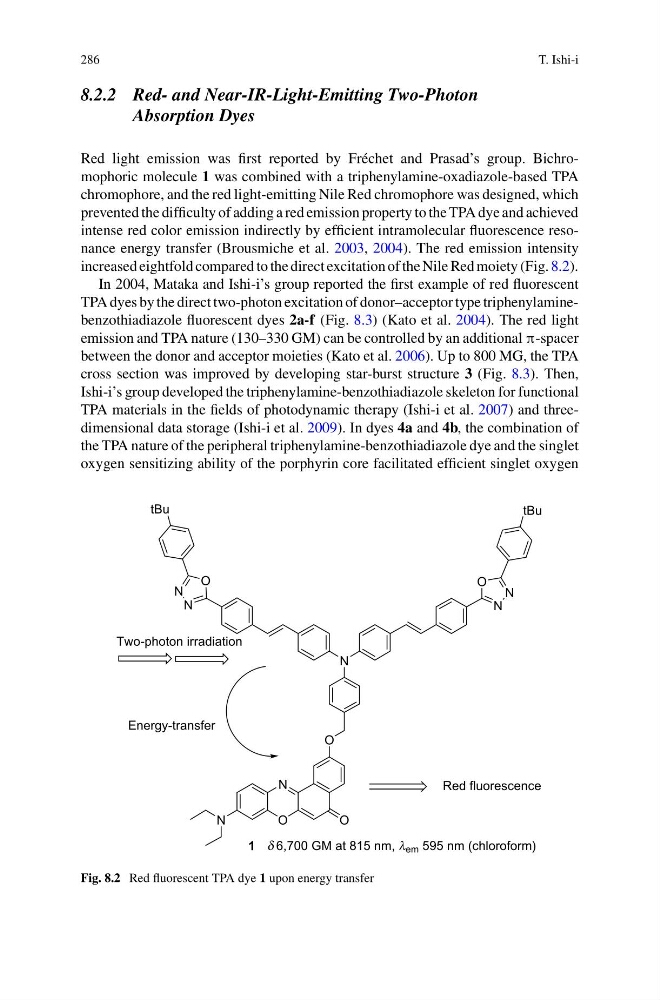
Red light emission was first reported by Fréchet and Prasad’s group. Bichromophoric molecule 1 was combined with a triphenylamine-oxadiazole-based TPA
chromophore, and the red light-emitting Nile Red chromophore was designed, which
prevented the difficulty of adding a red emission property to the TPA dye and achieved
intense red color emission indirectly by efficient intramolecular fluorescence resonance energy transfer (Brousmiche et al. 2003, 2004). The red emission intensity
increased eightfold compared to the direct excitation of the Nile Red moiety (Fig. 8.2).
In 2004, Mataka and Ishi-i’s group reported the first example of red fluorescent
TPA dyes by the direct two-photon excitation of donor–acceptor type triphenylaminebenzothiadiazole fluorescent dyes 2a-f (Fig. 8.3) (Kato et al. 2004). The red light
emission and TPA nature (130–330 GM) can be controlled by an additional π-spacer
between the donor and acceptor moieties (Kato et al. 2006). Up to 800 MG, the TPA
cross section was improved by developing star-burst structure 3 (Fig. 8.3). Then,
Ishi-i’s group developed the triphenylamine-benzothiadiazole skeleton for functional
TPA materials in the fields of photodynamic therapy (Ishi-i et al. 2007) and threedimensional data storage (Ishi-i et al. 2009). In dyes 4a and 4b, the combination of
the TPA nature of the peripheral triphenylamine-benzothiadiazole dye and the singlet
oxygen sensitizing ability of the porphyrin core facilitated efficient singlet oxygen
N
O
N
N
O
O
N
N
N
O
N
O
tBu
tBu
1
6,700 GM at 815 nm, em 595 nm (chloroform)
Energy-transfer
Two-photon irradiation
Red fluorescence
δ
λ
Fig. 8.2 Red fluorescent TPA dye 1 upon energy transfer
T. Ishi-i
8.2.2 Red- and Near-IR-Light-Emitting Two-Photon
Absorption Dyes
Red light emission was first reported by Fréchet and Prasad’s group. Bichromophoric molecule 1 was combined with a triphenylamine-oxadiazole-based TPA
chromophore, and the red light-emitting Nile Red chromophore was designed, which
prevented the difficulty of adding a red emission property to the TPA dye and achieved
intense red color emission indirectly by efficient intramolecular fluorescence resonance energy transfer (Brousmiche et al. 2003, 2004). The red emission intensity
increased eightfold compared to the direct excitation of the Nile Red moiety (Fig. 8.2).
In 2004, Mataka and Ishi-i’s group reported the first example of red fluorescent
TPA dyes by the direct two-photon excitation of donor–acceptor type triphenylaminebenzothiadiazole fluorescent dyes 2a-f (Fig. 8.3) (Kato et al. 2004). The red light
emission and TPA nature (130–330 GM) can be controlled by an additional π-spacer
between the donor and acceptor moieties (Kato et al. 2006). Up to 800 MG, the TPA
cross section was improved by developing star-burst structure 3 (Fig. 8.3). Then,
Ishi-i’s group developed the triphenylamine-benzothiadiazole skeleton for functional
TPA materials in the fields of photodynamic therapy (Ishi-i et al. 2007) and threedimensional data storage (Ishi-i et al. 2009). In dyes 4a and 4b, the combination of
the TPA nature of the peripheral triphenylamine-benzothiadiazole dye and the singlet
oxygen sensitizing ability of the porphyrin core facilitated efficient singlet oxygen
N
O
N
N
O
O
N
N
N
O
N
O
tBu
tBu
1
6,700 GM at 815 nm, em 595 nm (chloroform)
Energy-transfer
Two-photon irradiation
Red fluorescence
δ
λ
Fig. 8.2 Red fluorescent TPA dye 1 upon energy transfer