

284
T. Ishi-i
one-photon
absorption
two-photon
absorption
fluorescence
emission
excited state
ground state
virtual state
advantages:
i) reduced autofluorescence and deeper penetration,
ii) less photodamage and photobleaching,
iii) higher three-dimensional resolution
applications:
i) power limitation,
ii) microfabrication,
iii) three-dimensional optical data storage,
iv) photodynamic therapy,
v) laser scanning fluorescence imaging
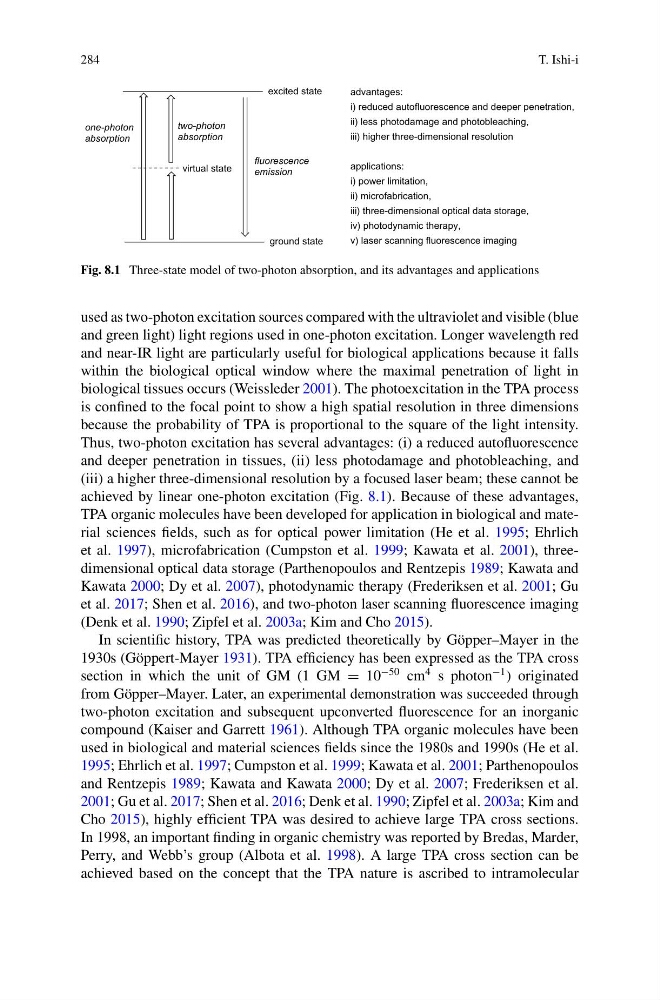
Fig. 8.1 Three-state model of two-photon absorption, and its advantages and applications
used as two-photon excitation sources compared with the ultraviolet and visible (blue
and green light) light regions used in one-photon excitation. Longer wavelength red
and near-IR light are particularly useful for biological applications because it falls
within the biological optical window where the maximal penetration of light in
biological tissues occurs (Weissleder 2001). The photoexcitation in the TPA process
is confined to the focal point to show a high spatial resolution in three dimensions
because the probability of TPA is proportional to the square of the light intensity.
Thus, two-photon excitation has several advantages: (i) a reduced autofluorescence
and deeper penetration in tissues, (ii) less photodamage and photobleaching, and
(iii) a higher three-dimensional resolution by a focused laser beam; these cannot be
achieved by linear one-photon excitation (Fig. 8.1). Because of these advantages,
TPA organic molecules have been developed for application in biological and material sciences fields, such as for optical power limitation (He et al. 1995; Ehrlich
et al. 1997), microfabrication (Cumpston et al. 1999; Kawata et al. 2001), threedimensional optical data storage (Parthenopoulos and Rentzepis 1989; Kawata and
Kawata 2000; Dy et al. 2007), photodynamic therapy (Frederiksen et al. 2001; Gu
et al. 2017; Shen et al. 2016), and two-photon laser scanning fluorescence imaging
(Denk et al. 1990; Zipfel et al. 2003a; Kim and Cho 2015).
In scientific history, TPA was predicted theoretically by Göpper–Mayer in the
1930s (Göppert-Mayer 1931). TPA efficiency has been expressed as the TPA cross
section in which the unit of GM (1 GM = 10
−50 cm
4 s photon
−1 ) originated
from Göpper–Mayer. Later, an experimental demonstration was succeeded through
two-photon excitation and subsequent upconverted fluorescence for an inorganic
compound (Kaiser and Garrett 1961). Although TPA organic molecules have been
used in biological and material sciences fields since the 1980s and 1990s (He et al.
1995; Ehrlich et al. 1997; Cumpston et al. 1999; Kawata et al. 2001; Parthenopoulos
and Rentzepis 1989; Kawata and Kawata 2000; Dy et al. 2007; Frederiksen et al.
2001; Gu et al. 2017; Shen et al. 2016; Denk et al. 1990; Zipfel et al. 2003a; Kim and
Cho 2015), highly efficient TPA was desired to achieve large TPA cross sections.
In 1998, an important finding in organic chemistry was reported by Bredas, Marder,
Perry, and Webb’s group (Albota et al. 1998). A large TPA cross section can be
achieved based on the concept that the TPA nature is ascribed to intramolecular
T. Ishi-i
one-photon
absorption
two-photon
absorption
fluorescence
emission
excited state
ground state
virtual state
advantages:
i) reduced autofluorescence and deeper penetration,
ii) less photodamage and photobleaching,
iii) higher three-dimensional resolution
applications:
i) power limitation,
ii) microfabrication,
iii) three-dimensional optical data storage,
iv) photodynamic therapy,
v) laser scanning fluorescence imaging
Fig. 8.1 Three-state model of two-photon absorption, and its advantages and applications
used as two-photon excitation sources compared with the ultraviolet and visible (blue
and green light) light regions used in one-photon excitation. Longer wavelength red
and near-IR light are particularly useful for biological applications because it falls
within the biological optical window where the maximal penetration of light in
biological tissues occurs (Weissleder 2001). The photoexcitation in the TPA process
is confined to the focal point to show a high spatial resolution in three dimensions
because the probability of TPA is proportional to the square of the light intensity.
Thus, two-photon excitation has several advantages: (i) a reduced autofluorescence
and deeper penetration in tissues, (ii) less photodamage and photobleaching, and
(iii) a higher three-dimensional resolution by a focused laser beam; these cannot be
achieved by linear one-photon excitation (Fig. 8.1). Because of these advantages,
TPA organic molecules have been developed for application in biological and material sciences fields, such as for optical power limitation (He et al. 1995; Ehrlich
et al. 1997), microfabrication (Cumpston et al. 1999; Kawata et al. 2001), threedimensional optical data storage (Parthenopoulos and Rentzepis 1989; Kawata and
Kawata 2000; Dy et al. 2007), photodynamic therapy (Frederiksen et al. 2001; Gu
et al. 2017; Shen et al. 2016), and two-photon laser scanning fluorescence imaging
(Denk et al. 1990; Zipfel et al. 2003a; Kim and Cho 2015).
In scientific history, TPA was predicted theoretically by Göpper–Mayer in the
1930s (Göppert-Mayer 1931). TPA efficiency has been expressed as the TPA cross
section in which the unit of GM (1 GM = 10
−50 cm
4 s photon
−1 ) originated
from Göpper–Mayer. Later, an experimental demonstration was succeeded through
two-photon excitation and subsequent upconverted fluorescence for an inorganic
compound (Kaiser and Garrett 1961). Although TPA organic molecules have been
used in biological and material sciences fields since the 1980s and 1990s (He et al.
1995; Ehrlich et al. 1997; Cumpston et al. 1999; Kawata et al. 2001; Parthenopoulos
and Rentzepis 1989; Kawata and Kawata 2000; Dy et al. 2007; Frederiksen et al.
2001; Gu et al. 2017; Shen et al. 2016; Denk et al. 1990; Zipfel et al. 2003a; Kim and
Cho 2015), highly efficient TPA was desired to achieve large TPA cross sections.
In 1998, an important finding in organic chemistry was reported by Bredas, Marder,
Perry, and Webb’s group (Albota et al. 1998). A large TPA cross section can be
achieved based on the concept that the TPA nature is ascribed to intramolecular