

7 Photochromism
271
7.6 Diarylethene
Diarylethene is a P-type photochromic compound that was found by Irie in the late
1980s and has developed rapidly to date. The history of discovery for diarylethene
is described in detail in the literature (Irie 2015). It is ring-closing and ring-opening
reactions which isomerizes between a hexatriene and a cyclohexadiene by alternating
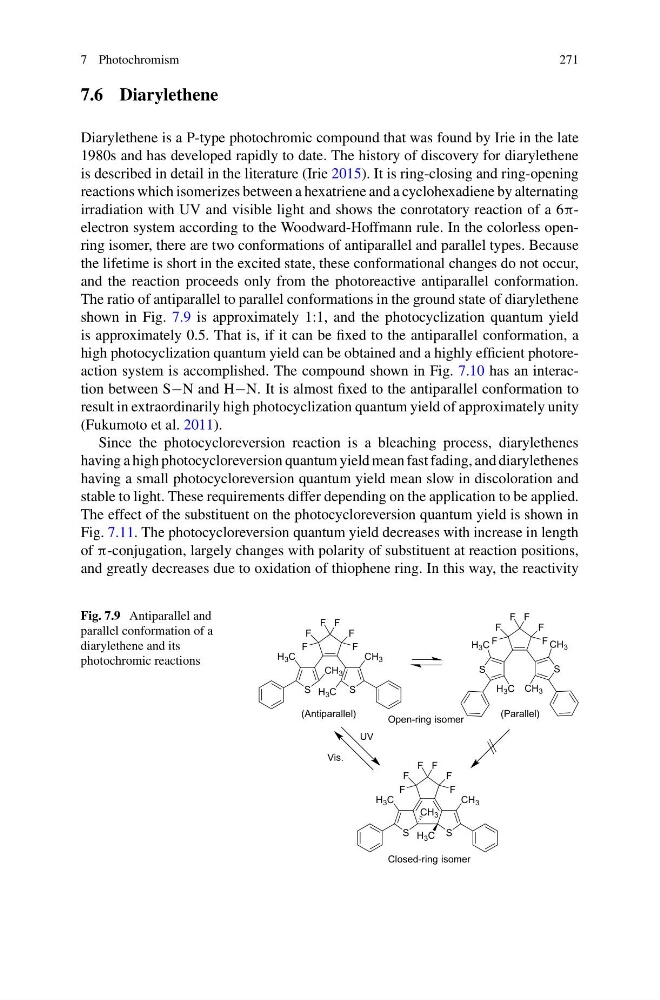
irradiation with UV and visible light and shows the conrotatory reaction of a 6πelectron system according to the Woodward-Hoffmann rule. In the colorless openring isomer, there are two conformations of antiparallel and parallel types. Because
the lifetime is short in the excited state, these conformational changes do not occur,
and the reaction proceeds only from the photoreactive antiparallel conformation.
The ratio of antiparallel to parallel conformations in the ground state of diarylethene
shown in Fig. 7.9 is approximately 1:1, and the photocyclization quantum yield
is approximately 0.5. That is, if it can be fixed to the antiparallel conformation, a
high photocyclization quantum yield can be obtained and a highly efficient photoreaction system is accomplished. The compound shown in Fig. 7.10 has an interaction between S−N and H−N. It is almost fixed to the antiparallel conformation to
result in extraordinarily high photocyclization quantum yield of approximately unity
(Fukumoto et al. 2011).
Since the photocycloreversion reaction is a bleaching process, diarylethenes
having a high photocycloreversion quantum yield mean fast fading, and diarylethenes
having a small photocycloreversion quantum yield mean slow in discoloration and
stable to light. These requirements differ depending on the application to be applied.
The effect of the substituent on the photocycloreversion quantum yield is shown in
Fig. 7.11. The photocycloreversion quantum yield decreases with increase in length
of π-conjugation, largely changes with polarity of substituent at reaction positions,
and greatly decreases due to oxidation of thiophene ring. In this way, the reactivity
Fig. 7.9 Antiparallel and
parallel conformation of a
diarylethene and its
photochromic reactions
F
F
F
F
F
F
S
S
CH 3
H 3 C
H 3 C
CH 3
(Antiparallel)
Open-ring isomer
F
F
F
F
F
F
S
S
CH 3
H 3 C
H 3 C
CH 3
Vis.
F
F
F
F
F
F
S
CH 3
S
H 3 C
H 3 C CH 3
(Parallel)
Closed-ring isomer
UV
271
7.6 Diarylethene
Diarylethene is a P-type photochromic compound that was found by Irie in the late
1980s and has developed rapidly to date. The history of discovery for diarylethene
is described in detail in the literature (Irie 2015). It is ring-closing and ring-opening
reactions which isomerizes between a hexatriene and a cyclohexadiene by alternating
irradiation with UV and visible light and shows the conrotatory reaction of a 6πelectron system according to the Woodward-Hoffmann rule. In the colorless openring isomer, there are two conformations of antiparallel and parallel types. Because
the lifetime is short in the excited state, these conformational changes do not occur,
and the reaction proceeds only from the photoreactive antiparallel conformation.
The ratio of antiparallel to parallel conformations in the ground state of diarylethene
shown in Fig. 7.9 is approximately 1:1, and the photocyclization quantum yield
is approximately 0.5. That is, if it can be fixed to the antiparallel conformation, a
high photocyclization quantum yield can be obtained and a highly efficient photoreaction system is accomplished. The compound shown in Fig. 7.10 has an interaction between S−N and H−N. It is almost fixed to the antiparallel conformation to
result in extraordinarily high photocyclization quantum yield of approximately unity
(Fukumoto et al. 2011).
Since the photocycloreversion reaction is a bleaching process, diarylethenes
having a high photocycloreversion quantum yield mean fast fading, and diarylethenes
having a small photocycloreversion quantum yield mean slow in discoloration and
stable to light. These requirements differ depending on the application to be applied.
The effect of the substituent on the photocycloreversion quantum yield is shown in
Fig. 7.11. The photocycloreversion quantum yield decreases with increase in length
of π-conjugation, largely changes with polarity of substituent at reaction positions,
and greatly decreases due to oxidation of thiophene ring. In this way, the reactivity
Fig. 7.9 Antiparallel and
parallel conformation of a
diarylethene and its
photochromic reactions
F
F
F
F
F
F
S
S
CH 3
H 3 C
H 3 C
CH 3
(Antiparallel)
Open-ring isomer
F
F
F
F
F
F
S
S
CH 3
H 3 C
H 3 C
CH 3
Vis.
F
F
F
F
F
F
S
CH 3
S
H 3 C
H 3 C CH 3
(Parallel)
Closed-ring isomer
UV