

254
S. Matsumoto and J. Hwang
(a) I
(b) II
(c) III
(d) IV
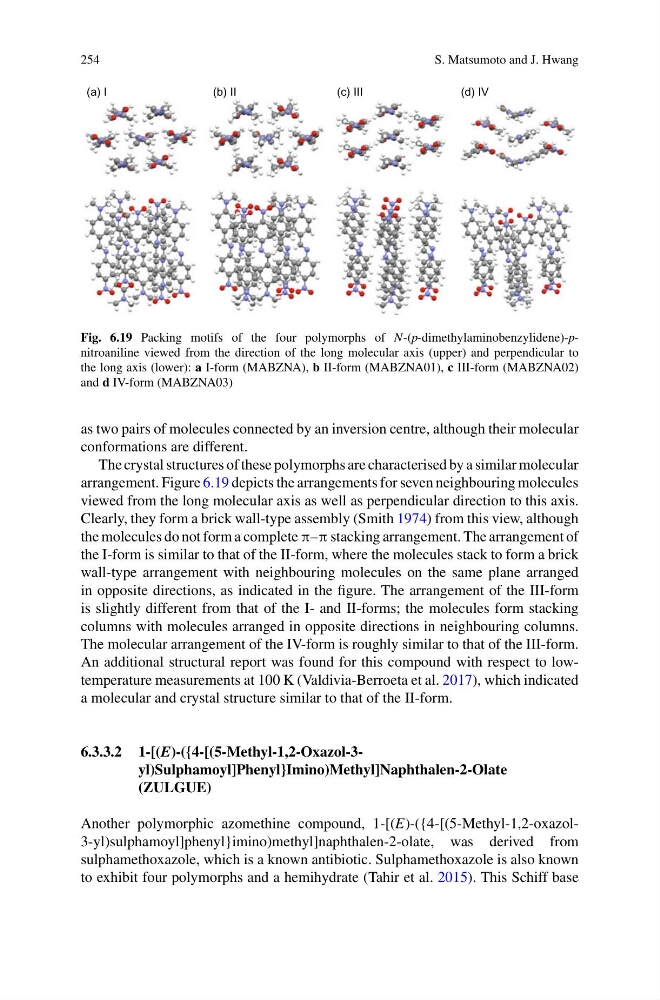
Fig. 6.19 Packing motifs of the four polymorphs of N-(p-dimethylaminobenzylidene)-pnitroaniline viewed from the direction of the long molecular axis (upper) and perpendicular to
the long axis (lower): a I-form (MABZNA), b II-form (MABZNA01), c III-form (MABZNA02)
and d IV-form (MABZNA03)
as two pairs of molecules connected by an inversion centre, although their molecular
conformations are different.
The crystal structures of these polymorphs are characterised by a similar molecular
arrangement. Figure 6.19 depicts the arrangements for seven neighbouring molecules
viewed from the long molecular axis as well as perpendicular direction to this axis.
Clearly, they form a brick wall-type assembly (Smith 1974) from this view, although
the molecules do not form a complete π–π stacking arrangement. The arrangement of
the I-form is similar to that of the II-form, where the molecules stack to form a brick
wall-type arrangement with neighbouring molecules on the same plane arranged
in opposite directions, as indicated in the figure. The arrangement of the III-form
is slightly different from that of the I- and II-forms; the molecules form stacking
columns with molecules arranged in opposite directions in neighbouring columns.
The molecular arrangement of the IV-form is roughly similar to that of the III-form.
An additional structural report was found for this compound with respect to lowtemperature measurements at 100 K (Valdivia-Berroeta et al. 2017), which indicated
a molecular and crystal structure similar to that of the II-form.
6.3.3.2 1-[(E)-({4-[(5-Methyl-1,2-Oxazol-3yl)Sulphamoyl]Phenyl}Imino)Methyl]Naphthalen-2-Olate
(ZULGUE)
Another polymorphic azomethine compound, 1-[(E)-({4-[(5-Methyl-1,2-oxazol3-yl)sulphamoyl]phenyl}imino)methyl]naphthalen-2-olate, was derived from
sulphamethoxazole, which is a known antibiotic. Sulphamethoxazole is also known
to exhibit four polymorphs and a hemihydrate (Tahir et al. 2015). This Schiff base
S. Matsumoto and J. Hwang
(a) I
(b) II
(c) III
(d) IV
Fig. 6.19 Packing motifs of the four polymorphs of N-(p-dimethylaminobenzylidene)-pnitroaniline viewed from the direction of the long molecular axis (upper) and perpendicular to
the long axis (lower): a I-form (MABZNA), b II-form (MABZNA01), c III-form (MABZNA02)
and d IV-form (MABZNA03)
as two pairs of molecules connected by an inversion centre, although their molecular
conformations are different.
The crystal structures of these polymorphs are characterised by a similar molecular
arrangement. Figure 6.19 depicts the arrangements for seven neighbouring molecules
viewed from the long molecular axis as well as perpendicular direction to this axis.
Clearly, they form a brick wall-type assembly (Smith 1974) from this view, although
the molecules do not form a complete π–π stacking arrangement. The arrangement of
the I-form is similar to that of the II-form, where the molecules stack to form a brick
wall-type arrangement with neighbouring molecules on the same plane arranged
in opposite directions, as indicated in the figure. The arrangement of the III-form
is slightly different from that of the I- and II-forms; the molecules form stacking
columns with molecules arranged in opposite directions in neighbouring columns.
The molecular arrangement of the IV-form is roughly similar to that of the III-form.
An additional structural report was found for this compound with respect to lowtemperature measurements at 100 K (Valdivia-Berroeta et al. 2017), which indicated
a molecular and crystal structure similar to that of the II-form.
6.3.3.2 1-[(E)-({4-[(5-Methyl-1,2-Oxazol-3yl)Sulphamoyl]Phenyl}Imino)Methyl]Naphthalen-2-Olate
(ZULGUE)
Another polymorphic azomethine compound, 1-[(E)-({4-[(5-Methyl-1,2-oxazol3-yl)sulphamoyl]phenyl}imino)methyl]naphthalen-2-olate, was derived from
sulphamethoxazole, which is a known antibiotic. Sulphamethoxazole is also known
to exhibit four polymorphs and a hemihydrate (Tahir et al. 2015). This Schiff base