

6 Molecular and Crystal Structures of Polymorphic …
247
(a) Y
(b) ON
(c) OP
(e) YN
(f) ORP
(d) R
(g) YT04
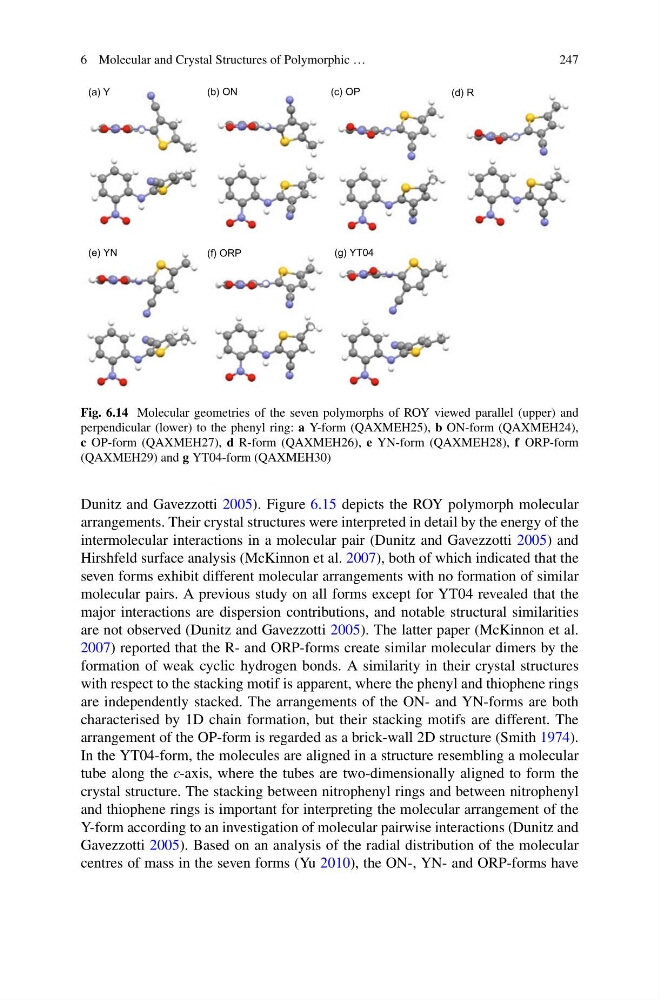
Fig. 6.14 Molecular geometries of the seven polymorphs of ROY viewed parallel (upper) and
perpendicular (lower) to the phenyl ring: a Y-form (QAXMEH25), b ON-form (QAXMEH24),
c OP-form (QAXMEH27), d R-form (QAXMEH26), e YN-form (QAXMEH28), f ORP-form
(QAXMEH29) and g YT04-form (QAXMEH30)
Dunitz and Gavezzotti 2005). Figure 6.15 depicts the ROY polymorph molecular
arrangements. Their crystal structures were interpreted in detail by the energy of the
intermolecular interactions in a molecular pair (Dunitz and Gavezzotti 2005) and
Hirshfeld surface analysis (McKinnon et al. 2007), both of which indicated that the
seven forms exhibit different molecular arrangements with no formation of similar
molecular pairs. A previous study on all forms except for YT04 revealed that the
major interactions are dispersion contributions, and notable structural similarities
are not observed (Dunitz and Gavezzotti 2005). The latter paper (McKinnon et al.
2007) reported that the R- and ORP-forms create similar molecular dimers by the
formation of weak cyclic hydrogen bonds. A similarity in their crystal structures
with respect to the stacking motif is apparent, where the phenyl and thiophene rings
are independently stacked. The arrangements of the ON- and YN-forms are both
characterised by 1D chain formation, but their stacking motifs are different. The
arrangement of the OP-form is regarded as a brick-wall 2D structure (Smith 1974).
In the YT04-form, the molecules are aligned in a structure resembling a molecular
tube along the c-axis, where the tubes are two-dimensionally aligned to form the
crystal structure. The stacking between nitrophenyl rings and between nitrophenyl
and thiophene rings is important for interpreting the molecular arrangement of the
Y-form according to an investigation of molecular pairwise interactions (Dunitz and
Gavezzotti 2005). Based on an analysis of the radial distribution of the molecular
centres of mass in the seven forms (Yu 2010), the ON-, YN- and ORP-forms have
247
(a) Y
(b) ON
(c) OP
(e) YN
(f) ORP
(d) R
(g) YT04
Fig. 6.14 Molecular geometries of the seven polymorphs of ROY viewed parallel (upper) and
perpendicular (lower) to the phenyl ring: a Y-form (QAXMEH25), b ON-form (QAXMEH24),
c OP-form (QAXMEH27), d R-form (QAXMEH26), e YN-form (QAXMEH28), f ORP-form
(QAXMEH29) and g YT04-form (QAXMEH30)
Dunitz and Gavezzotti 2005). Figure 6.15 depicts the ROY polymorph molecular
arrangements. Their crystal structures were interpreted in detail by the energy of the
intermolecular interactions in a molecular pair (Dunitz and Gavezzotti 2005) and
Hirshfeld surface analysis (McKinnon et al. 2007), both of which indicated that the
seven forms exhibit different molecular arrangements with no formation of similar
molecular pairs. A previous study on all forms except for YT04 revealed that the
major interactions are dispersion contributions, and notable structural similarities
are not observed (Dunitz and Gavezzotti 2005). The latter paper (McKinnon et al.
2007) reported that the R- and ORP-forms create similar molecular dimers by the
formation of weak cyclic hydrogen bonds. A similarity in their crystal structures
with respect to the stacking motif is apparent, where the phenyl and thiophene rings
are independently stacked. The arrangements of the ON- and YN-forms are both
characterised by 1D chain formation, but their stacking motifs are different. The
arrangement of the OP-form is regarded as a brick-wall 2D structure (Smith 1974).
In the YT04-form, the molecules are aligned in a structure resembling a molecular
tube along the c-axis, where the tubes are two-dimensionally aligned to form the
crystal structure. The stacking between nitrophenyl rings and between nitrophenyl
and thiophene rings is important for interpreting the molecular arrangement of the
Y-form according to an investigation of molecular pairwise interactions (Dunitz and
Gavezzotti 2005). Based on an analysis of the radial distribution of the molecular
centres of mass in the seven forms (Yu 2010), the ON-, YN- and ORP-forms have