

5 BODIPY Dyes and Their Analogues
193
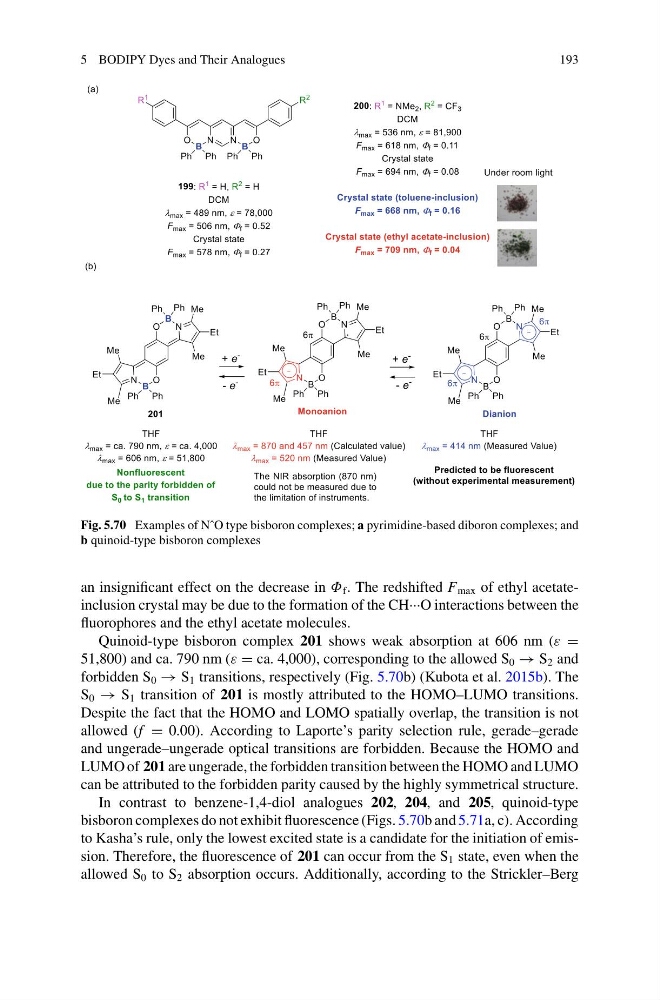
Fig. 5.70 Examples of NˆO type bisboron complexes; a pyrimidine-based diboron complexes; and
b quinoid-type bisboron complexes
an insignificant effect on the decrease in Φ f . The redshifted F max of ethyl acetateinclusion crystal may be due to the formation of the CH···O interactions between the
fluorophores and the ethyl acetate molecules.
Quinoid-type bisboron complex 201 shows weak absorption at 606 nm (ε =
51,800) and ca. 790 nm (ε = ca. 4,000), corresponding to the allowed S 0 → S 2 and
forbidden S 0 → S 1 transitions, respectively (Fig. 5.70b) (Kubota et al. 2015b). The
S 0 → S 1 transition of 201 is mostly attributed to the HOMO–LUMO transitions.
Despite the fact that the HOMO and LOMO spatially overlap, the transition is not
allowed (f = 0.00). According to Laporte’s parity selection rule, gerade–gerade
and ungerade–ungerade optical transitions are forbidden. Because the HOMO and
LUMO of 201 are ungerade, the forbidden transition between the HOMO and LUMO
can be attributed to the forbidden parity caused by the highly symmetrical structure.
In contrast to benzene-1,4-diol analogues 202, 204, and 205, quinoid-type
bisboron complexes do not exhibit fluorescence (Figs. 5.70b and 5.71a, c). According
to Kasha’s rule, only the lowest excited state is a candidate for the initiation of emission. Therefore, the fluorescence of 201 can occur from the S 1 state, even when the
allowed S 0 to S 2 absorption occurs. Additionally, according to the Strickler–Berg
193
Fig. 5.70 Examples of NˆO type bisboron complexes; a pyrimidine-based diboron complexes; and
b quinoid-type bisboron complexes
an insignificant effect on the decrease in Φ f . The redshifted F max of ethyl acetateinclusion crystal may be due to the formation of the CH···O interactions between the
fluorophores and the ethyl acetate molecules.
Quinoid-type bisboron complex 201 shows weak absorption at 606 nm (ε =
51,800) and ca. 790 nm (ε = ca. 4,000), corresponding to the allowed S 0 → S 2 and
forbidden S 0 → S 1 transitions, respectively (Fig. 5.70b) (Kubota et al. 2015b). The
S 0 → S 1 transition of 201 is mostly attributed to the HOMO–LUMO transitions.
Despite the fact that the HOMO and LOMO spatially overlap, the transition is not
allowed (f = 0.00). According to Laporte’s parity selection rule, gerade–gerade
and ungerade–ungerade optical transitions are forbidden. Because the HOMO and
LUMO of 201 are ungerade, the forbidden transition between the HOMO and LUMO
can be attributed to the forbidden parity caused by the highly symmetrical structure.
In contrast to benzene-1,4-diol analogues 202, 204, and 205, quinoid-type
bisboron complexes do not exhibit fluorescence (Figs. 5.70b and 5.71a, c). According
to Kasha’s rule, only the lowest excited state is a candidate for the initiation of emission. Therefore, the fluorescence of 201 can occur from the S 1 state, even when the
allowed S 0 to S 2 absorption occurs. Additionally, according to the Strickler–Berg