

12
M. Matsui
Conduction ban d
Semiconductors
Sensitizers
LUMO
HOMO
Valence band
hν
Electrolyte
Redox level
Energy level
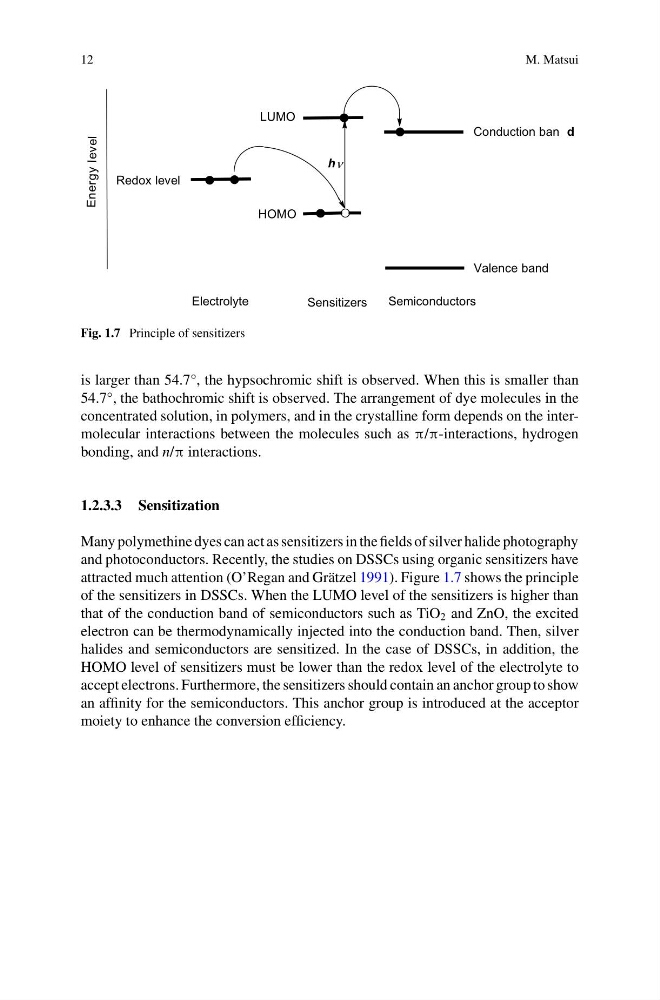
Fig. 1.7 Principle of sensitizers
is larger than 54.7°, the hypsochromic shift is observed. When this is smaller than
54.7°, the bathochromic shift is observed. The arrangement of dye molecules in the
concentrated solution, in polymers, and in the crystalline form depends on the intermolecular interactions between the molecules such as π/π-interactions, hydrogen
bonding, and n/π interactions.
1.2.3.3 Sensitization
Many polymethine dyes can act as sensitizers in the fields of silver halide photography
and photoconductors. Recently, the studies on DSSCs using organic sensitizers have
attracted much attention (O’Regan and Grätzel 1991). Figure 1.7 shows the principle
of the sensitizers in DSSCs. When the LUMO level of the sensitizers is higher than
that of the conduction band of semiconductors such as TiO 2 and ZnO, the excited
electron can be thermodynamically injected into the conduction band. Then, silver
halides and semiconductors are sensitized. In the case of DSSCs, in addition, the
HOMO level of sensitizers must be lower than the redox level of the electrolyte to
accept electrons. Furthermore, the sensitizers should contain an anchor group to show
an affinity for the semiconductors. This anchor group is introduced at the acceptor
moiety to enhance the conversion efficiency.
M. Matsui
Conduction ban d
Semiconductors
Sensitizers
LUMO
HOMO
Valence band
hν
Electrolyte
Redox level
Energy level
Fig. 1.7 Principle of sensitizers
is larger than 54.7°, the hypsochromic shift is observed. When this is smaller than
54.7°, the bathochromic shift is observed. The arrangement of dye molecules in the
concentrated solution, in polymers, and in the crystalline form depends on the intermolecular interactions between the molecules such as π/π-interactions, hydrogen
bonding, and n/π interactions.
1.2.3.3 Sensitization
Many polymethine dyes can act as sensitizers in the fields of silver halide photography
and photoconductors. Recently, the studies on DSSCs using organic sensitizers have
attracted much attention (O’Regan and Grätzel 1991). Figure 1.7 shows the principle
of the sensitizers in DSSCs. When the LUMO level of the sensitizers is higher than
that of the conduction band of semiconductors such as TiO 2 and ZnO, the excited
electron can be thermodynamically injected into the conduction band. Then, silver
halides and semiconductors are sensitized. In the case of DSSCs, in addition, the
HOMO level of sensitizers must be lower than the redox level of the electrolyte to
accept electrons. Furthermore, the sensitizers should contain an anchor group to show
an affinity for the semiconductors. This anchor group is introduced at the acceptor
moiety to enhance the conversion efficiency.