

182
Y. Kubota
the BCl 2 derivative is stable to non-protic Lewis bases, it undergoes slow hydrolysis.
The reaction of the BCl 2 derivative with AlMe 3 , Zn(Ph) 2 , and Zn(C 6 F 5 ) 2 gives the
corresponding BMe 2 162, BPh 2 163, and B(C 6 F 5 ) 2 164 derivatives, respectively;
these boron complexes are stable for months in wet solvent. 162, 163, and 164
show significantly redshifted λ max compared with that of the corresponding nonborylated ligand (λ max = 471 nm, ε = 15,700). Benzothiadiazole-based monoboron
complexes are non-emissive in solvent. In contrast,
6 NˆC type boron complex 165
shows fluorescence (Fig. 5.61d) (Liu et al. 2017).
7 NˆC type boron complex 166 shows fluorescence both in solution and in the
solid-state (Fig. 5.61e) (Zeng et al. 2019). For 166, upon increasing temperature, the
fluorescence peak slightly blueshifts with the appearance of a new peak at around
515 nm because of the dissociation of the B ← N bond and the formation of the
open isomer. The temperature-dependent emission spectral change of 166 is fully
reversible. The addition of 60 equivalents of TBAF to the THF solution of 166
converts 166 to its F
− -bound open form, accompanied by the λ max and F max change
from 516 nm to ca. 480 nm and 621 nm to ca. 510 nm, respectively. Other NˆC boron
complexes have also been reported (Rao et al. 2012).
5.3 Tridentate Boron Complex
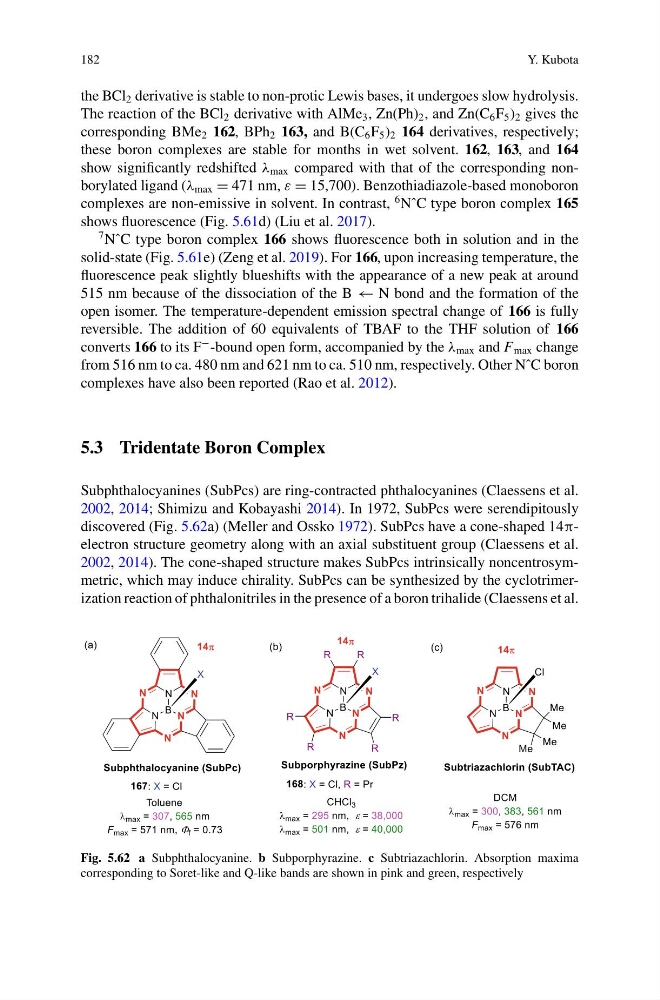
Subphthalocyanines (SubPcs) are ring-contracted phthalocyanines (Claessens et al.
2002, 2014; Shimizu and Kobayashi 2014). In 1972, SubPcs were serendipitously
discovered (Fig. 5.62a) (Meller and Ossko 1972). SubPcs have a cone-shaped 14πelectron structure geometry along with an axial substituent group (Claessens et al.
2002, 2014). The cone-shaped structure makes SubPcs intrinsically noncentrosymmetric, which may induce chirality. SubPcs can be synthesized by the cyclotrimerization reaction of phthalonitriles in the presence of a boron trihalide (Claessens et al.
Fig. 5.62 a Subphthalocyanine. b Subporphyrazine. c Subtriazachlorin. Absorption maxima
corresponding to Soret-like and Q-like bands are shown in pink and green, respectively
Y. Kubota
the BCl 2 derivative is stable to non-protic Lewis bases, it undergoes slow hydrolysis.
The reaction of the BCl 2 derivative with AlMe 3 , Zn(Ph) 2 , and Zn(C 6 F 5 ) 2 gives the
corresponding BMe 2 162, BPh 2 163, and B(C 6 F 5 ) 2 164 derivatives, respectively;
these boron complexes are stable for months in wet solvent. 162, 163, and 164
show significantly redshifted λ max compared with that of the corresponding nonborylated ligand (λ max = 471 nm, ε = 15,700). Benzothiadiazole-based monoboron
complexes are non-emissive in solvent. In contrast,
6 NˆC type boron complex 165
shows fluorescence (Fig. 5.61d) (Liu et al. 2017).
7 NˆC type boron complex 166 shows fluorescence both in solution and in the
solid-state (Fig. 5.61e) (Zeng et al. 2019). For 166, upon increasing temperature, the
fluorescence peak slightly blueshifts with the appearance of a new peak at around
515 nm because of the dissociation of the B ← N bond and the formation of the
open isomer. The temperature-dependent emission spectral change of 166 is fully
reversible. The addition of 60 equivalents of TBAF to the THF solution of 166
converts 166 to its F
− -bound open form, accompanied by the λ max and F max change
from 516 nm to ca. 480 nm and 621 nm to ca. 510 nm, respectively. Other NˆC boron
complexes have also been reported (Rao et al. 2012).
5.3 Tridentate Boron Complex
Subphthalocyanines (SubPcs) are ring-contracted phthalocyanines (Claessens et al.
2002, 2014; Shimizu and Kobayashi 2014). In 1972, SubPcs were serendipitously
discovered (Fig. 5.62a) (Meller and Ossko 1972). SubPcs have a cone-shaped 14πelectron structure geometry along with an axial substituent group (Claessens et al.
2002, 2014). The cone-shaped structure makes SubPcs intrinsically noncentrosymmetric, which may induce chirality. SubPcs can be synthesized by the cyclotrimerization reaction of phthalonitriles in the presence of a boron trihalide (Claessens et al.
Fig. 5.62 a Subphthalocyanine. b Subporphyrazine. c Subtriazachlorin. Absorption maxima
corresponding to Soret-like and Q-like bands are shown in pink and green, respectively