

166
Y. Kubota
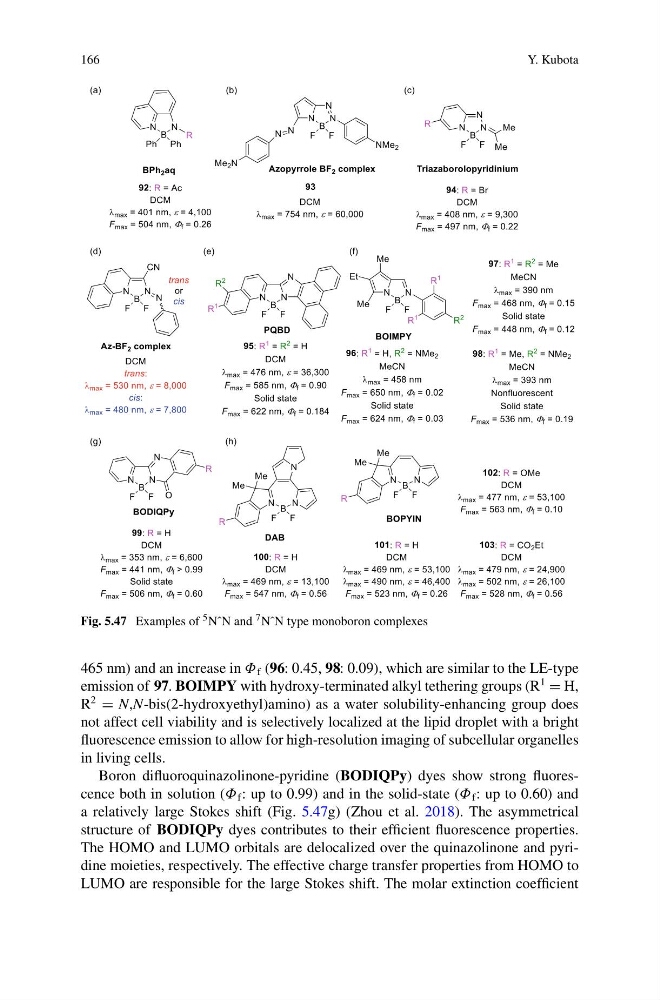
Fig. 5.47 Examples of 5 NˆN and 7 NˆN type monoboron complexes
465 nm) and an increase in Φ f (96: 0.45, 98: 0.09), which are similar to the LE-type
emission of 97. BOIMPY with hydroxy-terminated alkyl tethering groups (R
1
= H,
R
2
= N,N-bis(2-hydroxyethyl)amino) as a water solubility-enhancing group does
not affect cell viability and is selectively localized at the lipid droplet with a bright
fluorescence emission to allow for high-resolution imaging of subcellular organelles
in living cells.
Boron difluoroquinazolinone-pyridine (BODIQPy) dyes show strong fluorescence both in solution (Φ f : up to 0.99) and in the solid-state (Φ f : up to 0.60) and
a relatively large Stokes shift (Fig. 5.47g) (Zhou et al. 2018). The asymmetrical
structure of BODIQPy dyes contributes to their efficient fluorescence properties.
The HOMO and LUMO orbitals are delocalized over the quinazolinone and pyridine moieties, respectively. The effective charge transfer properties from HOMO to
LUMO are responsible for the large Stokes shift. The molar extinction coefficient
Y. Kubota
Fig. 5.47 Examples of 5 NˆN and 7 NˆN type monoboron complexes
465 nm) and an increase in Φ f (96: 0.45, 98: 0.09), which are similar to the LE-type
emission of 97. BOIMPY with hydroxy-terminated alkyl tethering groups (R
1
= H,
R
2
= N,N-bis(2-hydroxyethyl)amino) as a water solubility-enhancing group does
not affect cell viability and is selectively localized at the lipid droplet with a bright
fluorescence emission to allow for high-resolution imaging of subcellular organelles
in living cells.
Boron difluoroquinazolinone-pyridine (BODIQPy) dyes show strong fluorescence both in solution (Φ f : up to 0.99) and in the solid-state (Φ f : up to 0.60) and
a relatively large Stokes shift (Fig. 5.47g) (Zhou et al. 2018). The asymmetrical
structure of BODIQPy dyes contributes to their efficient fluorescence properties.
The HOMO and LUMO orbitals are delocalized over the quinazolinone and pyridine moieties, respectively. The effective charge transfer properties from HOMO to
LUMO are responsible for the large Stokes shift. The molar extinction coefficient