

164
Y. Kubota
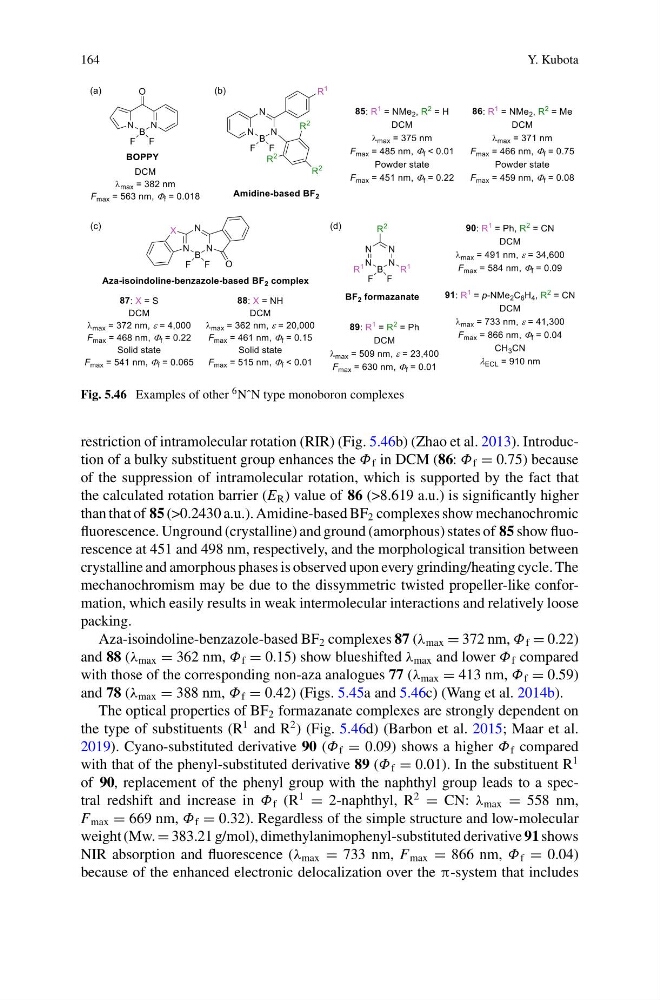
Fig. 5.46 Examples of other 6 NˆN type monoboron complexes
restriction of intramolecular rotation (RIR) (Fig. 5.46b) (Zhao et al. 2013). Introduction of a bulky substituent group enhances the Φ f in DCM (86: Φ f = 0.75) because
of the suppression of intramolecular rotation, which is supported by the fact that
the calculated rotation barrier (E R ) value of 86 (>8.619 a.u.) is significantly higher
than that of 85 (>0.2430 a.u.). Amidine-based BF 2 complexes show mechanochromic
fluorescence. Unground (crystalline) and ground (amorphous) states of 85 show fluorescence at 451 and 498 nm, respectively, and the morphological transition between
crystalline and amorphous phases is observed upon every grinding/heating cycle. The
mechanochromism may be due to the dissymmetric twisted propeller-like conformation, which easily results in weak intermolecular interactions and relatively loose
packing.
Aza-isoindoline-benzazole-based BF 2 complexes 87 (λ max = 372 nm, Φ f = 0.22)
and 88 (λ max = 362 nm, Φ f = 0.15) show blueshifted λ max and lower Φ f compared
with those of the corresponding non-aza analogues 77 (λ max = 413 nm, Φ f = 0.59)
and 78 (λ max = 388 nm, Φ f = 0.42) (Figs. 5.45a and 5.46c) (Wang et al. 2014b).
The optical properties of BF 2 formazanate complexes are strongly dependent on
the type of substituents (R
1 and R
2 ) (Fig. 5.46d) (Barbon et al. 2015; Maar et al.
2019). Cyano-substituted derivative 90 (Φ f = 0.09) shows a higher Φ f compared
with that of the phenyl-substituted derivative 89 (Φ f = 0.01). In the substituent R
1
of 90, replacement of the phenyl group with the naphthyl group leads to a spectral redshift and increase in Φ f (R
1
= 2-naphthyl, R
2
= CN: λ max = 558 nm,
F max = 669 nm, Φ f = 0.32). Regardless of the simple structure and low-molecular
weight (Mw. = 383.21 g/mol), dimethylanimophenyl-substituted derivative 91 shows
NIR absorption and fluorescence (λ max = 733 nm, F max = 866 nm, Φ f = 0.04)
because of the enhanced electronic delocalization over the π-system that includes
Y. Kubota
Fig. 5.46 Examples of other 6 NˆN type monoboron complexes
restriction of intramolecular rotation (RIR) (Fig. 5.46b) (Zhao et al. 2013). Introduction of a bulky substituent group enhances the Φ f in DCM (86: Φ f = 0.75) because
of the suppression of intramolecular rotation, which is supported by the fact that
the calculated rotation barrier (E R ) value of 86 (>8.619 a.u.) is significantly higher
than that of 85 (>0.2430 a.u.). Amidine-based BF 2 complexes show mechanochromic
fluorescence. Unground (crystalline) and ground (amorphous) states of 85 show fluorescence at 451 and 498 nm, respectively, and the morphological transition between
crystalline and amorphous phases is observed upon every grinding/heating cycle. The
mechanochromism may be due to the dissymmetric twisted propeller-like conformation, which easily results in weak intermolecular interactions and relatively loose
packing.
Aza-isoindoline-benzazole-based BF 2 complexes 87 (λ max = 372 nm, Φ f = 0.22)
and 88 (λ max = 362 nm, Φ f = 0.15) show blueshifted λ max and lower Φ f compared
with those of the corresponding non-aza analogues 77 (λ max = 413 nm, Φ f = 0.59)
and 78 (λ max = 388 nm, Φ f = 0.42) (Figs. 5.45a and 5.46c) (Wang et al. 2014b).
The optical properties of BF 2 formazanate complexes are strongly dependent on
the type of substituents (R
1 and R
2 ) (Fig. 5.46d) (Barbon et al. 2015; Maar et al.
2019). Cyano-substituted derivative 90 (Φ f = 0.09) shows a higher Φ f compared
with that of the phenyl-substituted derivative 89 (Φ f = 0.01). In the substituent R
1
of 90, replacement of the phenyl group with the naphthyl group leads to a spectral redshift and increase in Φ f (R
1
= 2-naphthyl, R
2
= CN: λ max = 558 nm,
F max = 669 nm, Φ f = 0.32). Regardless of the simple structure and low-molecular
weight (Mw. = 383.21 g/mol), dimethylanimophenyl-substituted derivative 91 shows
NIR absorption and fluorescence (λ max = 733 nm, F max = 866 nm, Φ f = 0.04)
because of the enhanced electronic delocalization over the π-system that includes