

134
Y. Kubota
is due to the more planar geometry of the methylated derivatives, which leads to more
rigid and delocalized cyanine-like chromophores while the quenching ICT process
is suppressed by the inductive electron donor character of the methyl groups (Esnal
et al. 2013). On the other hand, introduction of cyano groups results in redshifted
λ max (559 nm) and F max (570 nm) values (Yakubovskyi et al. 2016) because of the
stabilization of the LUMO level (Fig. 5.17e) (Nepomnyashchii et al. 2010).
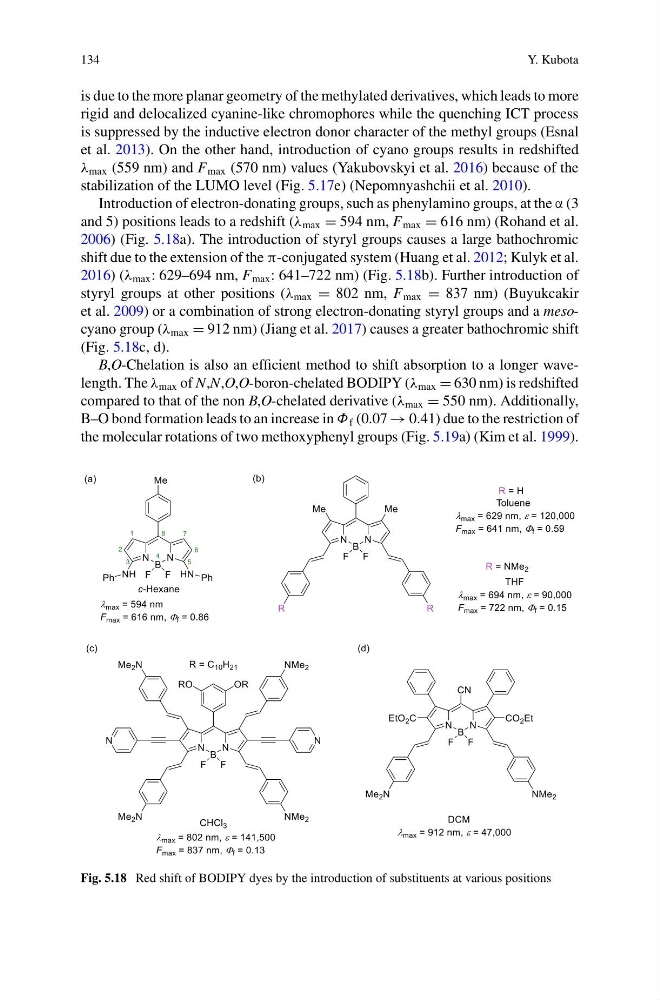
Introduction of electron-donating groups, such as phenylamino groups, at the α (3
and 5) positions leads to a redshift (λ max = 594 nm, F max = 616 nm) (Rohand et al.
2006) (Fig. 5.18a). The introduction of styryl groups causes a large bathochromic
shift due to the extension of the π-conjugated system (Huang et al. 2012; Kulyk et al.
2016) (λ max : 629–694 nm, F max : 641–722 nm) (Fig. 5.18b). Further introduction of
styryl groups at other positions (λ max = 802 nm, F max = 837 nm) (Buyukcakir
et al. 2009) or a combination of strong electron-donating styryl groups and a mesocyano group (λ max = 912 nm) (Jiang et al. 2017) causes a greater bathochromic shift
(Fig. 5.18c, d).
B,O-Chelation is also an efficient method to shift absorption to a longer wavelength. The λ max of N,N,O,O-boron-chelated BODIPY (λ max = 630 nm) is redshifted
compared to that of the non B,O-chelated derivative (λ max = 550 nm). Additionally,
B–O bond formation leads to an increase in Φ f (0.07 → 0.41) due to the restriction of
the molecular rotations of two methoxyphenyl groups (Fig. 5.19a) (Kim et al. 1999).
Fig. 5.18 Red shift of BODIPY dyes by the introduction of substituents at various positions
Y. Kubota
is due to the more planar geometry of the methylated derivatives, which leads to more
rigid and delocalized cyanine-like chromophores while the quenching ICT process
is suppressed by the inductive electron donor character of the methyl groups (Esnal
et al. 2013). On the other hand, introduction of cyano groups results in redshifted
λ max (559 nm) and F max (570 nm) values (Yakubovskyi et al. 2016) because of the
stabilization of the LUMO level (Fig. 5.17e) (Nepomnyashchii et al. 2010).
Introduction of electron-donating groups, such as phenylamino groups, at the α (3
and 5) positions leads to a redshift (λ max = 594 nm, F max = 616 nm) (Rohand et al.
2006) (Fig. 5.18a). The introduction of styryl groups causes a large bathochromic
shift due to the extension of the π-conjugated system (Huang et al. 2012; Kulyk et al.
2016) (λ max : 629–694 nm, F max : 641–722 nm) (Fig. 5.18b). Further introduction of
styryl groups at other positions (λ max = 802 nm, F max = 837 nm) (Buyukcakir
et al. 2009) or a combination of strong electron-donating styryl groups and a mesocyano group (λ max = 912 nm) (Jiang et al. 2017) causes a greater bathochromic shift
(Fig. 5.18c, d).
B,O-Chelation is also an efficient method to shift absorption to a longer wavelength. The λ max of N,N,O,O-boron-chelated BODIPY (λ max = 630 nm) is redshifted
compared to that of the non B,O-chelated derivative (λ max = 550 nm). Additionally,
B–O bond formation leads to an increase in Φ f (0.07 → 0.41) due to the restriction of
the molecular rotations of two methoxyphenyl groups (Fig. 5.19a) (Kim et al. 1999).
Fig. 5.18 Red shift of BODIPY dyes by the introduction of substituents at various positions