

126
Y. Kubota
synthesis. In this reaction, two equivalents of α-free pyrrole and one equivalent of
CF 3 CO 2 H react in the presence of one equivalent of PhSiCl 3 , followed by boron
complexation using NEt 3 and BF 3 ·OEt 2 (Jiang et al. 2017). PhSiCl 3 acts as the
source of chloride ion to generate trifluoroacetyl chloride.
In method (3) (Wu and Burgess 2008a), the treatment of pyrrole-2-carbaldehyde
with phosphoryl chloride, followed by boron complexation with NEt 3 and BF 3 ·OEt 2
to yield meso-unsubstituted BODIPY dyes (Fig. 5.7).
In method (4), halogenation of dipyrrylketone with phosphoryl halide generates
the dipyrromethenium cation. Subsequent deprotonation and boron complexation
gives meso-halogenated BODIPY dyes (Fig. 5.8) (Leen et al. 2012). Symmetric
dipyrrylketones are synthesized by the reaction of α-free pyrroles with triphosgene
(Zhang et al. 2015a). Similarly, the reaction of α-free pyrrole and thiophosgene
produces dipyrrylthioketones, which are oxidized by hydrogen peroxide to afford
dipyrrylketones (Plater et al. 2002). On the other hand, the reaction of dipyrrylthioketones with methyl iodide affords unstable hydroiodide salts, which are subsequently deprotonated and complexed with boron to form meso-methylthio substituted
BODIPY dyes (Goud et al. 2006).
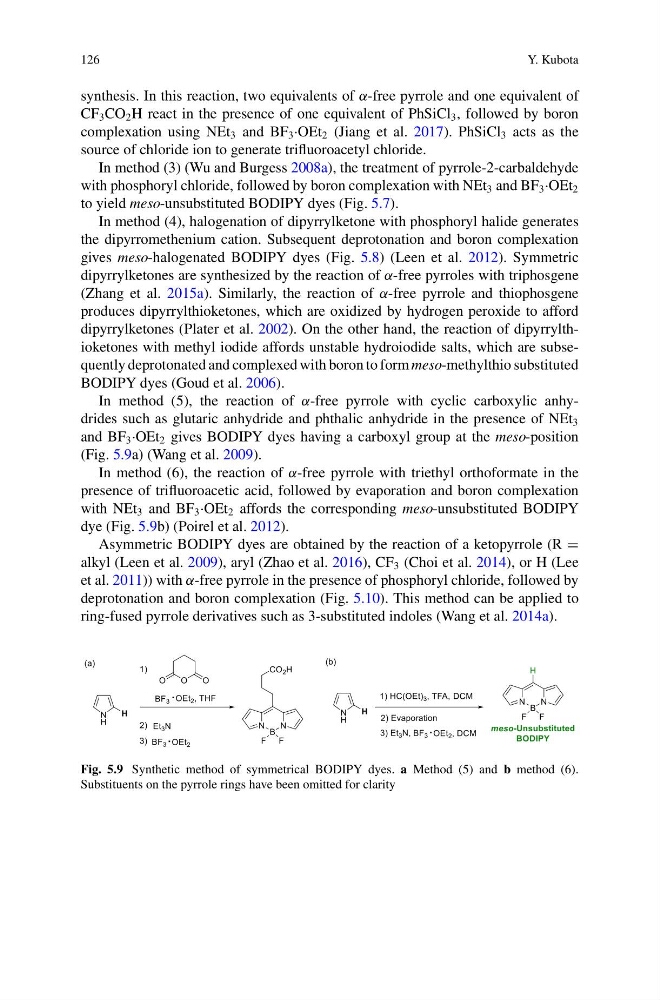
In method (5), the reaction of α-free pyrrole with cyclic carboxylic anhydrides such as glutaric anhydride and phthalic anhydride in the presence of NEt 3
and BF 3 ·OEt 2 gives BODIPY dyes having a carboxyl group at the meso-position
(Fig. 5.9a) (Wang et al. 2009).
In method (6), the reaction of α-free pyrrole with triethyl orthoformate in the
presence of trifluoroacetic acid, followed by evaporation and boron complexation
with NEt 3 and BF 3 ·OEt 2 affords the corresponding meso-unsubstituted BODIPY
dye (Fig. 5.9b) (Poirel et al. 2012).
Asymmetric BODIPY dyes are obtained by the reaction of a ketopyrrole (R =
alkyl (Leen et al. 2009), aryl (Zhao et al. 2016), CF 3 (Choi et al. 2014), or H (Lee
et al. 2011)) with α-free pyrrole in the presence of phosphoryl chloride, followed by
deprotonation and boron complexation (Fig. 5.10). This method can be applied to
ring-fused pyrrole derivatives such as 3-substituted indoles (Wang et al. 2014a).
Fig. 5.9 Synthetic method of symmetrical BODIPY dyes. a Method (5) and b method (6).
Substituents on the pyrrole rings have been omitted for clarity
Y. Kubota
synthesis. In this reaction, two equivalents of α-free pyrrole and one equivalent of
CF 3 CO 2 H react in the presence of one equivalent of PhSiCl 3 , followed by boron
complexation using NEt 3 and BF 3 ·OEt 2 (Jiang et al. 2017). PhSiCl 3 acts as the
source of chloride ion to generate trifluoroacetyl chloride.
In method (3) (Wu and Burgess 2008a), the treatment of pyrrole-2-carbaldehyde
with phosphoryl chloride, followed by boron complexation with NEt 3 and BF 3 ·OEt 2
to yield meso-unsubstituted BODIPY dyes (Fig. 5.7).
In method (4), halogenation of dipyrrylketone with phosphoryl halide generates
the dipyrromethenium cation. Subsequent deprotonation and boron complexation
gives meso-halogenated BODIPY dyes (Fig. 5.8) (Leen et al. 2012). Symmetric
dipyrrylketones are synthesized by the reaction of α-free pyrroles with triphosgene
(Zhang et al. 2015a). Similarly, the reaction of α-free pyrrole and thiophosgene
produces dipyrrylthioketones, which are oxidized by hydrogen peroxide to afford
dipyrrylketones (Plater et al. 2002). On the other hand, the reaction of dipyrrylthioketones with methyl iodide affords unstable hydroiodide salts, which are subsequently deprotonated and complexed with boron to form meso-methylthio substituted
BODIPY dyes (Goud et al. 2006).
In method (5), the reaction of α-free pyrrole with cyclic carboxylic anhydrides such as glutaric anhydride and phthalic anhydride in the presence of NEt 3
and BF 3 ·OEt 2 gives BODIPY dyes having a carboxyl group at the meso-position
(Fig. 5.9a) (Wang et al. 2009).
In method (6), the reaction of α-free pyrrole with triethyl orthoformate in the
presence of trifluoroacetic acid, followed by evaporation and boron complexation
with NEt 3 and BF 3 ·OEt 2 affords the corresponding meso-unsubstituted BODIPY
dye (Fig. 5.9b) (Poirel et al. 2012).
Asymmetric BODIPY dyes are obtained by the reaction of a ketopyrrole (R =
alkyl (Leen et al. 2009), aryl (Zhao et al. 2016), CF 3 (Choi et al. 2014), or H (Lee
et al. 2011)) with α-free pyrrole in the presence of phosphoryl chloride, followed by
deprotonation and boron complexation (Fig. 5.10). This method can be applied to
ring-fused pyrrole derivatives such as 3-substituted indoles (Wang et al. 2014a).
Fig. 5.9 Synthetic method of symmetrical BODIPY dyes. a Method (5) and b method (6).
Substituents on the pyrrole rings have been omitted for clarity