

4
M. Matsui
N
N
N
N
1.1
1.2
Fig. 1.1 William’s cyanines
Thus, the first practical application of cyanine dyes comes from the spectral sensitizers for silver halide photography. Now, polymethine dyes have been used as the
recording materials in optical disks and as probes in biological systems. They can
be also used as the sensitizers in dye-sensitized solar cells (DSSCs).
There are excellent reviews for cyanines (Hishiki 1974; Yasui 1987; Mishra et al.
2000; Tatikolov 2012). In this chapter, the bases of polymethine dyes such as synthesis
and physical properties and their topics are described.
1.2 Bases of Polymethine Dyes
1.2.1 Classification of Polymethine Dyes
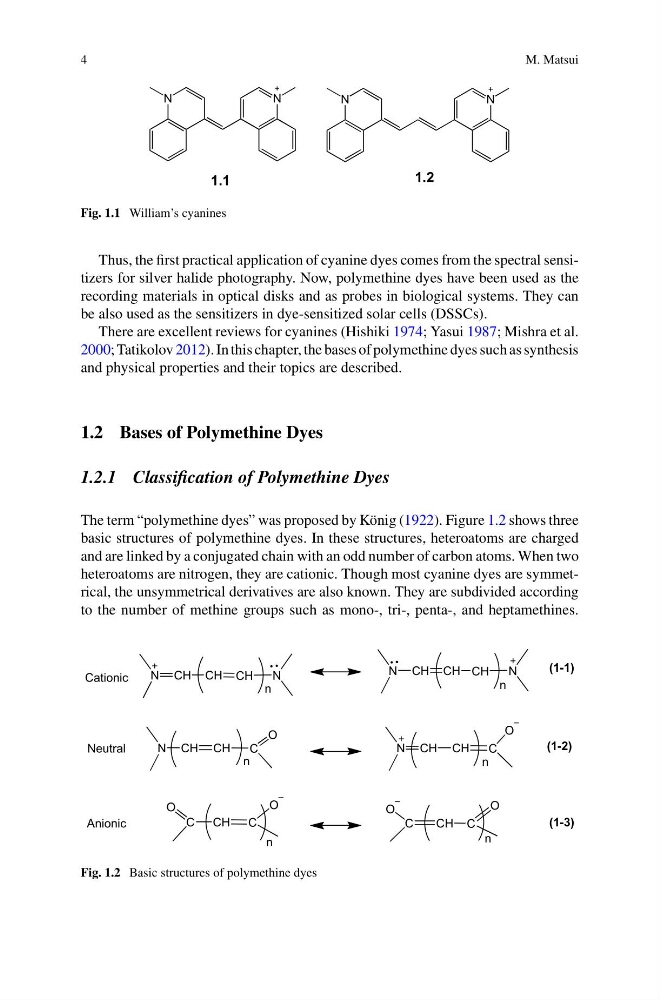
The term “polymethine dyes” was proposed by König (1922). Figure 1.2 shows three
basic structures of polymethine dyes. In these structures, heteroatoms are charged
and are linked by a conjugated chain with an odd number of carbon atoms. When two
heteroatoms are nitrogen, they are cationic. Though most cyanine dyes are symmetrical, the unsymmetrical derivatives are also known. They are subdivided according
to the number of methine groups such as mono-, tri-, penta-, and heptamethines.
N CH
N
CH
CH
n
N CH
N
CH
CH
n
O
C
O
C
CH
n
O
C
O
C
CH
n
Cationic
Anionic
N CH
O
C
CH
n
N CH
O
C
CH
n
Neutral
(1-1)
(1-2)
(1-3)
Fig. 1.2 Basic structures of polymethine dyes
M. Matsui
N
N
N
N
1.1
1.2
Fig. 1.1 William’s cyanines
Thus, the first practical application of cyanine dyes comes from the spectral sensitizers for silver halide photography. Now, polymethine dyes have been used as the
recording materials in optical disks and as probes in biological systems. They can
be also used as the sensitizers in dye-sensitized solar cells (DSSCs).
There are excellent reviews for cyanines (Hishiki 1974; Yasui 1987; Mishra et al.
2000; Tatikolov 2012). In this chapter, the bases of polymethine dyes such as synthesis
and physical properties and their topics are described.
1.2 Bases of Polymethine Dyes
1.2.1 Classification of Polymethine Dyes
The term “polymethine dyes” was proposed by König (1922). Figure 1.2 shows three
basic structures of polymethine dyes. In these structures, heteroatoms are charged
and are linked by a conjugated chain with an odd number of carbon atoms. When two
heteroatoms are nitrogen, they are cationic. Though most cyanine dyes are symmetrical, the unsymmetrical derivatives are also known. They are subdivided according
to the number of methine groups such as mono-, tri-, penta-, and heptamethines.
N CH
N
CH
CH
n
N CH
N
CH
CH
n
O
C
O
C
CH
n
O
C
O
C
CH
n
Cationic
Anionic
N CH
O
C
CH
n
N CH
O
C
CH
n
Neutral
(1-1)
(1-2)
(1-3)
Fig. 1.2 Basic structures of polymethine dyes