

more reactants. In later chapters we will see that surface chemistry plays a
crucial role in determining properties and reactivity in nanosystems.
First-order reactions are common and exhibited by many processes
such as nanoparticle decomposition and isomerization/rearrangement of
molecular moieties in self-assembled films. Furthermore, first-order
reactions are not limited to a single one-reactant process. For instance, an
A + B reaction may be first-order in A and zero-order in B (Table 3.1).
Reactions with orders larger than two are uncommon. Second-order
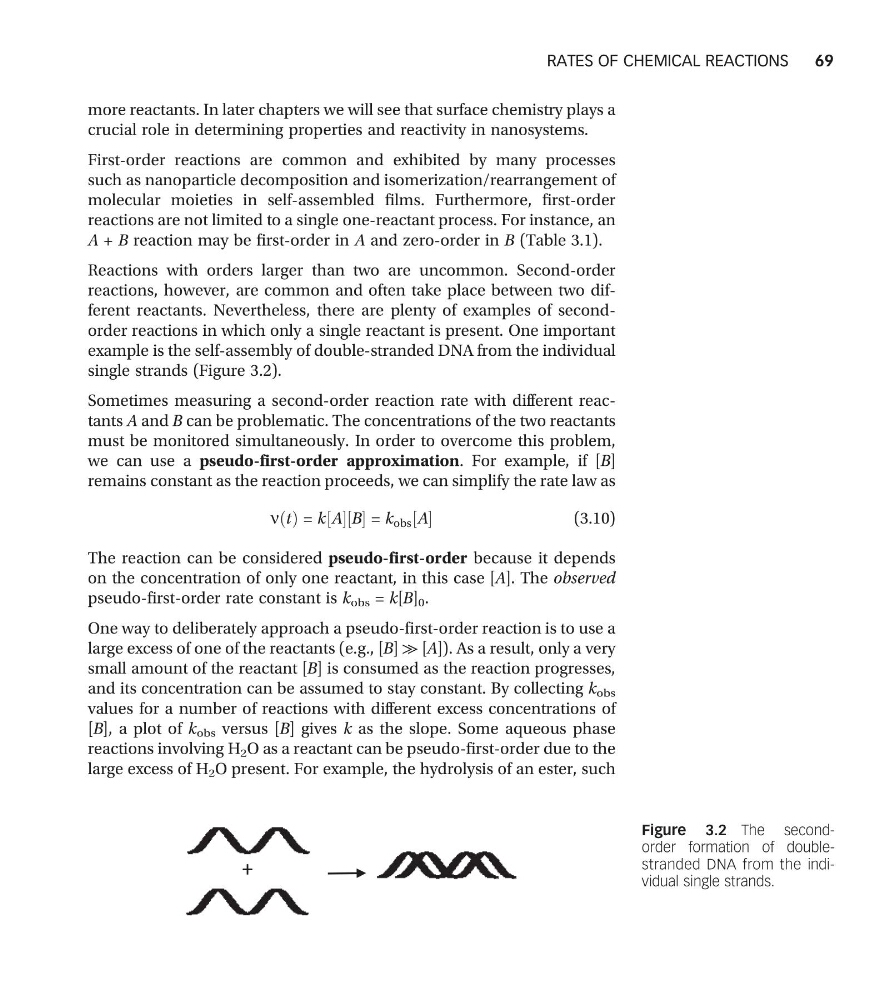
reactions, however, are common and often take place between two different reactants. Nevertheless, there are plenty of examples of secondorder reactions in which only a single reactant is present. One important
example is the self-assembly of double-stranded DNA from the individual
single strands (Figure 3.2).
Sometimes measuring a second-order reaction rate with different reactants A and B can be problematic. The concentrations of the two reactants
must be monitored simultaneously. In order to overcome this problem,
we can use a pseudo-first-order approximation. For example, if [B]
remains constant as the reaction proceeds, we can simplify the rate law as
n t
ð Þ = k A
½ B
½ = k obs A
½
(3.10)
The reaction can be considered pseudo-first-order because it depends
on the concentration of only one reactant, in this case [A]. The observed
pseudo-first-order rate constant is k obs = k[B] 0 .
One way to deliberately approach a pseudo-first-order reaction is to use a
large excess of one of the reactants (e.g., [B] ≫ [A]). As a result, only a very
small amount of the reactant [B] is consumed as the reaction progresses,
and its concentration can be assumed to stay constant. By collecting k obs
values for a number of reactions with different excess concentrations of
[B], a plot of k obs versus [B] gives k as the slope. Some aqueous phase
reactions involving H 2 O as a reactant can be pseudo-first-order due to the
large excess of H 2 O present. For example, the hydrolysis of an ester, such
Figure 3.2 The secondorder formation of doublestranded DNA from the individual single strands.
RATES OF CHEMICAL REACTIONS
69
crucial role in determining properties and reactivity in nanosystems.
First-order reactions are common and exhibited by many processes
such as nanoparticle decomposition and isomerization/rearrangement of
molecular moieties in self-assembled films. Furthermore, first-order
reactions are not limited to a single one-reactant process. For instance, an
A + B reaction may be first-order in A and zero-order in B (Table 3.1).
Reactions with orders larger than two are uncommon. Second-order
reactions, however, are common and often take place between two different reactants. Nevertheless, there are plenty of examples of secondorder reactions in which only a single reactant is present. One important
example is the self-assembly of double-stranded DNA from the individual
single strands (Figure 3.2).
Sometimes measuring a second-order reaction rate with different reactants A and B can be problematic. The concentrations of the two reactants
must be monitored simultaneously. In order to overcome this problem,
we can use a pseudo-first-order approximation. For example, if [B]
remains constant as the reaction proceeds, we can simplify the rate law as
n t
ð Þ = k A
½ B
½ = k obs A
½
(3.10)
The reaction can be considered pseudo-first-order because it depends
on the concentration of only one reactant, in this case [A]. The observed
pseudo-first-order rate constant is k obs = k[B] 0 .
One way to deliberately approach a pseudo-first-order reaction is to use a
large excess of one of the reactants (e.g., [B] ≫ [A]). As a result, only a very
small amount of the reactant [B] is consumed as the reaction progresses,
and its concentration can be assumed to stay constant. By collecting k obs
values for a number of reactions with different excess concentrations of
[B], a plot of k obs versus [B] gives k as the slope. Some aqueous phase
reactions involving H 2 O as a reactant can be pseudo-first-order due to the
large excess of H 2 O present. For example, the hydrolysis of an ester, such
Figure 3.2 The secondorder formation of doublestranded DNA from the individual single strands.
RATES OF CHEMICAL REACTIONS
69