

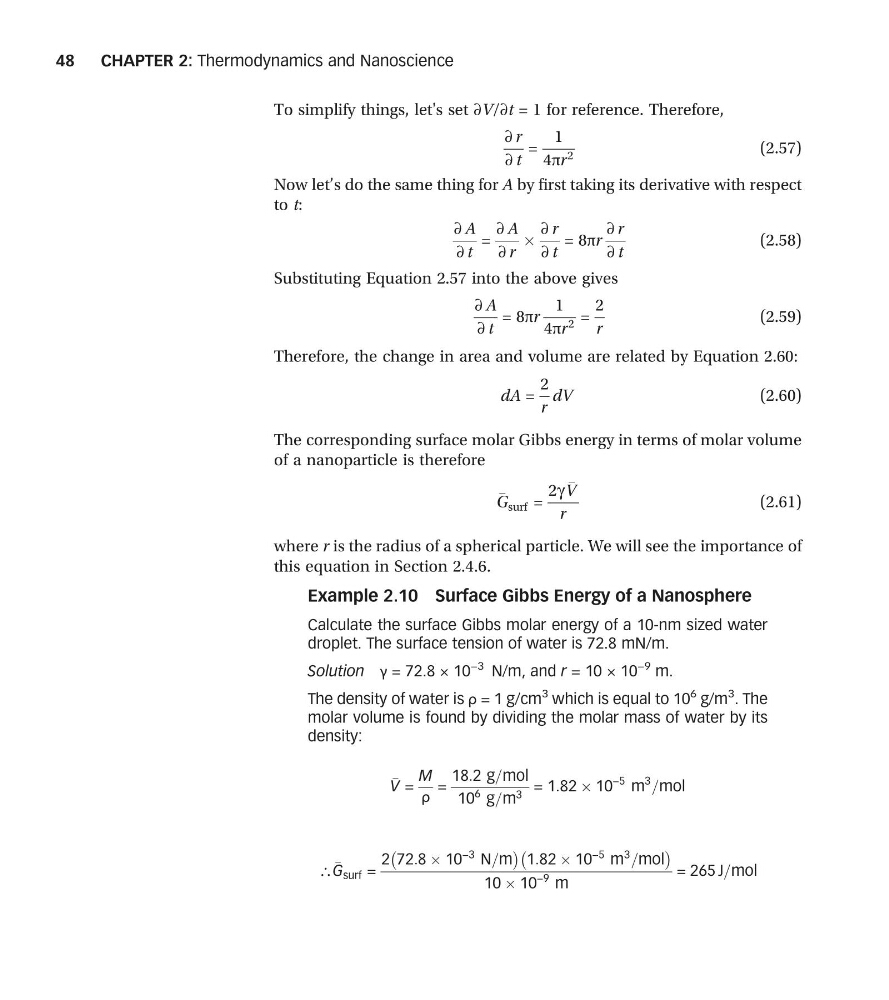
To simplify things, let's set ∂V/∂t = 1 for reference. Therefore,
∂ r
∂ t
=
1
4πr
2
(2.57)
Now let’s do the same thing for A by first taking its derivative with respect
to t:
∂ A
∂ t
=
∂ A
∂ r
Â
∂ r
∂ t
= 8πr
∂ r
∂ t
(2.58)
Substituting Equation 2.57 into the above gives
∂ A
∂ t
= 8πr
1
4πr
2 =
2
r
(2.59)
Therefore, the change in area and volume are related by Equation 2.60:
dA =
2
r
dV
(2.60)
The corresponding surface molar Gibbs energy in terms of molar volume
of a nanoparticle is therefore
G surf =
2g
V
r
(2.61)
where r is the radius of a spherical particle. We will see the importance of
this equation in Section 2.4.6.
Example 2.10 Surface Gibbs Energy of a Nanosphere
Calculate the surface Gibbs molar energy of a 10-nm sized water
droplet. The surface tension of water is 72.8 mN/m.
Solution γ = 72.8 × 10
−3 N/m, and r = 10 × 10
−9 m.
The density of water is ρ = 1 g/cm
3 which is equal to 10
6 g/m
3
. The
molar volume is found by dividing the molar mass of water by its
density:
V =
M
ρ
=
18:2 g=mol
10
6
g=m
3
= 1:82 Â 10
−5
m
3
=mol
∴
G surf =
2 72:8 Â 10
−3
N=m
À
Á
1:82 Â 10
−5
m
3
=mol
À
Á
10 Â 10
−9
m
= 265 J=mol
CHAPTER 2: Thermodynamics and Nanoscience
48
∂ r
∂ t
=
1
4πr
2
(2.57)
Now let’s do the same thing for A by first taking its derivative with respect
to t:
∂ A
∂ t
=
∂ A
∂ r
Â
∂ r
∂ t
= 8πr
∂ r
∂ t
(2.58)
Substituting Equation 2.57 into the above gives
∂ A
∂ t
= 8πr
1
4πr
2 =
2
r
(2.59)
Therefore, the change in area and volume are related by Equation 2.60:
dA =
2
r
dV
(2.60)
The corresponding surface molar Gibbs energy in terms of molar volume
of a nanoparticle is therefore
G surf =
2g
V
r
(2.61)
where r is the radius of a spherical particle. We will see the importance of
this equation in Section 2.4.6.
Example 2.10 Surface Gibbs Energy of a Nanosphere
Calculate the surface Gibbs molar energy of a 10-nm sized water
droplet. The surface tension of water is 72.8 mN/m.
Solution γ = 72.8 × 10
−3 N/m, and r = 10 × 10
−9 m.
The density of water is ρ = 1 g/cm
3 which is equal to 10
6 g/m
3
. The
molar volume is found by dividing the molar mass of water by its
density:
V =
M
ρ
=
18:2 g=mol
10
6
g=m
3
= 1:82 Â 10
−5
m
3
=mol
∴
G surf =
2 72:8 Â 10
−3
N=m
À
Á
1:82 Â 10
−5
m
3
=mol
À
Á
10 Â 10
−9
m
= 265 J=mol
CHAPTER 2: Thermodynamics and Nanoscience
48