

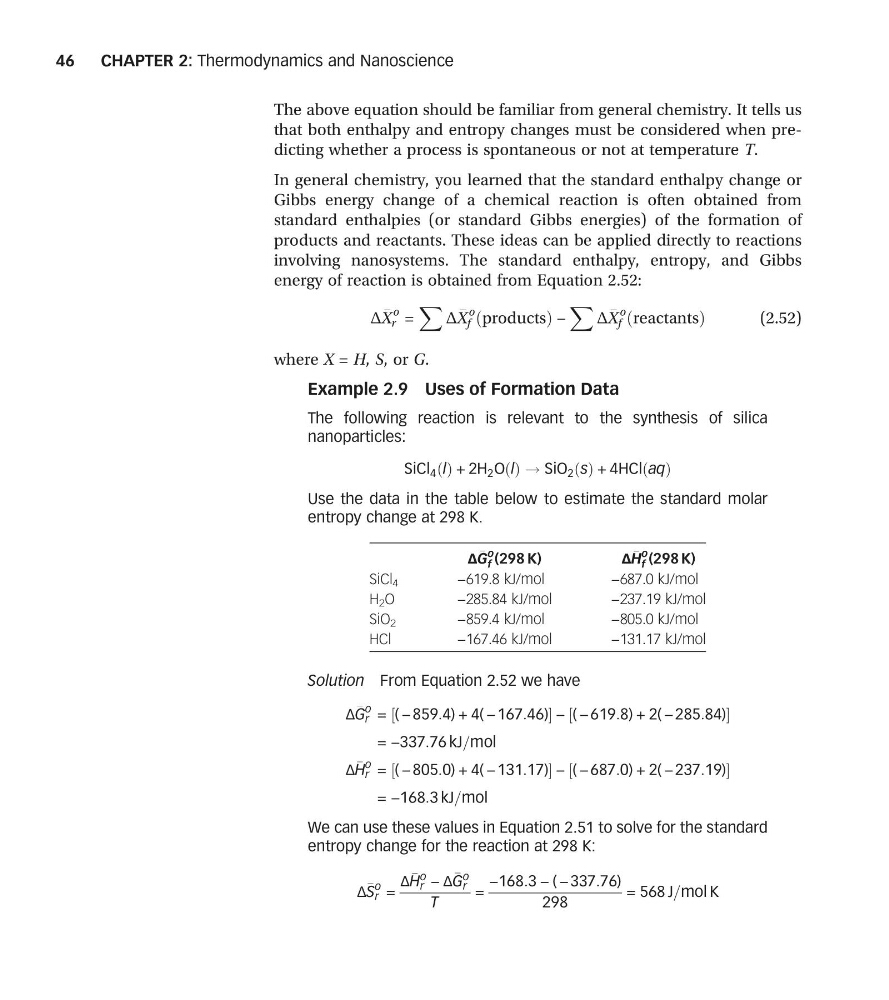
The above equation should be familiar from general chemistry. It tells us
that both enthalpy and entropy changes must be considered when predicting whether a process is spontaneous or not at temperature T.
In general chemistry, you learned that the standard enthalpy change or
Gibbs energy change of a chemical reaction is often obtained from
standard enthalpies (or standard Gibbs energies) of the formation of
products and reactants. These ideas can be applied directly to reactions
involving nanosystems. The standard enthalpy, entropy, and Gibbs
energy of reaction is obtained from Equation 2.52:
Δ
X
o
r =
X Δ
X
o
f products
ð
Þ−
X Δ
X
o
f reactants
ð
Þ
(2.52)
where X = H, S, or G.
Example 2.9 Uses of Formation Data
The following reaction is relevant to the synthesis of silica
nanoparticles:
SiCl 4 l
ð Þ + 2H 2 O l
ð Þ ! SiO 2 s
ð Þ + 4HCl aq
ð Þ
Use the data in the table below to estimate the standard molar
entropy change at 298 K.
Δ
G
o
f (298 K)
Δ
H
o
f (298 K)
SiCl 4
−619.8 kJ/mol
−687.0 kJ/mol
H 2 O
−285.84 kJ/mol
−237.19 kJ/mol
SiO 2
−859.4 kJ/mol
−805.0 kJ/mol
HCl
−167.46 kJ/mol
−131.17 kJ/mol
Solution From Equation 2.52 we have
Δ
G
o
r = ½( − 859:4) + 4( − 167:46) − ½( − 619:8) + 2( − 285:84)
= −337:76 kJ=mol
Δ
H
o
r = ½( − 805:0) + 4( − 131:17) − ½( − 687:0) + 2( − 237:19)
= −168:3 kJ=mol
We can use these values in Equation 2.51 to solve for the standard
entropy change for the reaction at 298 K:
Δ
S
o
r =
Δ
H
o
r − Δ
G
o
r
T
=
−168:3 − ( − 337:76)
298
= 568 J=mol K
CHAPTER 2: Thermodynamics and Nanoscience
46
that both enthalpy and entropy changes must be considered when predicting whether a process is spontaneous or not at temperature T.
In general chemistry, you learned that the standard enthalpy change or
Gibbs energy change of a chemical reaction is often obtained from
standard enthalpies (or standard Gibbs energies) of the formation of
products and reactants. These ideas can be applied directly to reactions
involving nanosystems. The standard enthalpy, entropy, and Gibbs
energy of reaction is obtained from Equation 2.52:
Δ
X
o
r =
X Δ
X
o
f products
ð
Þ−
X Δ
X
o
f reactants
ð
Þ
(2.52)
where X = H, S, or G.
Example 2.9 Uses of Formation Data
The following reaction is relevant to the synthesis of silica
nanoparticles:
SiCl 4 l
ð Þ + 2H 2 O l
ð Þ ! SiO 2 s
ð Þ + 4HCl aq
ð Þ
Use the data in the table below to estimate the standard molar
entropy change at 298 K.
Δ
G
o
f (298 K)
Δ
H
o
f (298 K)
SiCl 4
−619.8 kJ/mol
−687.0 kJ/mol
H 2 O
−285.84 kJ/mol
−237.19 kJ/mol
SiO 2
−859.4 kJ/mol
−805.0 kJ/mol
HCl
−167.46 kJ/mol
−131.17 kJ/mol
Solution From Equation 2.52 we have
Δ
G
o
r = ½( − 859:4) + 4( − 167:46) − ½( − 619:8) + 2( − 285:84)
= −337:76 kJ=mol
Δ
H
o
r = ½( − 805:0) + 4( − 131:17) − ½( − 687:0) + 2( − 237:19)
= −168:3 kJ=mol
We can use these values in Equation 2.51 to solve for the standard
entropy change for the reaction at 298 K:
Δ
S
o
r =
Δ
H
o
r − Δ
G
o
r
T
=
−168:3 − ( − 337:76)
298
= 568 J=mol K
CHAPTER 2: Thermodynamics and Nanoscience
46