

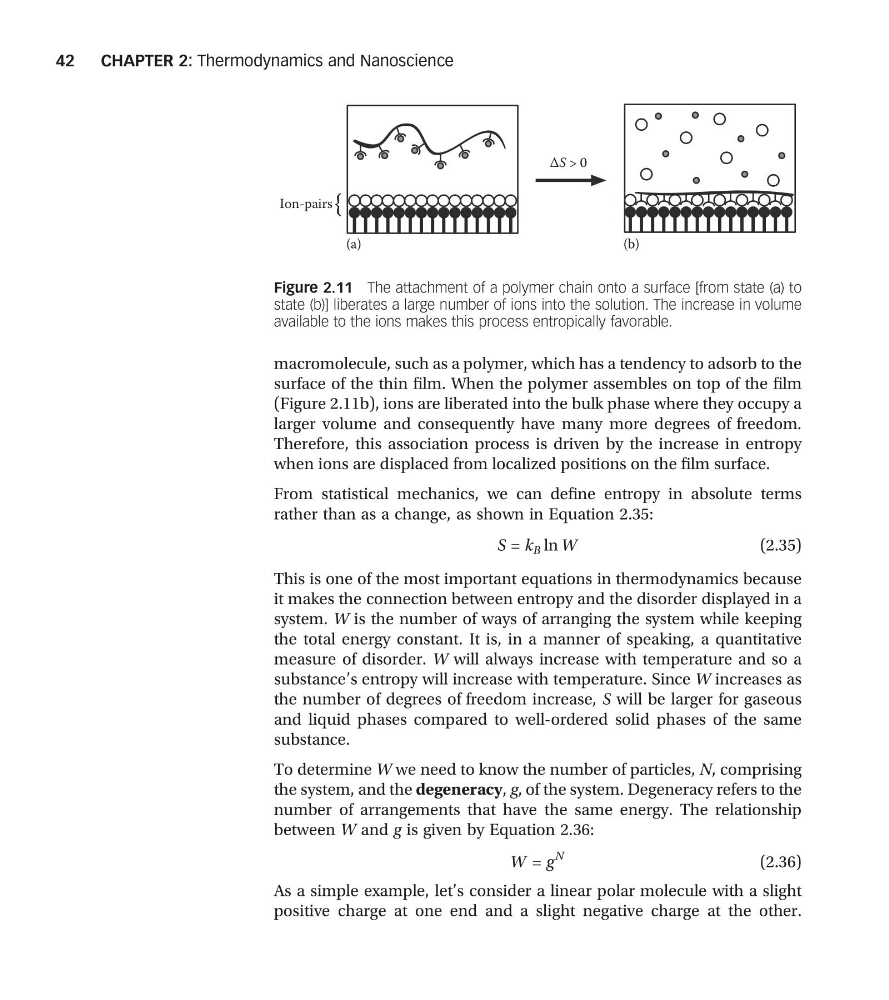
macromolecule, such as a polymer, which has a tendency to adsorb to the
surface of the thin film. When the polymer assembles on top of the film
(Figure 2.11b), ions are liberated into the bulk phase where they occupy a
larger volume and consequently have many more degrees of freedom.
Therefore, this association process is driven by the increase in entropy
when ions are displaced from localized positions on the film surface.
From statistical mechanics, we can define entropy in absolute terms
rather than as a change, as shown in Equation 2.35:
S = k B ln W
(2.35)
This is one of the most important equations in thermodynamics because
it makes the connection between entropy and the disorder displayed in a
system. W is the number of ways of arranging the system while keeping
the total energy constant. It is, in a manner of speaking, a quantitative
measure of disorder. W will always increase with temperature and so a
substance’s entropy will increase with temperature. Since W increases as
the number of degrees of freedom increase, S will be larger for gaseous
and liquid phases compared to well-ordered solid phases of the same
substance.
To determine W we need to know the number of particles, N, comprising
the system, and the degeneracy, g, of the system. Degeneracy refers to the
number of arrangements that have the same energy. The relationship
between W and g is given by Equation 2.36:
W = g
N
(2.36)
As a simple example, let’s consider a linear polar molecule with a slight
positive charge at one end and a slight negative charge at the other.
Ion-pairs
(a)
(b)
ΔS > 0
Figure 2.11 The attachment of a polymer chain onto a surface [from state (a) to
state (b)] liberates a large number of ions into the solution. The increase in volume
available to the ions makes this process entropically favorable.
CHAPTER 2: Thermodynamics and Nanoscience
42
surface of the thin film. When the polymer assembles on top of the film
(Figure 2.11b), ions are liberated into the bulk phase where they occupy a
larger volume and consequently have many more degrees of freedom.
Therefore, this association process is driven by the increase in entropy
when ions are displaced from localized positions on the film surface.
From statistical mechanics, we can define entropy in absolute terms
rather than as a change, as shown in Equation 2.35:
S = k B ln W
(2.35)
This is one of the most important equations in thermodynamics because
it makes the connection between entropy and the disorder displayed in a
system. W is the number of ways of arranging the system while keeping
the total energy constant. It is, in a manner of speaking, a quantitative
measure of disorder. W will always increase with temperature and so a
substance’s entropy will increase with temperature. Since W increases as
the number of degrees of freedom increase, S will be larger for gaseous
and liquid phases compared to well-ordered solid phases of the same
substance.
To determine W we need to know the number of particles, N, comprising
the system, and the degeneracy, g, of the system. Degeneracy refers to the
number of arrangements that have the same energy. The relationship
between W and g is given by Equation 2.36:
W = g
N
(2.36)
As a simple example, let’s consider a linear polar molecule with a slight
positive charge at one end and a slight negative charge at the other.
Ion-pairs
(a)
(b)
ΔS > 0
Figure 2.11 The attachment of a polymer chain onto a surface [from state (a) to
state (b)] liberates a large number of ions into the solution. The increase in volume
available to the ions makes this process entropically favorable.
CHAPTER 2: Thermodynamics and Nanoscience
42