

by its two-dimensional analog, surface pressure (P). Thus, the corresponding equation of state is given by Equation 2.15:
PA = nRT
(2.15)
For a reversible compression from A i to A f , the work is given by Equation
2.16:
w = −nRT
ð A f
A i
1
P
dA = −nRT ln
A f
A i
(2.16)
In practice, the process can be performed reversibly by compressing the
monolayer very slowly. We discuss this system more completely in
Chapter 7.
The usefulness of work has been applied to a number of nanoscale
systems. This usually involves measuring the force required to distort a
system. For example, studies have been done where a strand of DNA has
been stretched and the corresponding force measured (Cluzel et al.,
1996). Figure 2.10 illustrates the process. The naturally extended strand of
DNA (its contour length, l o ) has an end-to-end separation of about 15 nm.
The distance r is defined as x/l o , where x is the length of the stretch
strand. Thus, r = 1 at the contour length. Figure 2.10b shows how measured force changes with r. At (i), r < l o and the force is zero, corresponding to the unstretched (or coiled) form of DNA. At (ii), stretching
begins and the force increases. The flat region (iii) corresponds to a
structural transition, beyond which the strand is irreversibly damaged
(iv). By using our general expression for work (Equation 2.8), we can
derive an expression for the work done in stretching the DNA strand from
r 1 to r 2 (Equation 2.17):
Moveable
barriers
Moveable
barriers
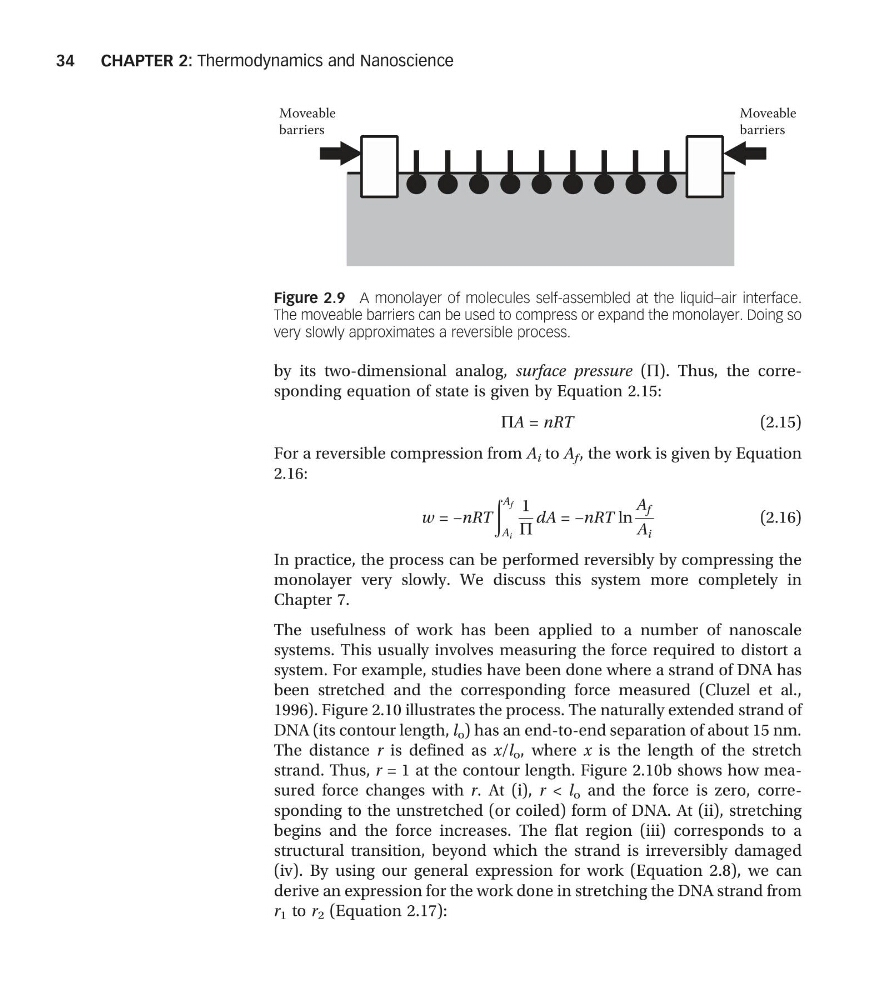
Figure 2.9 A monolayer of molecules self-assembled at the liquid–air interface.
The moveable barriers can be used to compress or expand the monolayer. Doing so
very slowly approximates a reversible process.
CHAPTER 2: Thermodynamics and Nanoscience
34
PA = nRT
(2.15)
For a reversible compression from A i to A f , the work is given by Equation
2.16:
w = −nRT
ð A f
A i
1
P
dA = −nRT ln
A f
A i
(2.16)
In practice, the process can be performed reversibly by compressing the
monolayer very slowly. We discuss this system more completely in
Chapter 7.
The usefulness of work has been applied to a number of nanoscale
systems. This usually involves measuring the force required to distort a
system. For example, studies have been done where a strand of DNA has
been stretched and the corresponding force measured (Cluzel et al.,
1996). Figure 2.10 illustrates the process. The naturally extended strand of
DNA (its contour length, l o ) has an end-to-end separation of about 15 nm.
The distance r is defined as x/l o , where x is the length of the stretch
strand. Thus, r = 1 at the contour length. Figure 2.10b shows how measured force changes with r. At (i), r < l o and the force is zero, corresponding to the unstretched (or coiled) form of DNA. At (ii), stretching
begins and the force increases. The flat region (iii) corresponds to a
structural transition, beyond which the strand is irreversibly damaged
(iv). By using our general expression for work (Equation 2.8), we can
derive an expression for the work done in stretching the DNA strand from
r 1 to r 2 (Equation 2.17):
Moveable
barriers
Moveable
barriers
Figure 2.9 A monolayer of molecules self-assembled at the liquid–air interface.
The moveable barriers can be used to compress or expand the monolayer. Doing so
very slowly approximates a reversible process.
CHAPTER 2: Thermodynamics and Nanoscience
34