

carefully to ensure the system remains close to equilibrium during the
process. For example, the slow compression of a collection of
nanoparticles over a period of hours approximates a reversible process.
Let’s use the reversible process to obtain the work done for gaseous
expansion and compression.
For a reversible process the internal and external pressures are the same.
If we approximate the gas in the cylinder as an ideal gas, then Equation
2.12 gives the external pressure.
P ext =
nRT
V
=
RT
V
(2.12)
Note that pressure in Equation 2.12 is not constant but depends on V and
so in order to determine work, we substitute Equation 2.12 into Equation
2.8 to yield the integral Equation 2.13.
w = −nRT
ð V f
V i
1
V
dV
(2.13)
Upon integrating Equation 2.13 from V i to V f we obtain the work done for
the reversible process (Equation 2.14).
w = −nRT ln
V f
V i
(2.14)
Example 2.6 Reversible Expansive Work
Determine the reversible work done when 1 mol of a gas expands
from 2 L to 10 L against a constant external pressure of 1 atm at
298 K.
Solution Substituting the appropriate values into Equation 2.14
gives
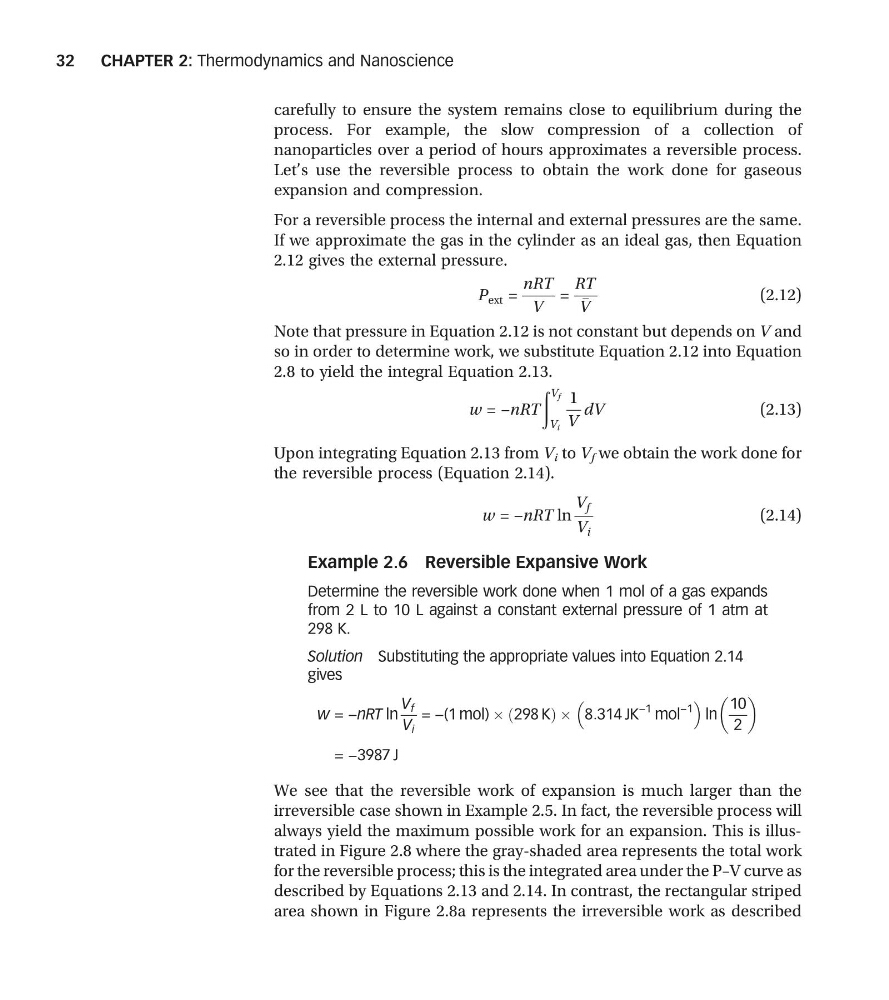
w = −nRT ln
V f
V i
= −(1 mol) Â 298 K
ð
ÞÂ 8:314 JK
−1 mol
−1
ln
10
2
= −3987 J
We see that the reversible work of expansion is much larger than the
irreversible case shown in Example 2.5. In fact, the reversible process will
always yield the maximum possible work for an expansion. This is illustrated in Figure 2.8 where the gray-shaded area represents the total work
for the reversible process; this is the integrated area under the P–V curve as
described by Equations 2.13 and 2.14. In contrast, the rectangular striped
area shown in Figure 2.8a represents the irreversible work as described
CHAPTER 2: Thermodynamics and Nanoscience
32
process. For example, the slow compression of a collection of
nanoparticles over a period of hours approximates a reversible process.
Let’s use the reversible process to obtain the work done for gaseous
expansion and compression.
For a reversible process the internal and external pressures are the same.
If we approximate the gas in the cylinder as an ideal gas, then Equation
2.12 gives the external pressure.
P ext =
nRT
V
=
RT
V
(2.12)
Note that pressure in Equation 2.12 is not constant but depends on V and
so in order to determine work, we substitute Equation 2.12 into Equation
2.8 to yield the integral Equation 2.13.
w = −nRT
ð V f
V i
1
V
dV
(2.13)
Upon integrating Equation 2.13 from V i to V f we obtain the work done for
the reversible process (Equation 2.14).
w = −nRT ln
V f
V i
(2.14)
Example 2.6 Reversible Expansive Work
Determine the reversible work done when 1 mol of a gas expands
from 2 L to 10 L against a constant external pressure of 1 atm at
298 K.
Solution Substituting the appropriate values into Equation 2.14
gives
w = −nRT ln
V f
V i
= −(1 mol) Â 298 K
ð
ÞÂ 8:314 JK
−1 mol
−1
ln
10
2
= −3987 J
We see that the reversible work of expansion is much larger than the
irreversible case shown in Example 2.5. In fact, the reversible process will
always yield the maximum possible work for an expansion. This is illustrated in Figure 2.8 where the gray-shaded area represents the total work
for the reversible process; this is the integrated area under the P–V curve as
described by Equations 2.13 and 2.14. In contrast, the rectangular striped
area shown in Figure 2.8a represents the irreversible work as described
CHAPTER 2: Thermodynamics and Nanoscience
32