

It is convention to assign this work a negative magnitude (i.e., −w). Conversely, when the surroundings do work on the system (a compression
process) it is convention to assign this work a positive magnitude (i.e., +w).
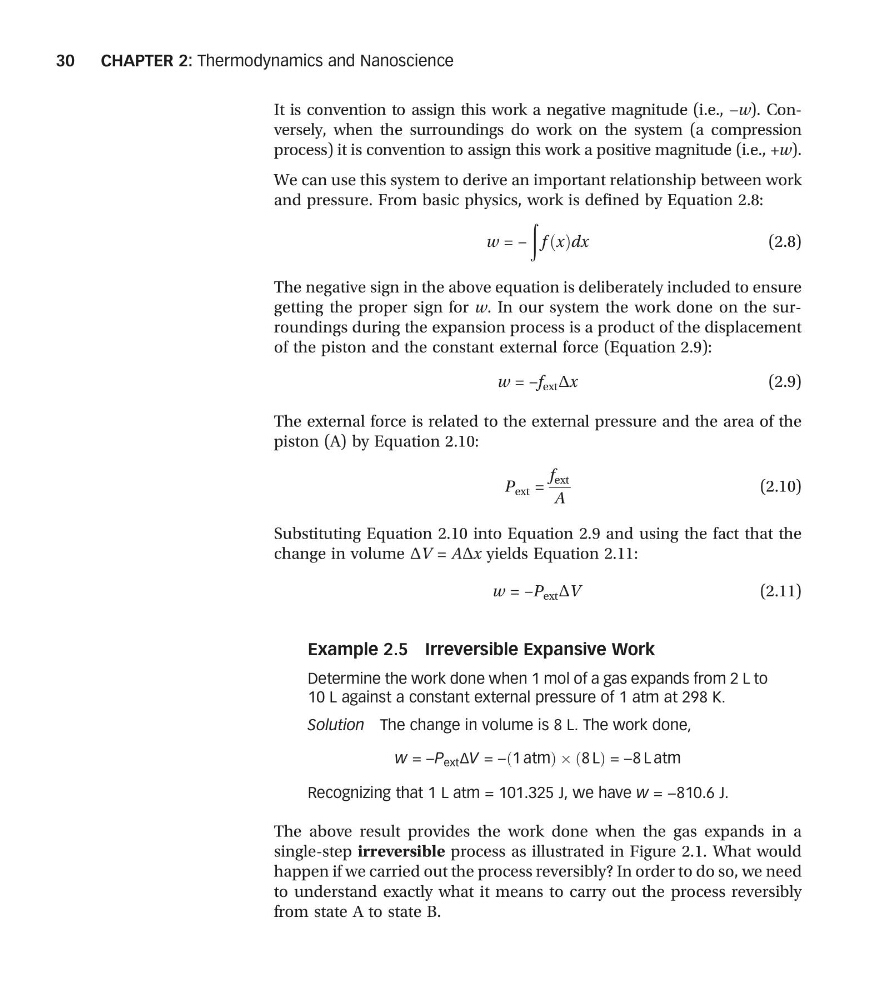
We can use this system to derive an important relationship between work
and pressure. From basic physics, work is defined by Equation 2.8:
w = −
ð
f x
ð Þdx
(2.8)
The negative sign in the above equation is deliberately included to ensure
getting the proper sign for w. In our system the work done on the surroundings during the expansion process is a product of the displacement
of the piston and the constant external force (Equation 2.9):
w = −f ext Δx
(2.9)
The external force is related to the external pressure and the area of the
piston (A) by Equation 2.10:
P ext =
f ext
A
(2.10)
Substituting Equation 2.10 into Equation 2.9 and using the fact that the
change in volume ΔV = AΔx yields Equation 2.11:
w = −P ext ΔV
(2.11)
Example 2.5 Irreversible Expansive Work
Determine the work done when 1 mol of a gas expands from 2 L to
10 L against a constant external pressure of 1 atm at 298 K.
Solution The change in volume is 8 L. The work done,
w = −P ext ΔV = − 1 atm
ð
ÞÂ 8 L
ð Þ = −8 L atm
Recognizing that 1 L atm = 101.325 J, we have w = −810.6 J.
The above result provides the work done when the gas expands in a
single-step irreversible process as illustrated in Figure 2.1. What would
happen if we carried out the process reversibly? In order to do so, we need
to understand exactly what it means to carry out the process reversibly
from state A to state B.
CHAPTER 2: Thermodynamics and Nanoscience
30
process) it is convention to assign this work a positive magnitude (i.e., +w).
We can use this system to derive an important relationship between work
and pressure. From basic physics, work is defined by Equation 2.8:
w = −
ð
f x
ð Þdx
(2.8)
The negative sign in the above equation is deliberately included to ensure
getting the proper sign for w. In our system the work done on the surroundings during the expansion process is a product of the displacement
of the piston and the constant external force (Equation 2.9):
w = −f ext Δx
(2.9)
The external force is related to the external pressure and the area of the
piston (A) by Equation 2.10:
P ext =
f ext
A
(2.10)
Substituting Equation 2.10 into Equation 2.9 and using the fact that the
change in volume ΔV = AΔx yields Equation 2.11:
w = −P ext ΔV
(2.11)
Example 2.5 Irreversible Expansive Work
Determine the work done when 1 mol of a gas expands from 2 L to
10 L against a constant external pressure of 1 atm at 298 K.
Solution The change in volume is 8 L. The work done,
w = −P ext ΔV = − 1 atm
ð
ÞÂ 8 L
ð Þ = −8 L atm
Recognizing that 1 L atm = 101.325 J, we have w = −810.6 J.
The above result provides the work done when the gas expands in a
single-step irreversible process as illustrated in Figure 2.1. What would
happen if we carried out the process reversibly? In order to do so, we need
to understand exactly what it means to carry out the process reversibly
from state A to state B.
CHAPTER 2: Thermodynamics and Nanoscience
30