

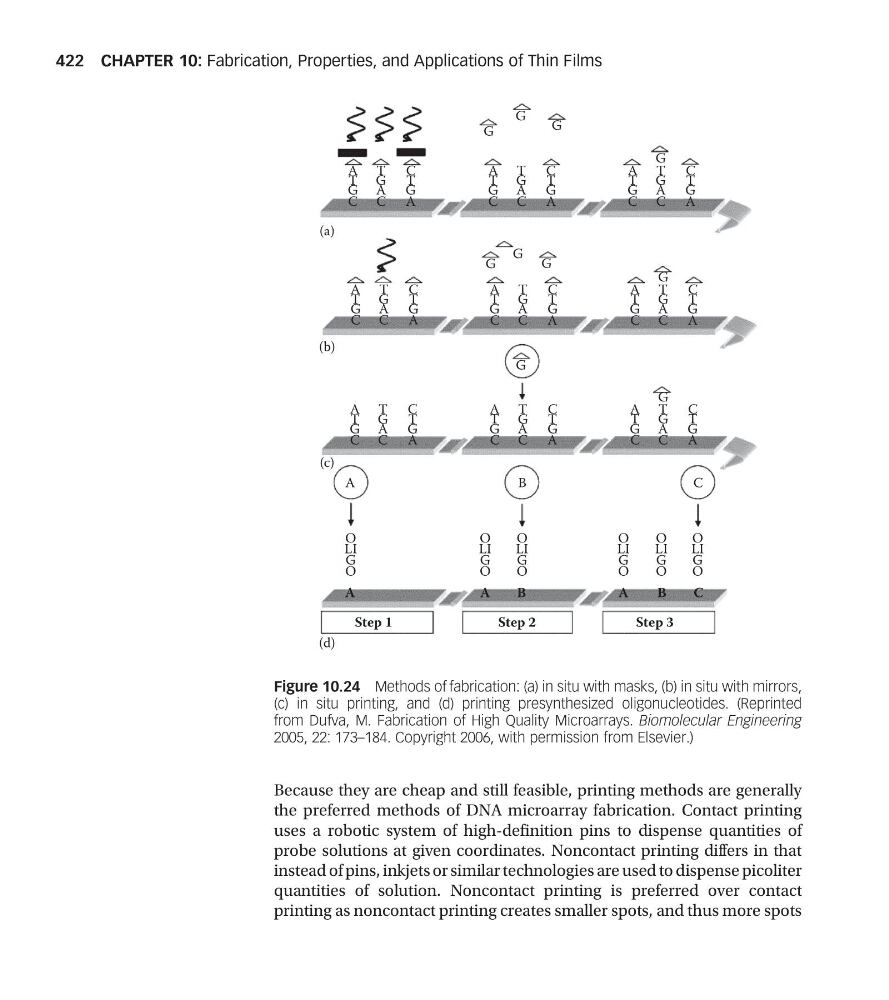
Because they are cheap and still feasible, printing methods are generally
the preferred methods of DNA microarray fabrication. Contact printing
uses a robotic system of high-definition pins to dispense quantities of
probe solutions at given coordinates. Noncontact printing differs in that
instead of pins, inkjets or similar technologies are used to dispense picoliter
quantities of solution. Noncontact printing is preferred over contact
printing as noncontact printing creates smaller spots, and thus more spots
G
G
A
(a)
(b)
(c)
(d)
T
G
C
T
G
A
C
C
T
G
A
A
T
G
C
T
G
A
C
C
T
G
A
A
T
G
C
T
G
A
C
C
T
G
A
G
G
G
G
G
G
A
T
G
C
T
G
A
C
C
T
G
A
G
A
T
G
C
T
G
A
C
C
T
G
A
A
T
G
C
T
G
A
C
C
T
G
A
A
T
G
C
T
G
A
C
C
T
G
A
G
A
T
G
C
T
G
A
C
O
LI
G
O
O
LI
G
O
A
B
B
C
A
A
Step 1
Step 2
Step 3
O
LI
G
O
O
LI
G
O
O
LI
G
O
O
LI
G
O
C
T
G
A
A
A
B
C
T
G
C
T
G
A
C
C
T
G
A
Figure 10.24 Methods of fabrication: (a) in situ with masks, (b) in situ with mirrors,
(c) in situ printing, and (d) printing presynthesized oligonucleotides. (Reprinted
from Dufva, M. Fabrication of High Quality Microarrays. Biomolecular Engineering
2005, 22: 173–184. Copyright 2006, with permission from Elsevier.)
CHAPTER 10: Fabrication, Properties, and Applications of Thin Films
422
the preferred methods of DNA microarray fabrication. Contact printing
uses a robotic system of high-definition pins to dispense quantities of
probe solutions at given coordinates. Noncontact printing differs in that
instead of pins, inkjets or similar technologies are used to dispense picoliter
quantities of solution. Noncontact printing is preferred over contact
printing as noncontact printing creates smaller spots, and thus more spots
G
G
A
(a)
(b)
(c)
(d)
T
G
C
T
G
A
C
C
T
G
A
A
T
G
C
T
G
A
C
C
T
G
A
A
T
G
C
T
G
A
C
C
T
G
A
G
G
G
G
G
G
A
T
G
C
T
G
A
C
C
T
G
A
G
A
T
G
C
T
G
A
C
C
T
G
A
A
T
G
C
T
G
A
C
C
T
G
A
A
T
G
C
T
G
A
C
C
T
G
A
G
A
T
G
C
T
G
A
C
O
LI
G
O
O
LI
G
O
A
B
B
C
A
A
Step 1
Step 2
Step 3
O
LI
G
O
O
LI
G
O
O
LI
G
O
O
LI
G
O
C
T
G
A
A
A
B
C
T
G
C
T
G
A
C
C
T
G
A
Figure 10.24 Methods of fabrication: (a) in situ with masks, (b) in situ with mirrors,
(c) in situ printing, and (d) printing presynthesized oligonucleotides. (Reprinted
from Dufva, M. Fabrication of High Quality Microarrays. Biomolecular Engineering
2005, 22: 173–184. Copyright 2006, with permission from Elsevier.)
CHAPTER 10: Fabrication, Properties, and Applications of Thin Films
422