

10.2 POLYELECTROLYTES
Polyelectrolytes are polymers, or chains of molecules, that contain ionizable functional groups that exist in a charged state in solution, allowing
the polymer to function as an electrolyte. Acidic functional groups such as
carboxylic or sulfonic acid groups can give up a proton, becoming negatively charged, and basic functional groups such as amines can accept a
proton, becoming positively charged. In order to maintain charge of
neutrality, these charges must always be countered by charges of opposite
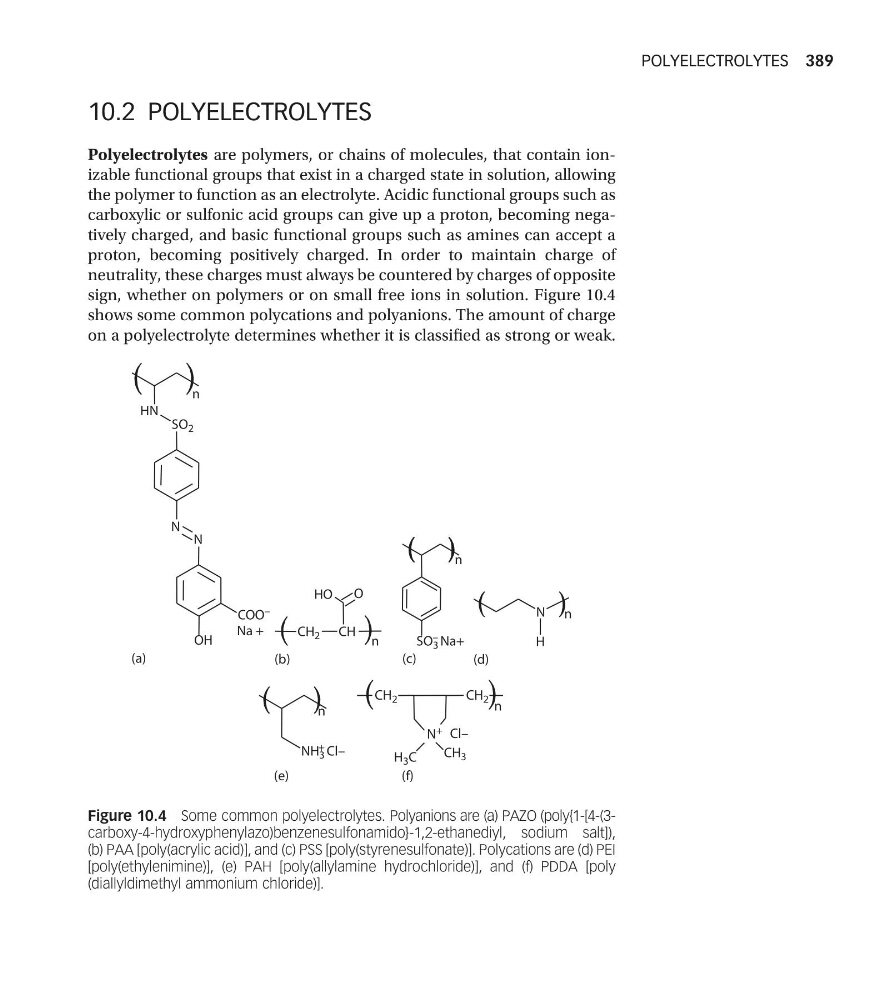
sign, whether on polymers or on small free ions in solution. Figure 10.4
shows some common polycations and polyanions. The amount of charge
on a polyelectrolyte determines whether it is classified as strong or weak.
CH
CH 2
O
HO
n
CH 2
CH 2
N +
CH 3
H 3 C
n
Cl–
N N
COO –
OH
SO 2
HN
Na +
n
(a)
(b)
SO 3 Na+
n
(c)
(d)
(e)
(f)
H
N n
NH 3 Cl–
n
–
+
Figure 10.4 Some common polyelectrolytes. Polyanions are (a) PAZO (poly{1-[4-(3carboxy-4-hydroxyphenylazo)benzenesulfonamido}-1,2-ethanediyl, sodium salt]),
(b) PAA [poly(acrylic acid)], and (c) PSS [poly(styrenesulfonate)]. Polycations are (d) PEI
[poly(ethylenimine)], (e) PAH [poly(allylamine hydrochloride)], and (f) PDDA [poly
(diallyldimethyl ammonium chloride)].
POLYELECTROLYTES 389
Polyelectrolytes are polymers, or chains of molecules, that contain ionizable functional groups that exist in a charged state in solution, allowing
the polymer to function as an electrolyte. Acidic functional groups such as
carboxylic or sulfonic acid groups can give up a proton, becoming negatively charged, and basic functional groups such as amines can accept a
proton, becoming positively charged. In order to maintain charge of
neutrality, these charges must always be countered by charges of opposite
sign, whether on polymers or on small free ions in solution. Figure 10.4
shows some common polycations and polyanions. The amount of charge
on a polyelectrolyte determines whether it is classified as strong or weak.
CH
CH 2
O
HO
n
CH 2
CH 2
N +
CH 3
H 3 C
n
Cl–
N N
COO –
OH
SO 2
HN
Na +
n
(a)
(b)
SO 3 Na+
n
(c)
(d)
(e)
(f)
H
N n
NH 3 Cl–
n
–
+
Figure 10.4 Some common polyelectrolytes. Polyanions are (a) PAZO (poly{1-[4-(3carboxy-4-hydroxyphenylazo)benzenesulfonamido}-1,2-ethanediyl, sodium salt]),
(b) PAA [poly(acrylic acid)], and (c) PSS [poly(styrenesulfonate)]. Polycations are (d) PEI
[poly(ethylenimine)], (e) PAH [poly(allylamine hydrochloride)], and (f) PDDA [poly
(diallyldimethyl ammonium chloride)].
POLYELECTROLYTES 389