

annealing. Annealing involves repeated compression and then expansion
of the Langmuir film. Studies have found that the calculated area per
molecule obtained through the P–A isotherm actually decreases under
such a procedure, leading to a closely packed and well-aligned monolayer.
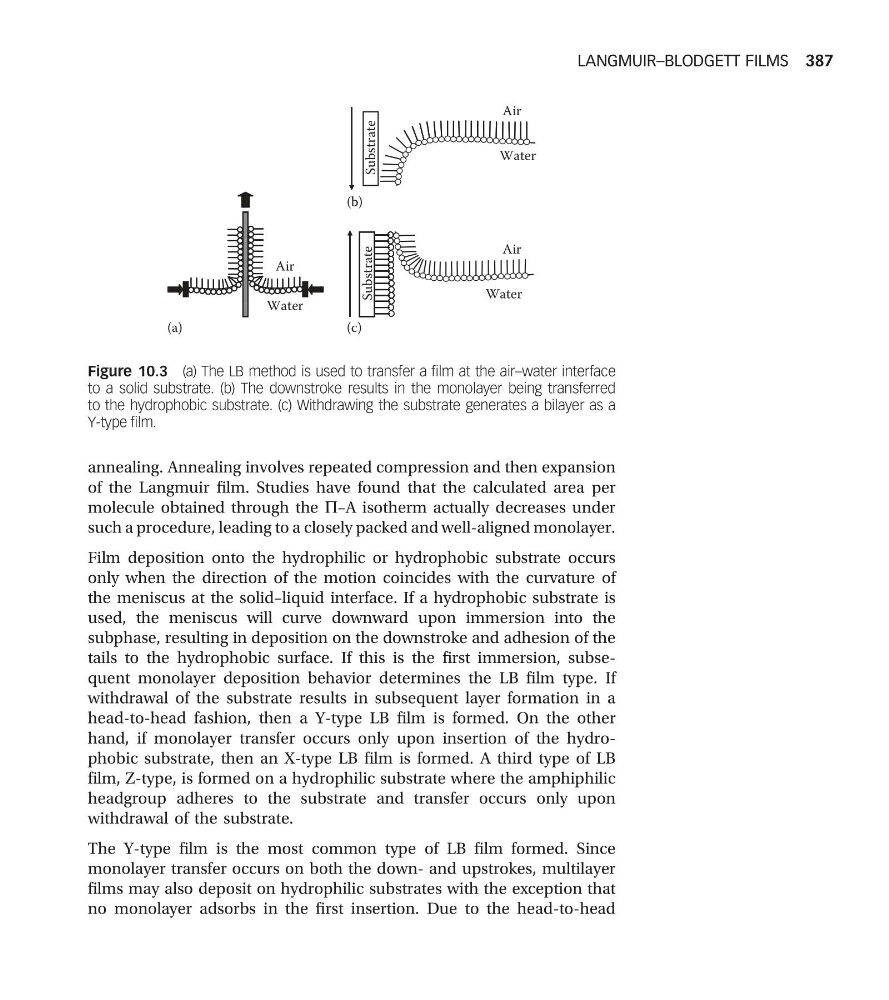
Film deposition onto the hydrophilic or hydrophobic substrate occurs
only when the direction of the motion coincides with the curvature of
the meniscus at the solid–liquid interface. If a hydrophobic substrate is
used, the meniscus will curve downward upon immersion into the
subphase, resulting in deposition on the downstroke and adhesion of the
tails to the hydrophobic surface. If this is the first immersion, subsequent monolayer deposition behavior determines the LB film type. If
withdrawal of the substrate results in subsequent layer formation in a
head-to-head fashion, then a Y-type LB film is formed. On the other
hand, if monolayer transfer occurs only upon insertion of the hydrophobic substrate, then an X-type LB film is formed. A third type of LB
film, Z-type, is formed on a hydrophilic substrate where the amphiphilic
headgroup adheres to the substrate and transfer occurs only upon
withdrawal of the substrate.
The Y-type film is the most common type of LB film formed. Since
monolayer transfer occurs on both the down- and upstrokes, multilayer
films may also deposit on hydrophilic substrates with the exception that
no monolayer adsorbs in the first insertion. Due to the head-to-head
Substrate
Substrate
(b)
Air
Air
Air
Water
(a)
Water
Water
(c)
Figure 10.3 (a) The LB method is used to transfer a film at the air–water interface
to a solid substrate. (b) The downstroke results in the monolayer being transferred
to the hydrophobic substrate. (c) Withdrawing the substrate generates a bilayer as a
Y-type film.
LANGMUIR–BLODGETT FILMS 387
of the Langmuir film. Studies have found that the calculated area per
molecule obtained through the P–A isotherm actually decreases under
such a procedure, leading to a closely packed and well-aligned monolayer.
Film deposition onto the hydrophilic or hydrophobic substrate occurs
only when the direction of the motion coincides with the curvature of
the meniscus at the solid–liquid interface. If a hydrophobic substrate is
used, the meniscus will curve downward upon immersion into the
subphase, resulting in deposition on the downstroke and adhesion of the
tails to the hydrophobic surface. If this is the first immersion, subsequent monolayer deposition behavior determines the LB film type. If
withdrawal of the substrate results in subsequent layer formation in a
head-to-head fashion, then a Y-type LB film is formed. On the other
hand, if monolayer transfer occurs only upon insertion of the hydrophobic substrate, then an X-type LB film is formed. A third type of LB
film, Z-type, is formed on a hydrophilic substrate where the amphiphilic
headgroup adheres to the substrate and transfer occurs only upon
withdrawal of the substrate.
The Y-type film is the most common type of LB film formed. Since
monolayer transfer occurs on both the down- and upstrokes, multilayer
films may also deposit on hydrophilic substrates with the exception that
no monolayer adsorbs in the first insertion. Due to the head-to-head
Substrate
Substrate
(b)
Air
Air
Air
Water
(a)
Water
Water
(c)
Figure 10.3 (a) The LB method is used to transfer a film at the air–water interface
to a solid substrate. (b) The downstroke results in the monolayer being transferred
to the hydrophobic substrate. (c) Withdrawing the substrate generates a bilayer as a
Y-type film.
LANGMUIR–BLODGETT FILMS 387