

metal catalysts on a substrate, but can be a dust or gas if raw material not
on a substrate is desired. The size of the catalyst on the substrate determines the diameter of the grown nanotubes.
The nanotubes produced by chemical vapor deposition are similar to
those produced by other methods; however, because the carbon is
already in the gas phase it does not have such a limited carbon source size
as laser ablation or arc discharge methods. There is also more control
over the aggregation sites where the carbon nanotubes are grown,
meaning that they can be grown as a raw material or on a substrate.
Unfortunately, the lower temperatures of chemical vapor deposition
result in nanotubes that are not as high quality as those produced in the
laser ablation and arc discharge methods, although techniques have been
designed to help overcome this drawback and make this method viable
for the large-scale production of high-quality nanotubes.
9.6.4 Catalyst-induced growth mechanism
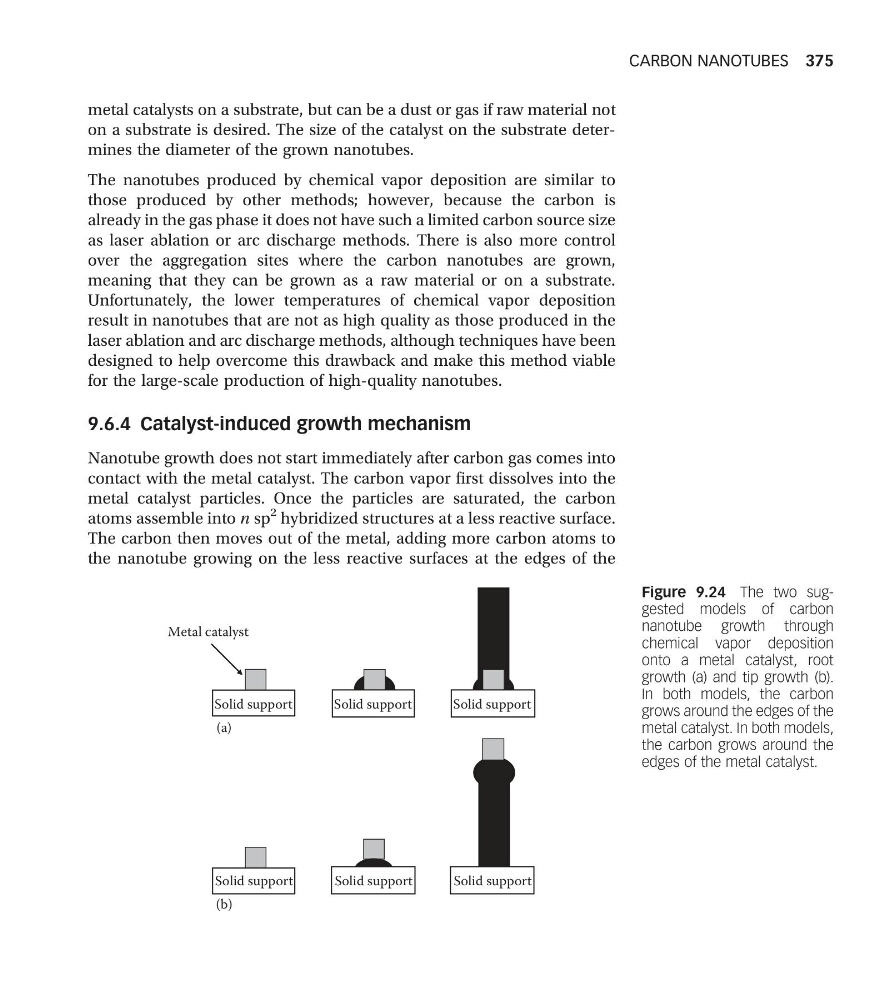
Nanotube growth does not start immediately after carbon gas comes into
contact with the metal catalyst. The carbon vapor first dissolves into the
metal catalyst particles. Once the particles are saturated, the carbon
atoms assemble into n sp
2 hybridized structures at a less reactive surface.
The carbon then moves out of the metal, adding more carbon atoms to
the nanotube growing on the less reactive surfaces at the edges of the
Metal catalyst
Solid support
Solid support
Solid support
(a)
Solid support
Solid support
Solid support
(b)
Figure 9.24 The two suggested models of carbon
nanotube growth through
chemical vapor deposition
onto a metal catalyst, root
growth (a) and tip growth (b).
In both models, the carbon
grows around the edges of the
metal catalyst. In both models,
the carbon grows around the
edges of the metal catalyst.
CARBON NANOTUBES 375
on a substrate is desired. The size of the catalyst on the substrate determines the diameter of the grown nanotubes.
The nanotubes produced by chemical vapor deposition are similar to
those produced by other methods; however, because the carbon is
already in the gas phase it does not have such a limited carbon source size
as laser ablation or arc discharge methods. There is also more control
over the aggregation sites where the carbon nanotubes are grown,
meaning that they can be grown as a raw material or on a substrate.
Unfortunately, the lower temperatures of chemical vapor deposition
result in nanotubes that are not as high quality as those produced in the
laser ablation and arc discharge methods, although techniques have been
designed to help overcome this drawback and make this method viable
for the large-scale production of high-quality nanotubes.
9.6.4 Catalyst-induced growth mechanism
Nanotube growth does not start immediately after carbon gas comes into
contact with the metal catalyst. The carbon vapor first dissolves into the
metal catalyst particles. Once the particles are saturated, the carbon
atoms assemble into n sp
2 hybridized structures at a less reactive surface.
The carbon then moves out of the metal, adding more carbon atoms to
the nanotube growing on the less reactive surfaces at the edges of the
Metal catalyst
Solid support
Solid support
Solid support
(a)
Solid support
Solid support
Solid support
(b)
Figure 9.24 The two suggested models of carbon
nanotube growth through
chemical vapor deposition
onto a metal catalyst, root
growth (a) and tip growth (b).
In both models, the carbon
grows around the edges of the
metal catalyst. In both models,
the carbon grows around the
edges of the metal catalyst.
CARBON NANOTUBES 375