

machine is nitrogenase, a protein found in certain soil bacteria such as
azotobacter vinelandii, which uses energy from hydrolyzing ATP to break
the strong triple bond in N 2 , transports electrons produced from other
reactions to the active sites on the proteins, and then reduces the N 2 to
ammonia (NH 3 ). The protein complex consists of two types of proteins,
each composed of multiple chains and with multiple iron–sulfur clusters,
for a total of nearly 50,000 atoms and with the longest dimension in excess
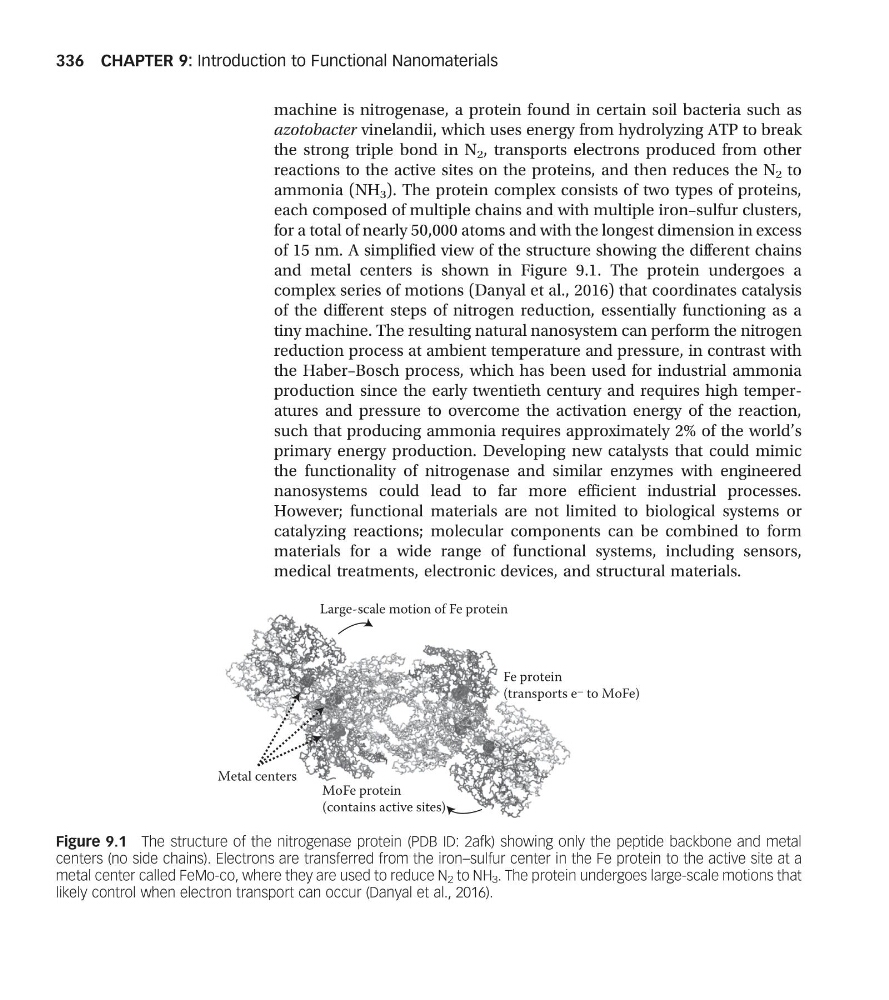
of 15 nm. A simplified view of the structure showing the different chains
and metal centers is shown in Figure 9.1. The protein undergoes a
complex series of motions (Danyal et al., 2016) that coordinates catalysis
of the different steps of nitrogen reduction, essentially functioning as a
tiny machine. The resulting natural nanosystem can perform the nitrogen
reduction process at ambient temperature and pressure, in contrast with
the Haber–Bosch process, which has been used for industrial ammonia
production since the early twentieth century and requires high temperatures and pressure to overcome the activation energy of the reaction,
such that producing ammonia requires approximately 2% of the world’s
primary energy production. Developing new catalysts that could mimic
the functionality of nitrogenase and similar enzymes with engineered
nanosystems could lead to far more efficient industrial processes.
However; functional materials are not limited to biological systems or
catalyzing reactions; molecular components can be combined to form
materials for a wide range of functional systems, including sensors,
medical treatments, electronic devices, and structural materials.
Metal centers
MoFe protein
(contains active sites)
Fe protein
(transports e – to MoFe)
Large-scale motion of Fe protein
Figure 9.1 The structure of the nitrogenase protein (PDB ID: 2afk) showing only the peptide backbone and metal
centers (no side chains). Electrons are transferred from the iron–sulfur center in the Fe protein to the active site at a
metal center called FeMo-co, where they are used to reduce N 2 to NH 3 . The protein undergoes large-scale motions that
likely control when electron transport can occur (Danyal et al., 2016).
CHAPTER 9: Introduction to Functional Nanomaterials
336
azotobacter vinelandii, which uses energy from hydrolyzing ATP to break
the strong triple bond in N 2 , transports electrons produced from other
reactions to the active sites on the proteins, and then reduces the N 2 to
ammonia (NH 3 ). The protein complex consists of two types of proteins,
each composed of multiple chains and with multiple iron–sulfur clusters,
for a total of nearly 50,000 atoms and with the longest dimension in excess
of 15 nm. A simplified view of the structure showing the different chains
and metal centers is shown in Figure 9.1. The protein undergoes a
complex series of motions (Danyal et al., 2016) that coordinates catalysis
of the different steps of nitrogen reduction, essentially functioning as a
tiny machine. The resulting natural nanosystem can perform the nitrogen
reduction process at ambient temperature and pressure, in contrast with
the Haber–Bosch process, which has been used for industrial ammonia
production since the early twentieth century and requires high temperatures and pressure to overcome the activation energy of the reaction,
such that producing ammonia requires approximately 2% of the world’s
primary energy production. Developing new catalysts that could mimic
the functionality of nitrogenase and similar enzymes with engineered
nanosystems could lead to far more efficient industrial processes.
However; functional materials are not limited to biological systems or
catalyzing reactions; molecular components can be combined to form
materials for a wide range of functional systems, including sensors,
medical treatments, electronic devices, and structural materials.
Metal centers
MoFe protein
(contains active sites)
Fe protein
(transports e – to MoFe)
Large-scale motion of Fe protein
Figure 9.1 The structure of the nitrogenase protein (PDB ID: 2afk) showing only the peptide backbone and metal
centers (no side chains). Electrons are transferred from the iron–sulfur center in the Fe protein to the active site at a
metal center called FeMo-co, where they are used to reduce N 2 to NH 3 . The protein undergoes large-scale motions that
likely control when electron transport can occur (Danyal et al., 2016).
CHAPTER 9: Introduction to Functional Nanomaterials
336