

facilitate understanding of how nonlinear optical effects can be used to
probe the properties of molecules in nanoassemblies.
Linear optical effects such as reflection, refraction, absorption, and interference are observed from all light sources regardless of intensity. Linear
optical effects are based on a linear relationship between an oscillating
electric field and an induced dipole moment in a molecule. Thus, when
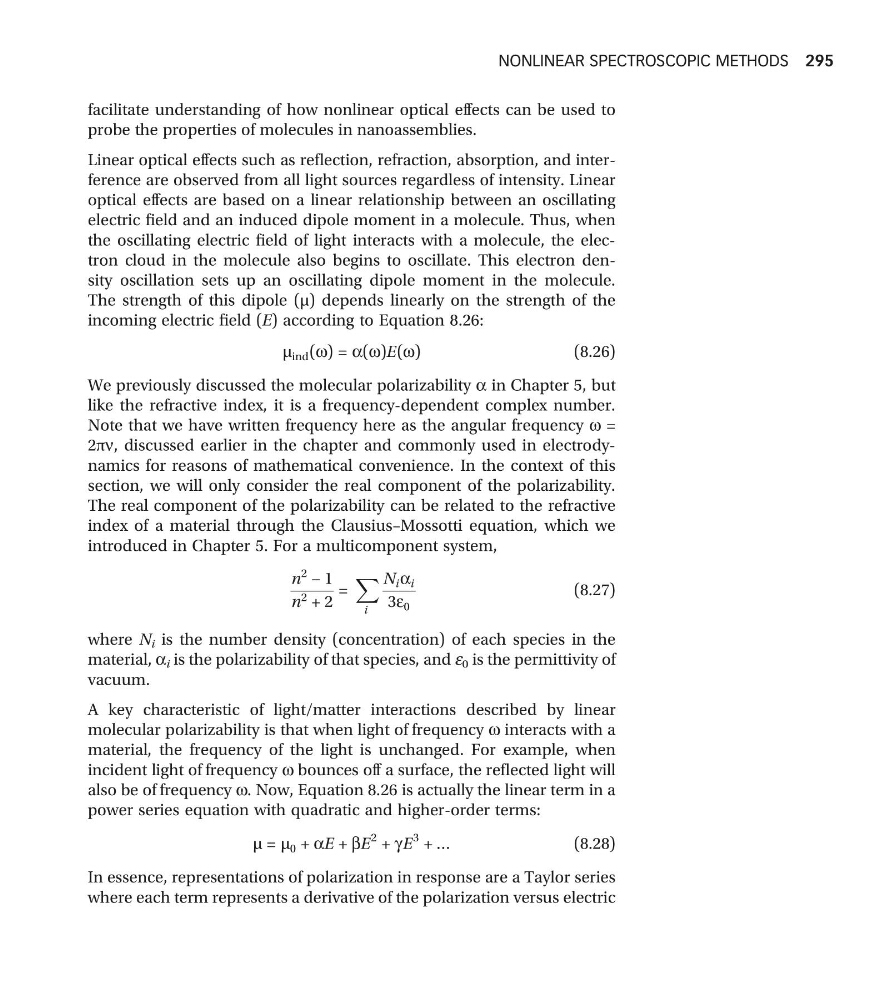
the oscillating electric field of light interacts with a molecule, the electron cloud in the molecule also begins to oscillate. This electron density oscillation sets up an oscillating dipole moment in the molecule.
The strength of this dipole (µ) depends linearly on the strength of the
incoming electric field (E) according to Equation 8.26:
μ ind (w) = a(w)E(w)
(8.26)
We previously discussed the molecular polarizability a in Chapter 5, but
like the refractive index, it is a frequency-dependent complex number.
Note that we have written frequency here as the angular frequency w =
2πn, discussed earlier in the chapter and commonly used in electrodynamics for reasons of mathematical convenience. In the context of this
section, we will only consider the real component of the polarizability.
The real component of the polarizability can be related to the refractive
index of a material through the Clausius–Mossotti equation, which we
introduced in Chapter 5. For a multicomponent system,
n
2
− 1
n
2 + 2
=
X
i
N i a i
3e 0
(8.27)
where N i is the number density (concentration) of each species in the
material, a i is the polarizability of that species, and e 0 is the permittivity of
vacuum.
A key characteristic of light/matter interactions described by linear
molecular polarizability is that when light of frequency w interacts with a
material, the frequency of the light is unchanged. For example, when
incident light of frequency w bounces off a surface, the reflected light will
also be of frequency w. Now, Equation 8.26 is actually the linear term in a
power series equation with quadratic and higher-order terms:
μ = μ 0 + aE + bE
2 + gE
3 + …
(8.28)
In essence, representations of polarization in response are a Taylor series
where each term represents a derivative of the polarization versus electric
NONLINEAR SPECTROSCOPIC METHODS 295
probe the properties of molecules in nanoassemblies.
Linear optical effects such as reflection, refraction, absorption, and interference are observed from all light sources regardless of intensity. Linear
optical effects are based on a linear relationship between an oscillating
electric field and an induced dipole moment in a molecule. Thus, when
the oscillating electric field of light interacts with a molecule, the electron cloud in the molecule also begins to oscillate. This electron density oscillation sets up an oscillating dipole moment in the molecule.
The strength of this dipole (µ) depends linearly on the strength of the
incoming electric field (E) according to Equation 8.26:
μ ind (w) = a(w)E(w)
(8.26)
We previously discussed the molecular polarizability a in Chapter 5, but
like the refractive index, it is a frequency-dependent complex number.
Note that we have written frequency here as the angular frequency w =
2πn, discussed earlier in the chapter and commonly used in electrodynamics for reasons of mathematical convenience. In the context of this
section, we will only consider the real component of the polarizability.
The real component of the polarizability can be related to the refractive
index of a material through the Clausius–Mossotti equation, which we
introduced in Chapter 5. For a multicomponent system,
n
2
− 1
n
2 + 2
=
X
i
N i a i
3e 0
(8.27)
where N i is the number density (concentration) of each species in the
material, a i is the polarizability of that species, and e 0 is the permittivity of
vacuum.
A key characteristic of light/matter interactions described by linear
molecular polarizability is that when light of frequency w interacts with a
material, the frequency of the light is unchanged. For example, when
incident light of frequency w bounces off a surface, the reflected light will
also be of frequency w. Now, Equation 8.26 is actually the linear term in a
power series equation with quadratic and higher-order terms:
μ = μ 0 + aE + bE
2 + gE
3 + …
(8.28)
In essence, representations of polarization in response are a Taylor series
where each term represents a derivative of the polarization versus electric
NONLINEAR SPECTROSCOPIC METHODS 295