

ATR-FTIR makes use of evanescent waves in a manner that is similar to
DPI, as both are able to measure the intensity of the waves that are
formed from total internal reflection within the surface-sensor medium.
One significant difference is that ATR-FTIR monitors the absorption of IR
light of an adsorbate rather than changes in its thickness and refractive
index like DPI. A system of mirrors is set up so that IR light is shone on
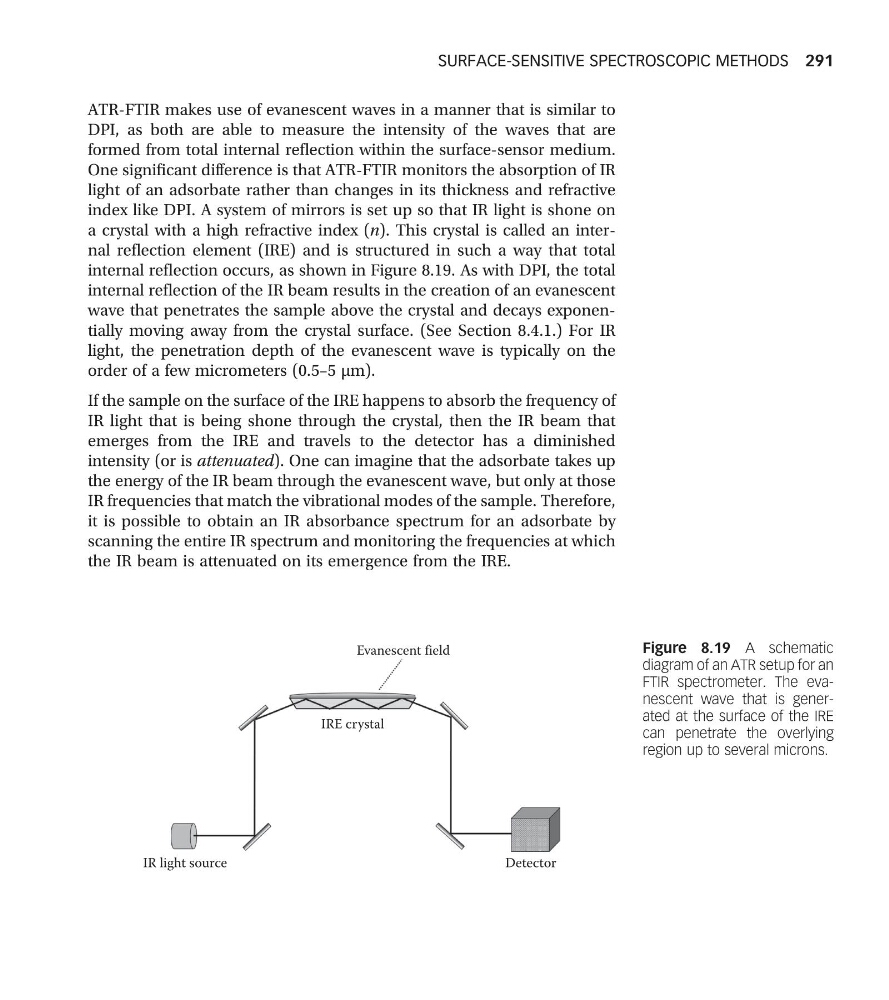
a crystal with a high refractive index (n). This crystal is called an internal reflection element (IRE) and is structured in such a way that total
internal reflection occurs, as shown in Figure 8.19. As with DPI, the total
internal reflection of the IR beam results in the creation of an evanescent
wave that penetrates the sample above the crystal and decays exponentially moving away from the crystal surface. (See Section 8.4.1.) For IR
light, the penetration depth of the evanescent wave is typically on the
order of a few micrometers (0.5–5 µm).
If the sample on the surface of the IRE happens to absorb the frequency of
IR light that is being shone through the crystal, then the IR beam that
emerges from the IRE and travels to the detector has a diminished
intensity (or is attenuated). One can imagine that the adsorbate takes up
the energy of the IR beam through the evanescent wave, but only at those
IR frequencies that match the vibrational modes of the sample. Therefore,
it is possible to obtain an IR absorbance spectrum for an adsorbate by
scanning the entire IR spectrum and monitoring the frequencies at which
the IR beam is attenuated on its emergence from the IRE.
IRE crystal
Evanescent field
Detector
IR light source
Figure 8.19 A schematic
diagram of an ATR setup for an
FTIR spectrometer. The evanescent wave that is generated at the surface of the IRE
can penetrate the overlying
region up to several microns.
SURFACE-SENSITIVE SPECTROSCOPIC METHODS 291
DPI, as both are able to measure the intensity of the waves that are
formed from total internal reflection within the surface-sensor medium.
One significant difference is that ATR-FTIR monitors the absorption of IR
light of an adsorbate rather than changes in its thickness and refractive
index like DPI. A system of mirrors is set up so that IR light is shone on
a crystal with a high refractive index (n). This crystal is called an internal reflection element (IRE) and is structured in such a way that total
internal reflection occurs, as shown in Figure 8.19. As with DPI, the total
internal reflection of the IR beam results in the creation of an evanescent
wave that penetrates the sample above the crystal and decays exponentially moving away from the crystal surface. (See Section 8.4.1.) For IR
light, the penetration depth of the evanescent wave is typically on the
order of a few micrometers (0.5–5 µm).
If the sample on the surface of the IRE happens to absorb the frequency of
IR light that is being shone through the crystal, then the IR beam that
emerges from the IRE and travels to the detector has a diminished
intensity (or is attenuated). One can imagine that the adsorbate takes up
the energy of the IR beam through the evanescent wave, but only at those
IR frequencies that match the vibrational modes of the sample. Therefore,
it is possible to obtain an IR absorbance spectrum for an adsorbate by
scanning the entire IR spectrum and monitoring the frequencies at which
the IR beam is attenuated on its emergence from the IRE.
IRE crystal
Evanescent field
Detector
IR light source
Figure 8.19 A schematic
diagram of an ATR setup for an
FTIR spectrometer. The evanescent wave that is generated at the surface of the IRE
can penetrate the overlying
region up to several microns.
SURFACE-SENSITIVE SPECTROSCOPIC METHODS 291