

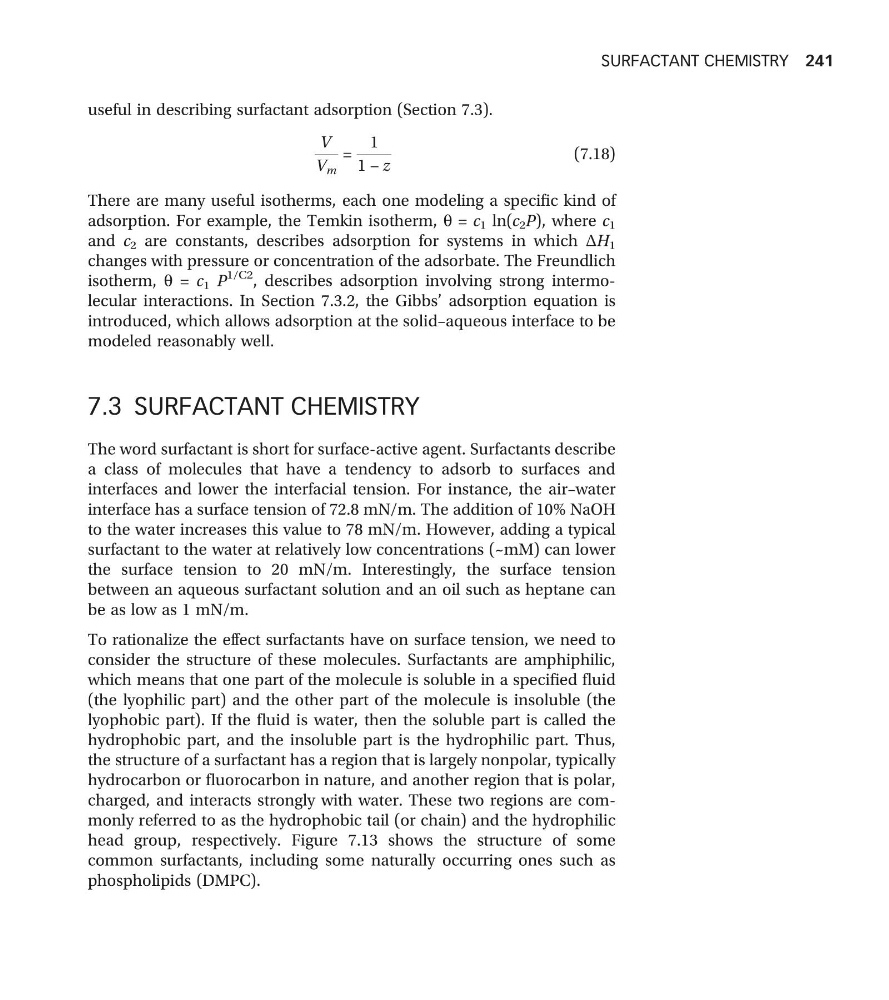
useful in describing surfactant adsorption (Section 7.3).
V
V m
=
1
1 − z
(7.18)
There are many useful isotherms, each one modeling a specific kind of
adsorption. For example, the Temkin isotherm, q = c 1 ln(c 2 P), where c 1
and c 2 are constants, describes adsorption for systems in which ΔH 1
changes with pressure or concentration of the adsorbate. The Freundlich
isotherm, q = c 1 P
1/C2 , describes adsorption involving strong intermolecular interactions. In Section 7.3.2, the Gibbs’ adsorption equation is
introduced, which allows adsorption at the solid–aqueous interface to be
modeled reasonably well.
7.3 SURFACTANT CHEMISTRY
The word surfactant is short for surface-active agent. Surfactants describe
a class of molecules that have a tendency to adsorb to surfaces and
interfaces and lower the interfacial tension. For instance, the air–water
interface has a surface tension of 72.8 mN/m. The addition of 10% NaOH
to the water increases this value to 78 mN/m. However, adding a typical
surfactant to the water at relatively low concentrations (~mM) can lower
the surface tension to 20 mN/m. Interestingly, the surface tension
between an aqueous surfactant solution and an oil such as heptane can
be as low as 1 mN/m.
To rationalize the effect surfactants have on surface tension, we need to
consider the structure of these molecules. Surfactants are amphiphilic,
which means that one part of the molecule is soluble in a specified fluid
(the lyophilic part) and the other part of the molecule is insoluble (the
lyophobic part). If the fluid is water, then the soluble part is called the
hydrophobic part, and the insoluble part is the hydrophilic part. Thus,
the structure of a surfactant has a region that is largely nonpolar, typically
hydrocarbon or fluorocarbon in nature, and another region that is polar,
charged, and interacts strongly with water. These two regions are commonly referred to as the hydrophobic tail (or chain) and the hydrophilic
head group, respectively. Figure 7.13 shows the structure of some
common surfactants, including some naturally occurring ones such as
phospholipids (DMPC).
SURFACTANT CHEMISTRY 241
V
V m
=
1
1 − z
(7.18)
There are many useful isotherms, each one modeling a specific kind of
adsorption. For example, the Temkin isotherm, q = c 1 ln(c 2 P), where c 1
and c 2 are constants, describes adsorption for systems in which ΔH 1
changes with pressure or concentration of the adsorbate. The Freundlich
isotherm, q = c 1 P
1/C2 , describes adsorption involving strong intermolecular interactions. In Section 7.3.2, the Gibbs’ adsorption equation is
introduced, which allows adsorption at the solid–aqueous interface to be
modeled reasonably well.
7.3 SURFACTANT CHEMISTRY
The word surfactant is short for surface-active agent. Surfactants describe
a class of molecules that have a tendency to adsorb to surfaces and
interfaces and lower the interfacial tension. For instance, the air–water
interface has a surface tension of 72.8 mN/m. The addition of 10% NaOH
to the water increases this value to 78 mN/m. However, adding a typical
surfactant to the water at relatively low concentrations (~mM) can lower
the surface tension to 20 mN/m. Interestingly, the surface tension
between an aqueous surfactant solution and an oil such as heptane can
be as low as 1 mN/m.
To rationalize the effect surfactants have on surface tension, we need to
consider the structure of these molecules. Surfactants are amphiphilic,
which means that one part of the molecule is soluble in a specified fluid
(the lyophilic part) and the other part of the molecule is insoluble (the
lyophobic part). If the fluid is water, then the soluble part is called the
hydrophobic part, and the insoluble part is the hydrophilic part. Thus,
the structure of a surfactant has a region that is largely nonpolar, typically
hydrocarbon or fluorocarbon in nature, and another region that is polar,
charged, and interacts strongly with water. These two regions are commonly referred to as the hydrophobic tail (or chain) and the hydrophilic
head group, respectively. Figure 7.13 shows the structure of some
common surfactants, including some naturally occurring ones such as
phospholipids (DMPC).
SURFACTANT CHEMISTRY 241