

or
k a
k d
=
AS
½
A
½ S
½
= K
(7.7)
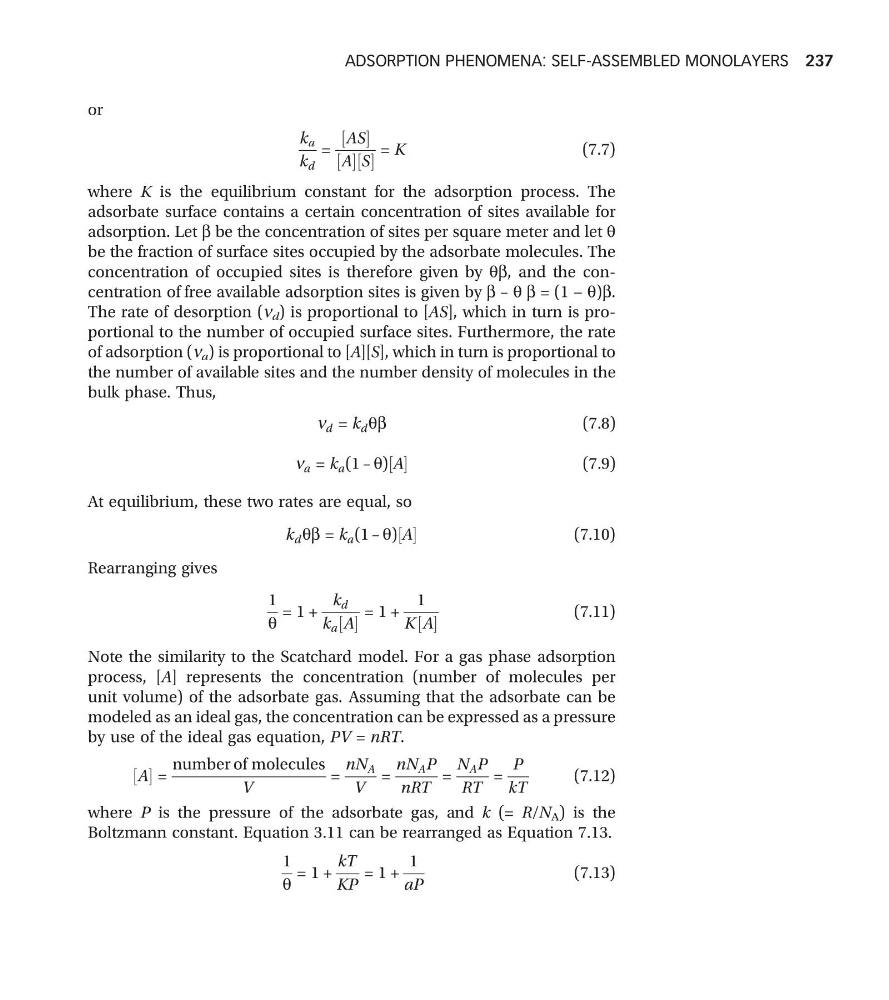
where K is the equilibrium constant for the adsorption process. The
adsorbate surface contains a certain concentration of sites available for
adsorption. Let b be the concentration of sites per square meter and let q
be the fraction of surface sites occupied by the adsorbate molecules. The
concentration of occupied sites is therefore given by qb, and the concentration of free available adsorption sites is given by b – q b = (1 − q)b.
The rate of desorption (n d ) is proportional to [AS], which in turn is proportional to the number of occupied surface sites. Furthermore, the rate
of adsorption (n a ) is proportional to [A][S], which in turn is proportional to
the number of available sites and the number density of molecules in the
bulk phase. Thus,
n d = k d qb
(7.8)
n a = k a (1 – q)½A
(7.9)
At equilibrium, these two rates are equal, so
k d qb = k a (1 – q)½A
(7.10)
Rearranging gives
1
q
= 1 +
k d
k a A
½
= 1 +
1
K A
½
(7.11)
Note the similarity to the Scatchard model. For a gas phase adsorption
process, [A] represents the concentration (number of molecules per
unit volume) of the adsorbate gas. Assuming that the adsorbate can be
modeled as an ideal gas, the concentration can be expressed as a pressure
by use of the ideal gas equation, PV = nRT.
A
½ =
number of molecules
V
=
nN A
V
=
nN A P
nRT
=
N A P
RT
=
P
kT
(7.12)
where P is the pressure of the adsorbate gas, and k (= R/N A ) is the
Boltzmann constant. Equation 3.11 can be rearranged as Equation 7.13.
1
q
= 1 +
kT
KP
= 1 +
1
aP
(7.13)
ADSORPTION PHENOMENA: SELF-ASSEMBLED MONOLAYERS 237
k a
k d
=
AS
½
A
½ S
½
= K
(7.7)
where K is the equilibrium constant for the adsorption process. The
adsorbate surface contains a certain concentration of sites available for
adsorption. Let b be the concentration of sites per square meter and let q
be the fraction of surface sites occupied by the adsorbate molecules. The
concentration of occupied sites is therefore given by qb, and the concentration of free available adsorption sites is given by b – q b = (1 − q)b.
The rate of desorption (n d ) is proportional to [AS], which in turn is proportional to the number of occupied surface sites. Furthermore, the rate
of adsorption (n a ) is proportional to [A][S], which in turn is proportional to
the number of available sites and the number density of molecules in the
bulk phase. Thus,
n d = k d qb
(7.8)
n a = k a (1 – q)½A
(7.9)
At equilibrium, these two rates are equal, so
k d qb = k a (1 – q)½A
(7.10)
Rearranging gives
1
q
= 1 +
k d
k a A
½
= 1 +
1
K A
½
(7.11)
Note the similarity to the Scatchard model. For a gas phase adsorption
process, [A] represents the concentration (number of molecules per
unit volume) of the adsorbate gas. Assuming that the adsorbate can be
modeled as an ideal gas, the concentration can be expressed as a pressure
by use of the ideal gas equation, PV = nRT.
A
½ =
number of molecules
V
=
nN A
V
=
nN A P
nRT
=
N A P
RT
=
P
kT
(7.12)
where P is the pressure of the adsorbate gas, and k (= R/N A ) is the
Boltzmann constant. Equation 3.11 can be rearranged as Equation 7.13.
1
q
= 1 +
kT
KP
= 1 +
1
aP
(7.13)
ADSORPTION PHENOMENA: SELF-ASSEMBLED MONOLAYERS 237