

Rearranging gives
γ =
F
2L
:
Since force is measured in N, the units of γ are N m
–1
.
The larger the surface tension, the greater the resistance to increase the
surface area, which in turn fundamentally depends on the interplay
between various intermolecular interactions occurring on the surface.
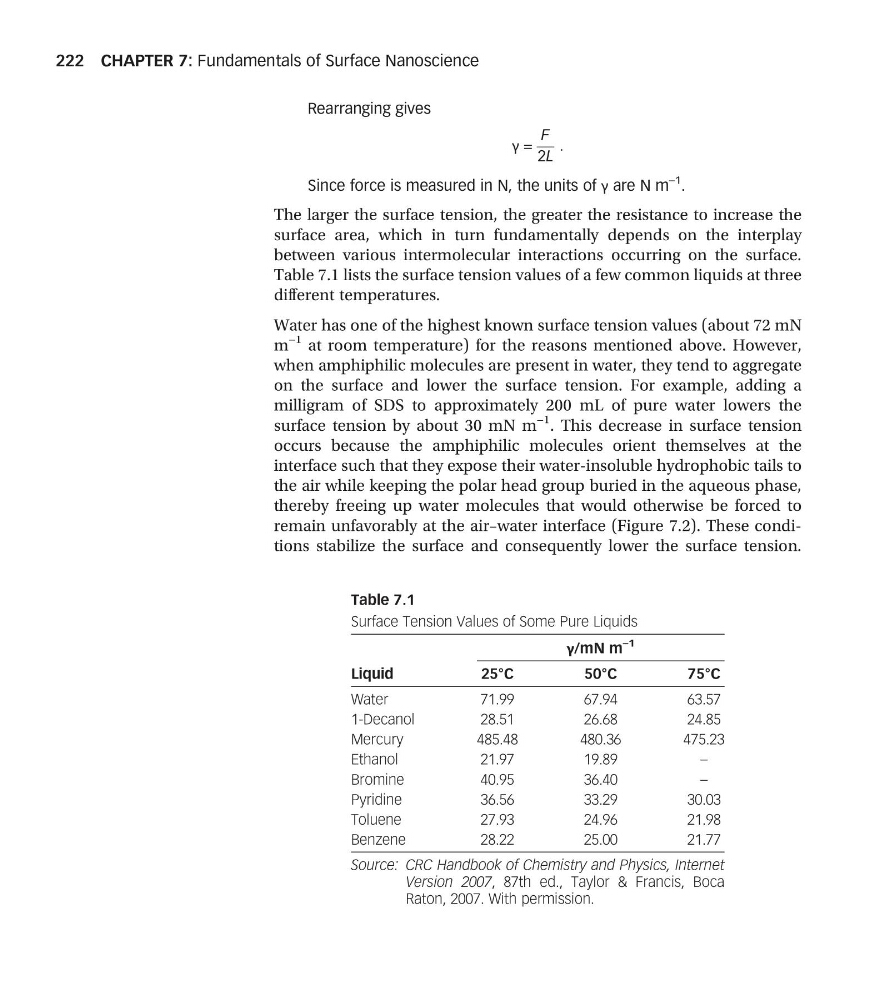
Table 7.1 lists the surface tension values of a few common liquids at three
different temperatures.
Water has one of the highest known surface tension values (about 72 mN
m
−1 at room temperature) for the reasons mentioned above. However,
when amphiphilic molecules are present in water, they tend to aggregate
on the surface and lower the surface tension. For example, adding a
milligram of SDS to approximately 200 mL of pure water lowers the
surface tension by about 30 mN m
−1 . This decrease in surface tension
occurs because the amphiphilic molecules orient themselves at the
interface such that they expose their water-insoluble hydrophobic tails to
the air while keeping the polar head group buried in the aqueous phase,
thereby freeing up water molecules that would otherwise be forced to
remain unfavorably at the air–water interface (Figure 7.2). These conditions stabilize the surface and consequently lower the surface tension.
Table 7.1
Surface Tension Values of Some Pure Liquids
Liquid
γ/mN m
–1
25°C
50°C
75°C
Water
71.99
67.94
63.57
1-Decanol
28.51
26.68
24.85
Mercury
485.48
480.36
475.23
Ethanol
21.97
19.89
–
Bromine
40.95
36.40
–
Pyridine
36.56
33.29
30.03
Toluene
27.93
24.96
21.98
Benzene
28.22
25.00
21.77
Source: CRC Handbook of Chemistry and Physics, Internet
Version 2007, 87th ed., Taylor & Francis, Boca
Raton, 2007. With permission.
CHAPTER 7: Fundamentals of Surface Nanoscience
222
γ =
F
2L
:
Since force is measured in N, the units of γ are N m
–1
.
The larger the surface tension, the greater the resistance to increase the
surface area, which in turn fundamentally depends on the interplay
between various intermolecular interactions occurring on the surface.
Table 7.1 lists the surface tension values of a few common liquids at three
different temperatures.
Water has one of the highest known surface tension values (about 72 mN
m
−1 at room temperature) for the reasons mentioned above. However,
when amphiphilic molecules are present in water, they tend to aggregate
on the surface and lower the surface tension. For example, adding a
milligram of SDS to approximately 200 mL of pure water lowers the
surface tension by about 30 mN m
−1 . This decrease in surface tension
occurs because the amphiphilic molecules orient themselves at the
interface such that they expose their water-insoluble hydrophobic tails to
the air while keeping the polar head group buried in the aqueous phase,
thereby freeing up water molecules that would otherwise be forced to
remain unfavorably at the air–water interface (Figure 7.2). These conditions stabilize the surface and consequently lower the surface tension.
Table 7.1
Surface Tension Values of Some Pure Liquids
Liquid
γ/mN m
–1
25°C
50°C
75°C
Water
71.99
67.94
63.57
1-Decanol
28.51
26.68
24.85
Mercury
485.48
480.36
475.23
Ethanol
21.97
19.89
–
Bromine
40.95
36.40
–
Pyridine
36.56
33.29
30.03
Toluene
27.93
24.96
21.98
Benzene
28.22
25.00
21.77
Source: CRC Handbook of Chemistry and Physics, Internet
Version 2007, 87th ed., Taylor & Francis, Boca
Raton, 2007. With permission.
CHAPTER 7: Fundamentals of Surface Nanoscience
222