

surface, but rather to be surrounded completely by other water molecules
and interact with them through energetically favorable intermolecular
hydrogen bonding.
A more rigorous way to define surface tension is to say that it is the free
energy required to transport a molecule from the bulk phase to the
surface and hence expand the area of the surface (dA). This surface free
energy (dG surf ) is given by
dG surf = gdA
(7.1)
where the proportionality constant g is the surface tension. The units of
surface tension are energy per unit area, J m
–2 (or since energy can be
thought of as applied force multiplied by the distance moved, the units
are also newtons per meter, N m
–1
). Astute readers may have observed
that these dimensions are the same as the Hooke’s law force constant.
Hydrophilic
moiety
Hydrophobic
moiety
SO 4
– Na
+
(CH 2 ) 11
CH 3
Air
Aqueous phase
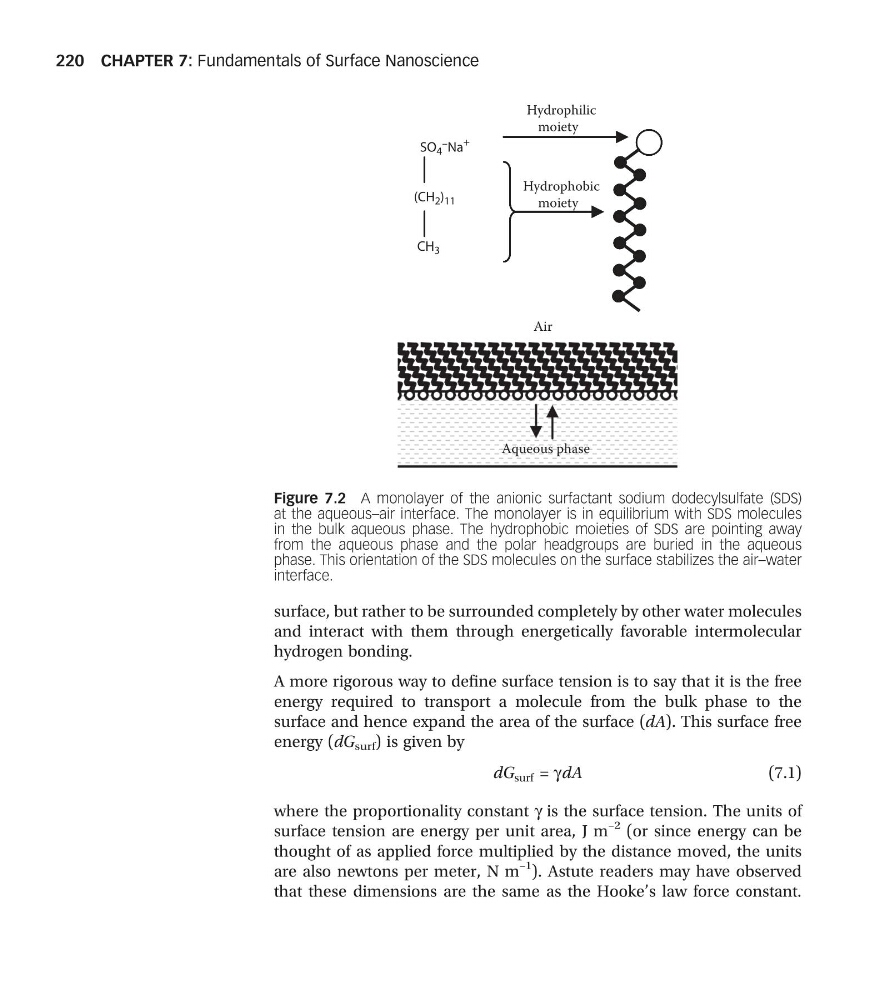
Figure 7.2 A monolayer of the anionic surfactant sodium dodecylsulfate (SDS)
at the aqueous–air interface. The monolayer is in equilibrium with SDS molecules
in the bulk aqueous phase. The hydrophobic moieties of SDS are pointing away
from the aqueous phase and the polar headgroups are buried in the aqueous
phase. This orientation of the SDS molecules on the surface stabilizes the air–water
interface.
CHAPTER 7: Fundamentals of Surface Nanoscience
220
and interact with them through energetically favorable intermolecular
hydrogen bonding.
A more rigorous way to define surface tension is to say that it is the free
energy required to transport a molecule from the bulk phase to the
surface and hence expand the area of the surface (dA). This surface free
energy (dG surf ) is given by
dG surf = gdA
(7.1)
where the proportionality constant g is the surface tension. The units of
surface tension are energy per unit area, J m
–2 (or since energy can be
thought of as applied force multiplied by the distance moved, the units
are also newtons per meter, N m
–1
). Astute readers may have observed
that these dimensions are the same as the Hooke’s law force constant.
Hydrophilic
moiety
Hydrophobic
moiety
SO 4
– Na
+
(CH 2 ) 11
CH 3
Air
Aqueous phase
Figure 7.2 A monolayer of the anionic surfactant sodium dodecylsulfate (SDS)
at the aqueous–air interface. The monolayer is in equilibrium with SDS molecules
in the bulk aqueous phase. The hydrophobic moieties of SDS are pointing away
from the aqueous phase and the polar headgroups are buried in the aqueous
phase. This orientation of the SDS molecules on the surface stabilizes the air–water
interface.
CHAPTER 7: Fundamentals of Surface Nanoscience
220