

7.1 FUNDAMENTALS OF SURFACE SCIENCE
7.1.1 Surface energy of solids and liquids
As discussed in Chapter 5, molecules of the same type tend to experience
a net attractive interaction. In liquids, this cohesive force keeps molecules
close to each other, and each molecule is symmetrically surrounded by
others such that averaged over the bulk, the constituent molecules have
no preferred orientation or direction of motion and the system as a whole
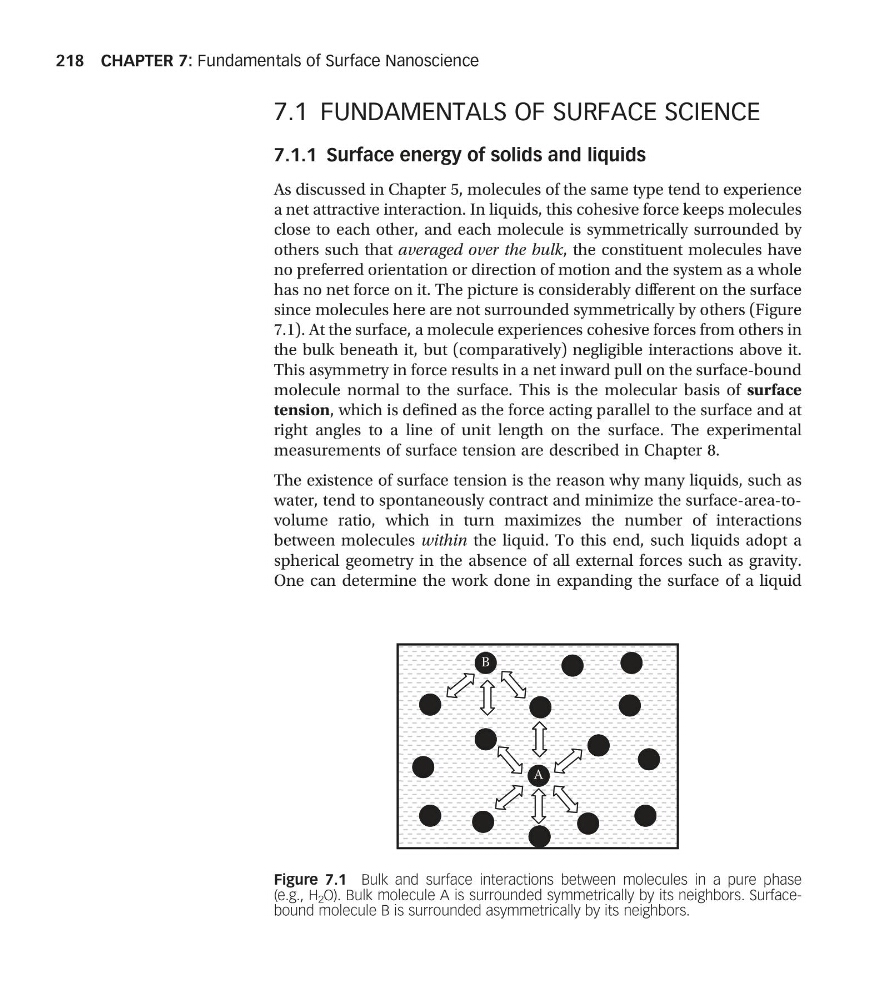
has no net force on it. The picture is considerably different on the surface
since molecules here are not surrounded symmetrically by others (Figure
7.1). At the surface, a molecule experiences cohesive forces from others in
the bulk beneath it, but (comparatively) negligible interactions above it.
This asymmetry in force results in a net inward pull on the surface-bound
molecule normal to the surface. This is the molecular basis of surface
tension, which is defined as the force acting parallel to the surface and at
right angles to a line of unit length on the surface. The experimental
measurements of surface tension are described in Chapter 8.
The existence of surface tension is the reason why many liquids, such as
water, tend to spontaneously contract and minimize the surface-area-tovolume ratio, which in turn maximizes the number of interactions
between molecules within the liquid. To this end, such liquids adopt a
spherical geometry in the absence of all external forces such as gravity.
One can determine the work done in expanding the surface of a liquid
B
A
Figure 7.1 Bulk and surface interactions between molecules in a pure phase
(e.g., H 2 O). Bulk molecule A is surrounded symmetrically by its neighbors. Surfacebound molecule B is surrounded asymmetrically by its neighbors.
CHAPTER 7: Fundamentals of Surface Nanoscience
218
7.1.1 Surface energy of solids and liquids
As discussed in Chapter 5, molecules of the same type tend to experience
a net attractive interaction. In liquids, this cohesive force keeps molecules
close to each other, and each molecule is symmetrically surrounded by
others such that averaged over the bulk, the constituent molecules have
no preferred orientation or direction of motion and the system as a whole
has no net force on it. The picture is considerably different on the surface
since molecules here are not surrounded symmetrically by others (Figure
7.1). At the surface, a molecule experiences cohesive forces from others in
the bulk beneath it, but (comparatively) negligible interactions above it.
This asymmetry in force results in a net inward pull on the surface-bound
molecule normal to the surface. This is the molecular basis of surface
tension, which is defined as the force acting parallel to the surface and at
right angles to a line of unit length on the surface. The experimental
measurements of surface tension are described in Chapter 8.
The existence of surface tension is the reason why many liquids, such as
water, tend to spontaneously contract and minimize the surface-area-tovolume ratio, which in turn maximizes the number of interactions
between molecules within the liquid. To this end, such liquids adopt a
spherical geometry in the absence of all external forces such as gravity.
One can determine the work done in expanding the surface of a liquid
B
A
Figure 7.1 Bulk and surface interactions between molecules in a pure phase
(e.g., H 2 O). Bulk molecule A is surrounded symmetrically by its neighbors. Surfacebound molecule B is surrounded asymmetrically by its neighbors.
CHAPTER 7: Fundamentals of Surface Nanoscience
218