

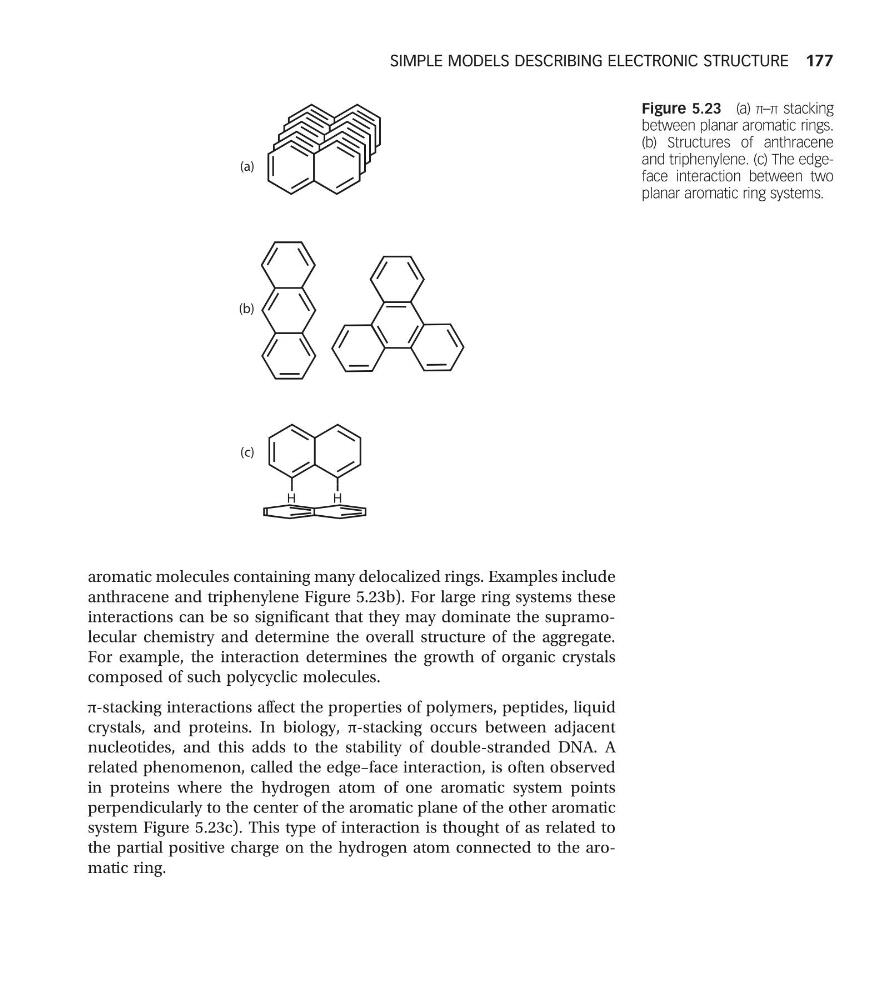
aromatic molecules containing many delocalized rings. Examples include
anthracene and triphenylene Figure 5.23b). For large ring systems these
interactions can be so significant that they may dominate the supramolecular chemistry and determine the overall structure of the aggregate.
For example, the interaction determines the growth of organic crystals
composed of such polycyclic molecules.
π-stacking interactions affect the properties of polymers, peptides, liquid
crystals, and proteins. In biology, π-stacking occurs between adjacent
nucleotides, and this adds to the stability of double-stranded DNA. A
related phenomenon, called the edge–face interaction, is often observed
in proteins where the hydrogen atom of one aromatic system points
perpendicularly to the center of the aromatic plane of the other aromatic
system Figure 5.23c). This type of interaction is thought of as related to
the partial positive charge on the hydrogen atom connected to the aromatic ring.
(a)
(b)
(c)
H
H
Figure 5.23 (a) π–π stacking
between planar aromatic rings.
(b) Structures of anthracene
and triphenylene. (c) The edgeface interaction between two
planar aromatic ring systems.
SIMPLE MODELS DESCRIBING ELECTRONIC STRUCTURE 177
anthracene and triphenylene Figure 5.23b). For large ring systems these
interactions can be so significant that they may dominate the supramolecular chemistry and determine the overall structure of the aggregate.
For example, the interaction determines the growth of organic crystals
composed of such polycyclic molecules.
π-stacking interactions affect the properties of polymers, peptides, liquid
crystals, and proteins. In biology, π-stacking occurs between adjacent
nucleotides, and this adds to the stability of double-stranded DNA. A
related phenomenon, called the edge–face interaction, is often observed
in proteins where the hydrogen atom of one aromatic system points
perpendicularly to the center of the aromatic plane of the other aromatic
system Figure 5.23c). This type of interaction is thought of as related to
the partial positive charge on the hydrogen atom connected to the aromatic ring.
(a)
(b)
(c)
H
H
Figure 5.23 (a) π–π stacking
between planar aromatic rings.
(b) Structures of anthracene
and triphenylene. (c) The edgeface interaction between two
planar aromatic ring systems.
SIMPLE MODELS DESCRIBING ELECTRONIC STRUCTURE 177