

wavelength (or color) of light absorbed or emitted due to transitions
between such levels. For example, electron configurations of atoms and
molecules provide an excellent explanation of such observations.
However, as we discussed in Chapter 4, in many cases an electron (or
electrons) is free to move within a certain region of space, such as a
nanoscale aggregate or other nanomaterial (nanoparticles, nanowires,
etc.). Metals and conjugated molecules are other examples where electrons are not restricted to the individual nuclei, but rather are delocalized
over a larger region of space.
The particle-in-a-box model can be used to model delocalized electrons
in conjugated systems. Recall that in the simplest, one-dimensional, case,
the particle is confined between infinite potential barriers at x = 0 and x =
a, with zero potential energy between the barriers. These values of energy
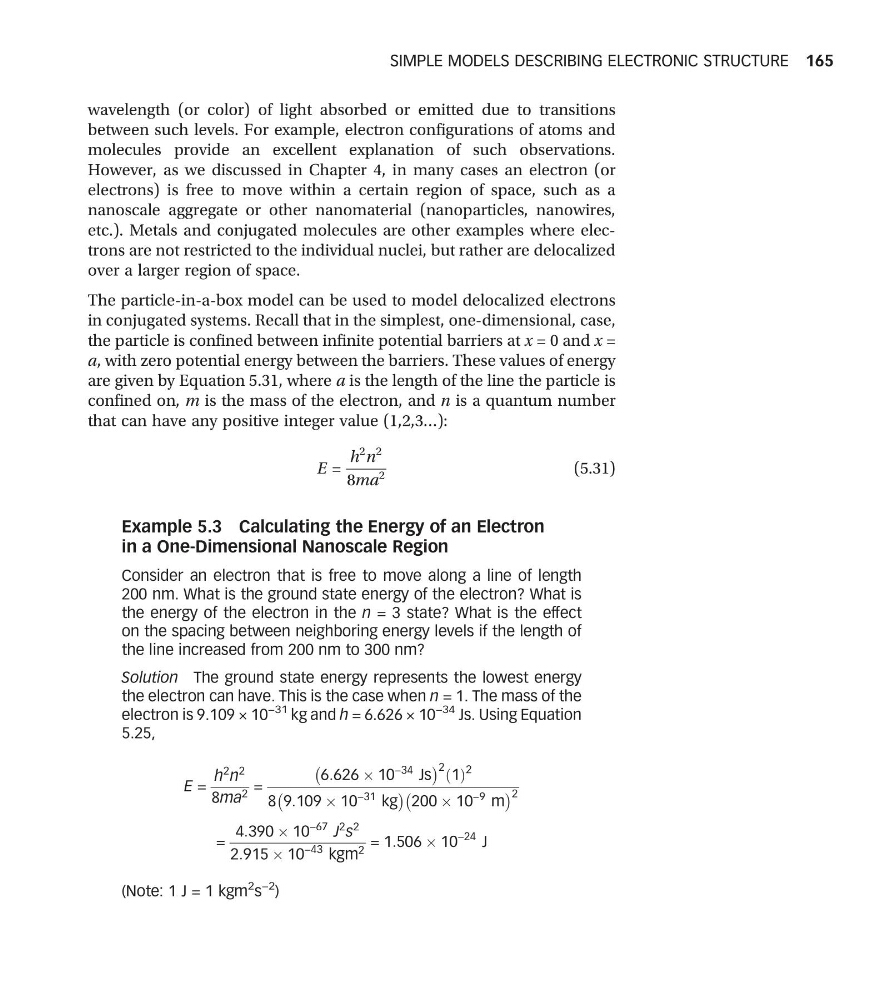
are given by Equation 5.31, where a is the length of the line the particle is
confined on, m is the mass of the electron, and n is a quantum number
that can have any positive integer value (1,2,3…):
E =
h
2 n
2
8ma
2
(5.31)
Example 5.3 Calculating the Energy of an Electron
in a One-Dimensional Nanoscale Region
Consider an electron that is free to move along a line of length
200 nm. What is the ground state energy of the electron? What is
the energy of the electron in the n = 3 state? What is the effect
on the spacing between neighboring energy levels if the length of
the line increased from 200 nm to 300 nm?
Solution The ground state energy represents the lowest energy
the electron can have. This is the case when n = 1. The mass of the
electron is 9.109 × 10
−31 kg and h = 6.626 × 10
−34 Js. Using Equation
5.25,
E =
h
2 n
2
8ma 2 =
6:626 Â 10
−34
Js
À
Á 2 1
ð Þ
2
8 9:109 Â 10
−31
kg
À
Á
200 Â 10
−9
m
À
Á 2
=
4:390 Â 10
−67
J
2 s
2
2:915 Â 10
−43
kgm
2
= 1:506 Â 10
−24
J
(Note: 1 J = 1 kgm
2
s
−2
)
SIMPLE MODELS DESCRIBING ELECTRONIC STRUCTURE 165
between such levels. For example, electron configurations of atoms and
molecules provide an excellent explanation of such observations.
However, as we discussed in Chapter 4, in many cases an electron (or
electrons) is free to move within a certain region of space, such as a
nanoscale aggregate or other nanomaterial (nanoparticles, nanowires,
etc.). Metals and conjugated molecules are other examples where electrons are not restricted to the individual nuclei, but rather are delocalized
over a larger region of space.
The particle-in-a-box model can be used to model delocalized electrons
in conjugated systems. Recall that in the simplest, one-dimensional, case,
the particle is confined between infinite potential barriers at x = 0 and x =
a, with zero potential energy between the barriers. These values of energy
are given by Equation 5.31, where a is the length of the line the particle is
confined on, m is the mass of the electron, and n is a quantum number
that can have any positive integer value (1,2,3…):
E =
h
2 n
2
8ma
2
(5.31)
Example 5.3 Calculating the Energy of an Electron
in a One-Dimensional Nanoscale Region
Consider an electron that is free to move along a line of length
200 nm. What is the ground state energy of the electron? What is
the energy of the electron in the n = 3 state? What is the effect
on the spacing between neighboring energy levels if the length of
the line increased from 200 nm to 300 nm?
Solution The ground state energy represents the lowest energy
the electron can have. This is the case when n = 1. The mass of the
electron is 9.109 × 10
−31 kg and h = 6.626 × 10
−34 Js. Using Equation
5.25,
E =
h
2 n
2
8ma 2 =
6:626 Â 10
−34
Js
À
Á 2 1
ð Þ
2
8 9:109 Â 10
−31
kg
À
Á
200 Â 10
−9
m
À
Á 2
=
4:390 Â 10
−67
J
2 s
2
2:915 Â 10
−43
kgm
2
= 1:506 Â 10
−24
J
(Note: 1 J = 1 kgm
2
s
−2
)
SIMPLE MODELS DESCRIBING ELECTRONIC STRUCTURE 165