

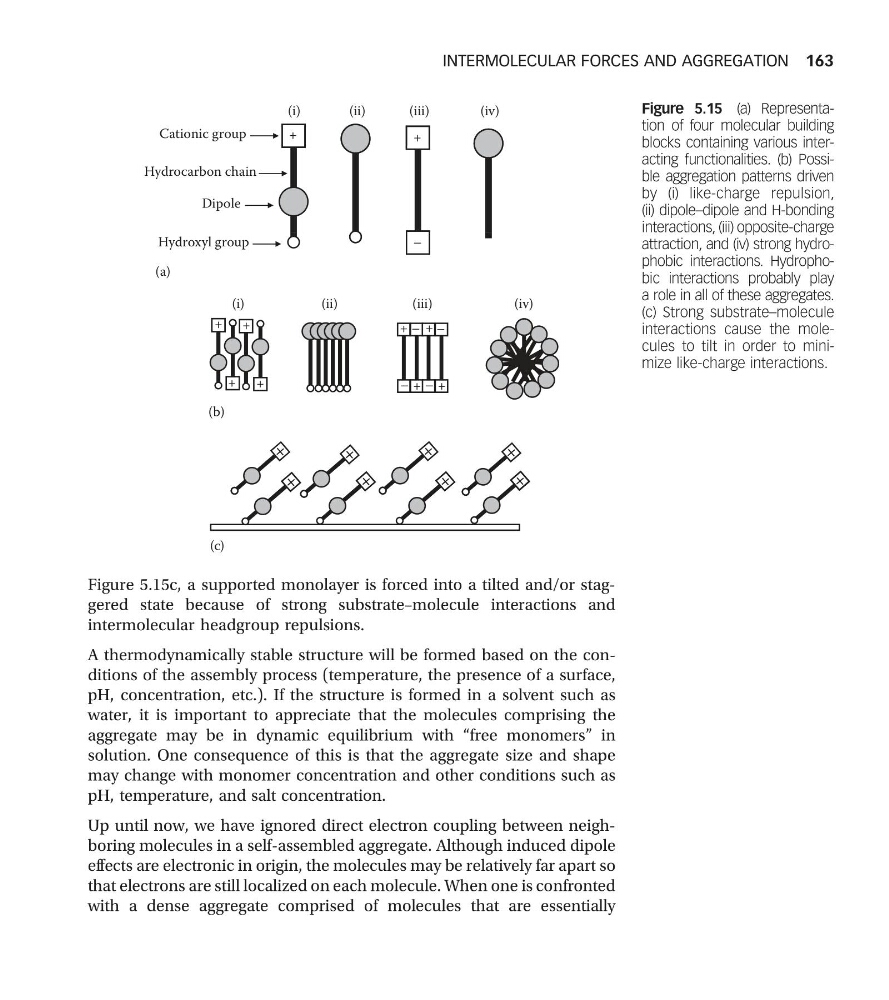
Figure 5.15c, a supported monolayer is forced into a tilted and/or staggered state because of strong substrate–molecule interactions and
intermolecular headgroup repulsions.
A thermodynamically stable structure will be formed based on the conditions of the assembly process (temperature, the presence of a surface,
pH, concentration, etc.). If the structure is formed in a solvent such as
water, it is important to appreciate that the molecules comprising the
aggregate may be in dynamic equilibrium with “free monomers” in
solution. One consequence of this is that the aggregate size and shape
may change with monomer concentration and other conditions such as
pH, temperature, and salt concentration.
Up until now, we have ignored direct electron coupling between neighboring molecules in a self-assembled aggregate. Although induced dipole
effects are electronic in origin, the molecules may be relatively far apart so
that electrons are still localized on each molecule. When one is confronted
with a dense aggregate comprised of molecules that are essentially
+
Cationic group
+
(iv)
Hydrocarbon chain
Dipole
Hydroxyl group
–
(a)
+
+
+
+
–
+
–
+
–
+
–
+
(b)
(c)
(i)
(ii)
(iii)
(iv)
(i)
(ii)
(iii)
Figure 5.15 (a) Representation of four molecular building
blocks containing various interacting functionalities. (b) Possible aggregation patterns driven
by (i) like-charge repulsion,
(ii) dipole–dipole and H-bonding
interactions, (iii) opposite-charge
attraction, and (iv) strong hydrophobic interactions. Hydrophobic interactions probably play
a role in all of these aggregates.
(c) Strong substrate–molecule
interactions cause the molecules to tilt in order to minimize like-charge interactions.
INTERMOLECULAR FORCES AND AGGREGATION 163
intermolecular headgroup repulsions.
A thermodynamically stable structure will be formed based on the conditions of the assembly process (temperature, the presence of a surface,
pH, concentration, etc.). If the structure is formed in a solvent such as
water, it is important to appreciate that the molecules comprising the
aggregate may be in dynamic equilibrium with “free monomers” in
solution. One consequence of this is that the aggregate size and shape
may change with monomer concentration and other conditions such as
pH, temperature, and salt concentration.
Up until now, we have ignored direct electron coupling between neighboring molecules in a self-assembled aggregate. Although induced dipole
effects are electronic in origin, the molecules may be relatively far apart so
that electrons are still localized on each molecule. When one is confronted
with a dense aggregate comprised of molecules that are essentially
+
Cationic group
+
(iv)
Hydrocarbon chain
Dipole
Hydroxyl group
–
(a)
+
+
+
+
–
+
–
+
–
+
–
+
(b)
(c)
(i)
(ii)
(iii)
(iv)
(i)
(ii)
(iii)
Figure 5.15 (a) Representation of four molecular building
blocks containing various interacting functionalities. (b) Possible aggregation patterns driven
by (i) like-charge repulsion,
(ii) dipole–dipole and H-bonding
interactions, (iii) opposite-charge
attraction, and (iv) strong hydrophobic interactions. Hydrophobic interactions probably play
a role in all of these aggregates.
(c) Strong substrate–molecule
interactions cause the molecules to tilt in order to minimize like-charge interactions.
INTERMOLECULAR FORCES AND AGGREGATION 163