

which describes the tendency of nonpolar molecules to form aggregates
of like molecules in water.
Experience shows us that at the macroscopic level oil and water do not
mix, but rather form separate layers. We also know that water forms
beads, or distinct droplets, on oil-like surfaces such as the surface of a leaf.
Often when organic molecules containing large nonpolar hydrocarbon
moieties are placed in water they spontaneously self-organize themselves
into larger aggregates because this arrangement minimizes overall
contact between the hydrocarbon part of the molecule and the water
molecules of the solvent. The origin of this phase separation is primarily
to maximize the water–water intermolecular interactions because the
dipole–dipole interactions are stronger than the interactions between
nonpolar molecules. In other words, the enthalpic force is in the water,
not the nonpolar phase, meaning that this type of phase separation is
enthalpically driven.
In order to complete our understanding of the hydrophobic effect, we
need to say something about the contributions of entropy to intermolecular interactions. As discussed in Chapter 2, entropy is a thermodynamic state function related to the number of energy levels among which
the energy of a system is spread. A collection of water molecules confined
and “ordered” within a small region of space will have smaller entropy
H
O
H
r hydrogen bond
O
H
H
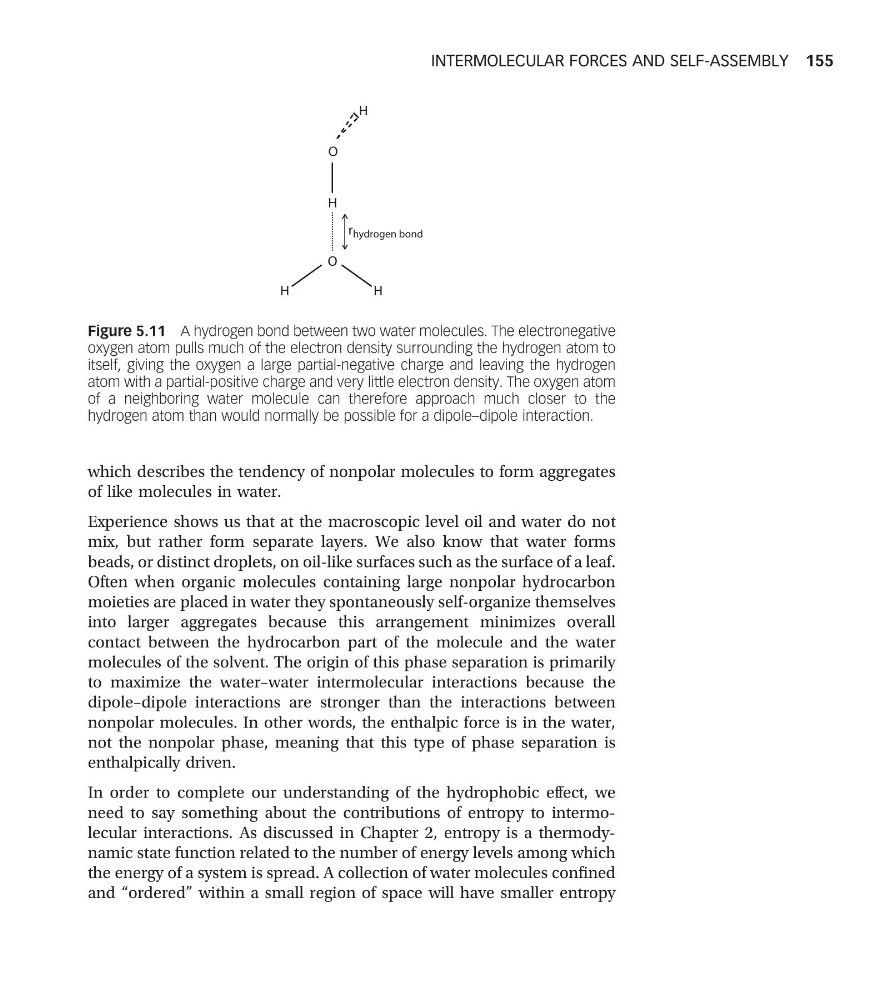
Figure 5.11 A hydrogen bond between two water molecules. The electronegative
oxygen atom pulls much of the electron density surrounding the hydrogen atom to
itself, giving the oxygen a large partial-negative charge and leaving the hydrogen
atom with a partial-positive charge and very little electron density. The oxygen atom
of a neighboring water molecule can therefore approach much closer to the
hydrogen atom than would normally be possible for a dipole–dipole interaction.
INTERMOLECULAR FORCES AND SELF-ASSEMBLY 155
of like molecules in water.
Experience shows us that at the macroscopic level oil and water do not
mix, but rather form separate layers. We also know that water forms
beads, or distinct droplets, on oil-like surfaces such as the surface of a leaf.
Often when organic molecules containing large nonpolar hydrocarbon
moieties are placed in water they spontaneously self-organize themselves
into larger aggregates because this arrangement minimizes overall
contact between the hydrocarbon part of the molecule and the water
molecules of the solvent. The origin of this phase separation is primarily
to maximize the water–water intermolecular interactions because the
dipole–dipole interactions are stronger than the interactions between
nonpolar molecules. In other words, the enthalpic force is in the water,
not the nonpolar phase, meaning that this type of phase separation is
enthalpically driven.
In order to complete our understanding of the hydrophobic effect, we
need to say something about the contributions of entropy to intermolecular interactions. As discussed in Chapter 2, entropy is a thermodynamic state function related to the number of energy levels among which
the energy of a system is spread. A collection of water molecules confined
and “ordered” within a small region of space will have smaller entropy
H
O
H
r hydrogen bond
O
H
H
Figure 5.11 A hydrogen bond between two water molecules. The electronegative
oxygen atom pulls much of the electron density surrounding the hydrogen atom to
itself, giving the oxygen a large partial-negative charge and leaving the hydrogen
atom with a partial-positive charge and very little electron density. The oxygen atom
of a neighboring water molecule can therefore approach much closer to the
hydrogen atom than would normally be possible for a dipole–dipole interaction.
INTERMOLECULAR FORCES AND SELF-ASSEMBLY 155