

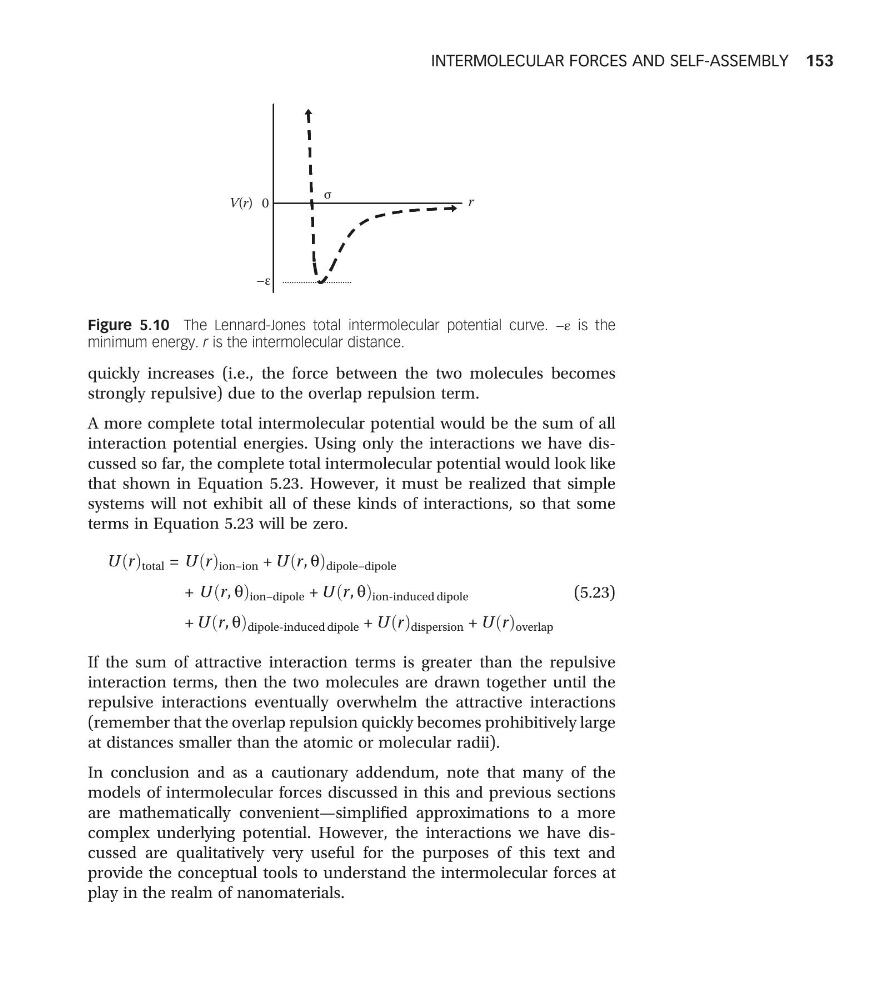
quickly increases (i.e., the force between the two molecules becomes
strongly repulsive) due to the overlap repulsion term.
A more complete total intermolecular potential would be the sum of all
interaction potential energies. Using only the interactions we have discussed so far, the complete total intermolecular potential would look like
that shown in Equation 5.23. However, it must be realized that simple
systems will not exhibit all of these kinds of interactions, so that some
terms in Equation 5.23 will be zero.
U r
ð Þ total = U r
ð Þ ion−ion + U r, q
ð Þ dipole−dipole
+ U r, q
ð Þ ion−dipole + U r, q
ð Þ ion‐induced dipole
+ U r, q
ð Þ dipole‐induced dipole + U r
ð Þ dispersion + U r
ð Þ overlap
(5.23)
If the sum of attractive interaction terms is greater than the repulsive
interaction terms, then the two molecules are drawn together until the
repulsive interactions eventually overwhelm the attractive interactions
(remember that the overlap repulsion quickly becomes prohibitively large
at distances smaller than the atomic or molecular radii).
In conclusion and as a cautionary addendum, note that many of the
models of intermolecular forces discussed in this and previous sections
are mathematically convenient—simplified approximations to a more
complex underlying potential. However, the interactions we have discussed are qualitatively very useful for the purposes of this text and
provide the conceptual tools to understand the intermolecular forces at
play in the realm of nanomaterials.
V(r)
σ
r
0
–ε
Figure 5.10 The Lennard-Jones total intermolecular potential curve. −ε is the
minimum energy. r is the intermolecular distance.
INTERMOLECULAR FORCES AND SELF-ASSEMBLY 153
strongly repulsive) due to the overlap repulsion term.
A more complete total intermolecular potential would be the sum of all
interaction potential energies. Using only the interactions we have discussed so far, the complete total intermolecular potential would look like
that shown in Equation 5.23. However, it must be realized that simple
systems will not exhibit all of these kinds of interactions, so that some
terms in Equation 5.23 will be zero.
U r
ð Þ total = U r
ð Þ ion−ion + U r, q
ð Þ dipole−dipole
+ U r, q
ð Þ ion−dipole + U r, q
ð Þ ion‐induced dipole
+ U r, q
ð Þ dipole‐induced dipole + U r
ð Þ dispersion + U r
ð Þ overlap
(5.23)
If the sum of attractive interaction terms is greater than the repulsive
interaction terms, then the two molecules are drawn together until the
repulsive interactions eventually overwhelm the attractive interactions
(remember that the overlap repulsion quickly becomes prohibitively large
at distances smaller than the atomic or molecular radii).
In conclusion and as a cautionary addendum, note that many of the
models of intermolecular forces discussed in this and previous sections
are mathematically convenient—simplified approximations to a more
complex underlying potential. However, the interactions we have discussed are qualitatively very useful for the purposes of this text and
provide the conceptual tools to understand the intermolecular forces at
play in the realm of nanomaterials.
V(r)
σ
r
0
–ε
Figure 5.10 The Lennard-Jones total intermolecular potential curve. −ε is the
minimum energy. r is the intermolecular distance.
INTERMOLECULAR FORCES AND SELF-ASSEMBLY 153