

4.2 BASIC INTRODUCTION TO QUANTUM
MECHANICS
4.2.1 Electromagnetic radiation
From general physics you learned that electromagnetic radiation (light)
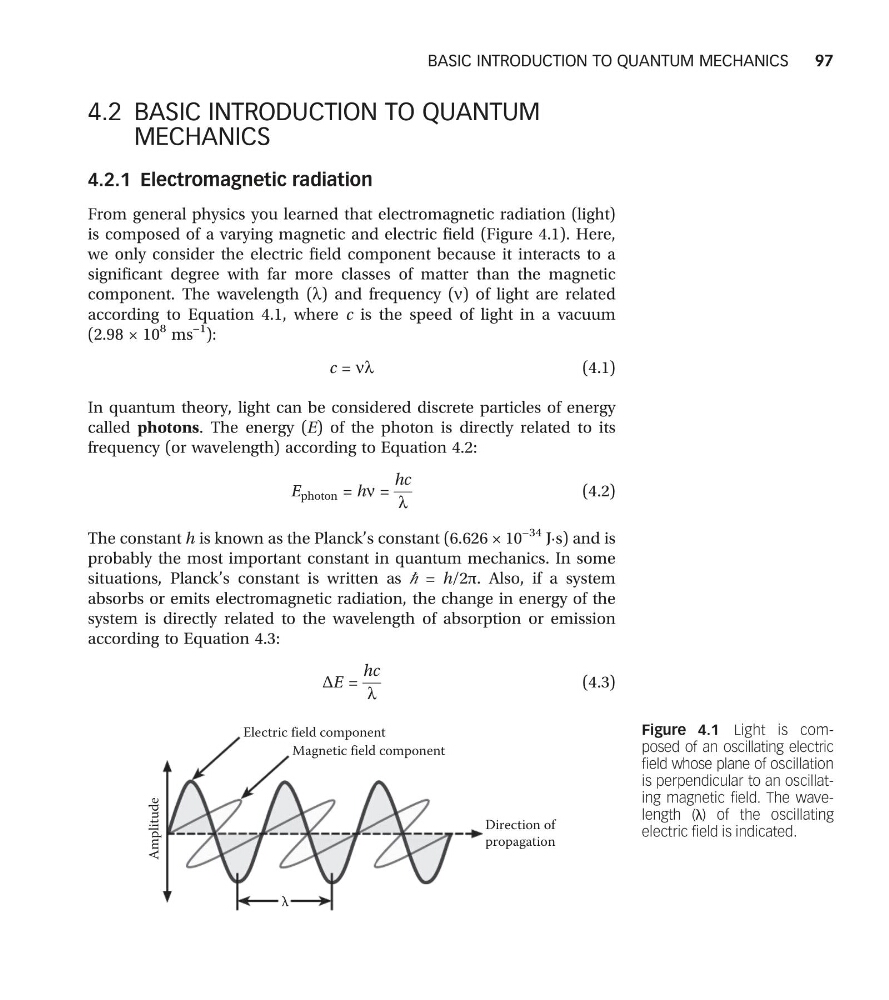
is composed of a varying magnetic and electric field (Figure 4.1). Here,
we only consider the electric field component because it interacts to a
significant degree with far more classes of matter than the magnetic
component. The wavelength (l) and frequency (n) of light are related
according to Equation 4.1, where c is the speed of light in a vacuum
(2.98 × 10
8 ms
−1 ):
c = nl
(4.1)
In quantum theory, light can be considered discrete particles of energy
called photons. The energy (E) of the photon is directly related to its
frequency (or wavelength) according to Equation 4.2:
E photon = hn =
hc
l
(4.2)
The constant h is known as the Planck’s constant (6.626 × 10
−34 J·s) and is
probably the most important constant in quantum mechanics. In some
situations, Planck’s constant is written as ℏ = h/2π. Also, if a system
absorbs or emits electromagnetic radiation, the change in energy of the
system is directly related to the wavelength of absorption or emission
according to Equation 4.3:
ΔE =
hc
l
(4.3)
Electric field component
Magnetic field component
Direction of
propagation
Amplitude
λ
Figure 4.1 Light is composed of an oscillating electric
field whose plane of oscillation
is perpendicular to an oscillating magnetic field. The wavelength (λ) of the oscillating
electric field is indicated.
BASIC INTRODUCTION TO QUANTUM MECHANICS
97
MECHANICS
4.2.1 Electromagnetic radiation
From general physics you learned that electromagnetic radiation (light)
is composed of a varying magnetic and electric field (Figure 4.1). Here,
we only consider the electric field component because it interacts to a
significant degree with far more classes of matter than the magnetic
component. The wavelength (l) and frequency (n) of light are related
according to Equation 4.1, where c is the speed of light in a vacuum
(2.98 × 10
8 ms
−1 ):
c = nl
(4.1)
In quantum theory, light can be considered discrete particles of energy
called photons. The energy (E) of the photon is directly related to its
frequency (or wavelength) according to Equation 4.2:
E photon = hn =
hc
l
(4.2)
The constant h is known as the Planck’s constant (6.626 × 10
−34 J·s) and is
probably the most important constant in quantum mechanics. In some
situations, Planck’s constant is written as ℏ = h/2π. Also, if a system
absorbs or emits electromagnetic radiation, the change in energy of the
system is directly related to the wavelength of absorption or emission
according to Equation 4.3:
ΔE =
hc
l
(4.3)
Electric field component
Magnetic field component
Direction of
propagation
Amplitude
λ
Figure 4.1 Light is composed of an oscillating electric
field whose plane of oscillation
is perpendicular to an oscillating magnetic field. The wavelength (λ) of the oscillating
electric field is indicated.
BASIC INTRODUCTION TO QUANTUM MECHANICS
97