

3 PAIRING COAL WITH SOLAR: THE UAE’S FRAGMENTED …
59
natural gas demand would flatten or even decline. 2 Ultimately, policymakers aim to end the UAE’s status as a net importer of natural gas by
2030. 3
This paper examines the political and strategic drivers for the UAE’s
shift toward coal, nuclear, and solar power. It finds that while coal
and solar appear competitive with gas on the basis of cost, and nuclear
and coal provide reliability of supply, the policy is also being driven
by higher priority strategic rationales around power projection, external
image enhancement, energy supply security, and ultimately the security
and stability of the regime.
Background on UAE Power Sector
Electricity policy in the UAE is of vital importance due to two extremes:
high average temperatures and high levels of demand. Per capita electricity consumption in the UAE is near world-leading levels, at 13,000
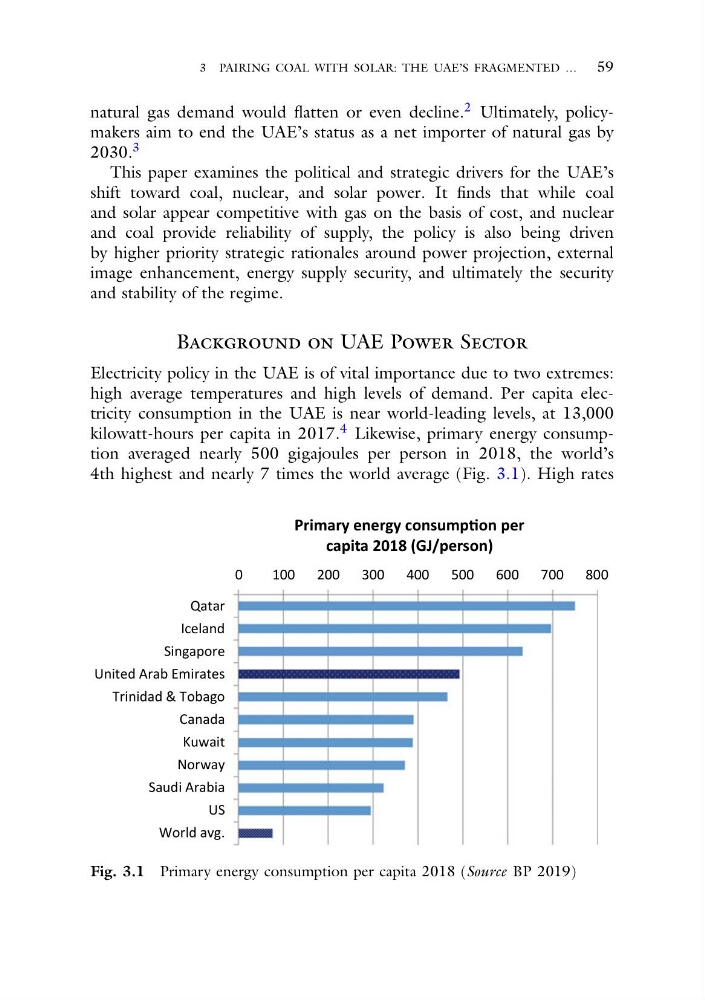
kilowatt-hours per capita in 2017. 4 Likewise, primary energy consumption averaged nearly 500 gigajoules per person in 2018, the world’s
4th highest and nearly 7 times the world average (Fig. 3.1). High rates
0
100 200 300 400 500 600 700 800
Qatar
Iceland
Singapore
United Arab Emirates
Trinidad & Tobago
Canada
Kuwait
Norway
Saudi Arabia
US
World avg.
Primary energy consumpƟon per
capita 2018 (GJ/person)
Fig. 3.1 Primary energy consumption per capita 2018 (Source BP 2019)
59
natural gas demand would flatten or even decline. 2 Ultimately, policymakers aim to end the UAE’s status as a net importer of natural gas by
2030. 3
This paper examines the political and strategic drivers for the UAE’s
shift toward coal, nuclear, and solar power. It finds that while coal
and solar appear competitive with gas on the basis of cost, and nuclear
and coal provide reliability of supply, the policy is also being driven
by higher priority strategic rationales around power projection, external
image enhancement, energy supply security, and ultimately the security
and stability of the regime.
Background on UAE Power Sector
Electricity policy in the UAE is of vital importance due to two extremes:
high average temperatures and high levels of demand. Per capita electricity consumption in the UAE is near world-leading levels, at 13,000
kilowatt-hours per capita in 2017. 4 Likewise, primary energy consumption averaged nearly 500 gigajoules per person in 2018, the world’s
4th highest and nearly 7 times the world average (Fig. 3.1). High rates
0
100 200 300 400 500 600 700 800
Qatar
Iceland
Singapore
United Arab Emirates
Trinidad & Tobago
Canada
Kuwait
Norway
Saudi Arabia
US
World avg.
Primary energy consumpƟon per
capita 2018 (GJ/person)
Fig. 3.1 Primary energy consumption per capita 2018 (Source BP 2019)