

238 P. MAHDAVI AND N. UDDIN
to 50% by 2050. Likewise, Iran, Kuwait, and Saudi Arabia have sought
renewables investments as a means to free up petroleum for export, lower
greenhouse gas emissions, and create new jobs and local businesses.
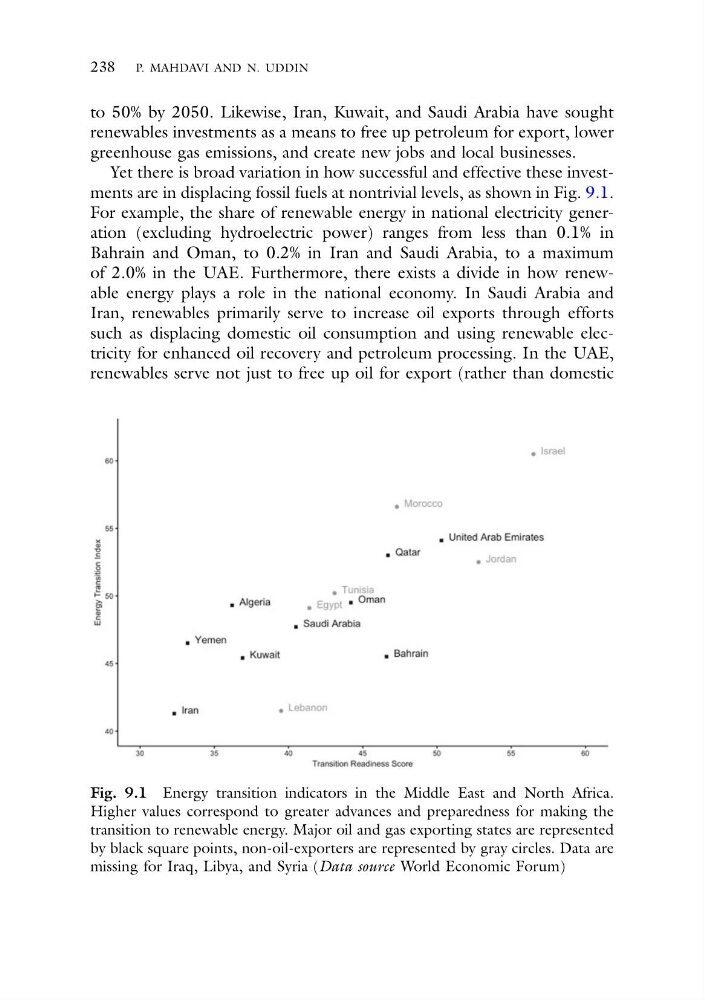
Yet there is broad variation in how successful and effective these investments are in displacing fossil fuels at nontrivial levels, as shown in Fig. 9.1.
For example, the share of renewable energy in national electricity generation (excluding hydroelectric power) ranges from less than 0.1% in
Bahrain and Oman, to 0.2% in Iran and Saudi Arabia, to a maximum
of 2.0% in the UAE. Furthermore, there exists a divide in how renewable energy plays a role in the national economy. In Saudi Arabia and
Iran, renewables primarily serve to increase oil exports through efforts
such as displacing domestic oil consumption and using renewable electricity for enhanced oil recovery and petroleum processing. In the UAE,
renewables serve not just to free up oil for export (rather than domestic
Fig. 9.1 Energy transition indicators in the Middle East and North Africa.
Higher values correspond to greater advances and preparedness for making the
transition to renewable energy. Major oil and gas exporting states are represented
by black square points, non-oil-exporters are represented by gray circles. Data are
missing for Iraq, Libya, and Syria (Data source World Economic Forum)
to 50% by 2050. Likewise, Iran, Kuwait, and Saudi Arabia have sought
renewables investments as a means to free up petroleum for export, lower
greenhouse gas emissions, and create new jobs and local businesses.
Yet there is broad variation in how successful and effective these investments are in displacing fossil fuels at nontrivial levels, as shown in Fig. 9.1.
For example, the share of renewable energy in national electricity generation (excluding hydroelectric power) ranges from less than 0.1% in
Bahrain and Oman, to 0.2% in Iran and Saudi Arabia, to a maximum
of 2.0% in the UAE. Furthermore, there exists a divide in how renewable energy plays a role in the national economy. In Saudi Arabia and
Iran, renewables primarily serve to increase oil exports through efforts
such as displacing domestic oil consumption and using renewable electricity for enhanced oil recovery and petroleum processing. In the UAE,
renewables serve not just to free up oil for export (rather than domestic
Fig. 9.1 Energy transition indicators in the Middle East and North Africa.
Higher values correspond to greater advances and preparedness for making the
transition to renewable energy. Major oil and gas exporting states are represented
by black square points, non-oil-exporters are represented by gray circles. Data are
missing for Iraq, Libya, and Syria (Data source World Economic Forum)