

1 LOW CARBON ENERGY IN THE MIDDLE EAST …
5
MENA and the Global Energy System
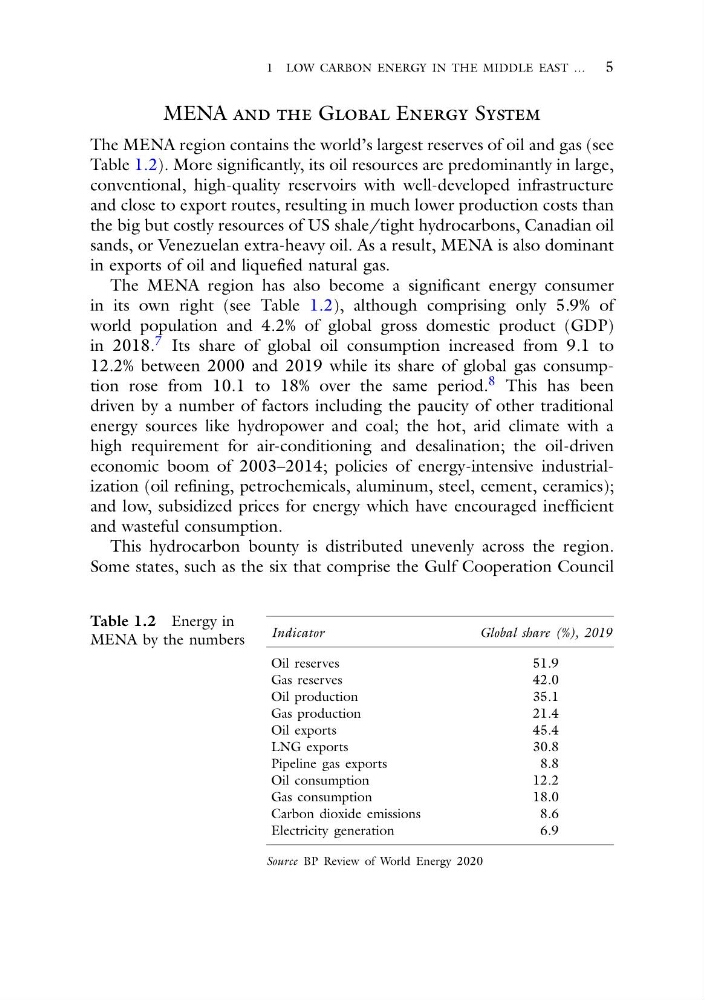
The MENA region contains the world’s largest reserves of oil and gas (see
Table 1.2). More significantly, its oil resources are predominantly in large,
conventional, high-quality reservoirs with well-developed infrastructure
and close to export routes, resulting in much lower production costs than
the big but costly resources of US shale/tight hydrocarbons, Canadian oil
sands, or Venezuelan extra-heavy oil. As a result, MENA is also dominant
in exports of oil and liquefied natural gas.
The MENA region has also become a significant energy consumer
in its own right (see Table 1.2), although comprising only 5.9% of
world population and 4.2% of global gross domestic product (GDP)
in 2018. 7 Its share of global oil consumption increased from 9.1 to
12.2% between 2000 and 2019 while its share of global gas consumption rose from 10.1 to 18% over the same period. 8 This has been
driven by a number of factors including the paucity of other traditional
energy sources like hydropower and coal; the hot, arid climate with a
high requirement for air-conditioning and desalination; the oil-driven
economic boom of 2003–2014; policies of energy-intensive industrialization (oil refining, petrochemicals, aluminum, steel, cement, ceramics);
and low, subsidized prices for energy which have encouraged inefficient
and wasteful consumption.
This hydrocarbon bounty is distributed unevenly across the region.
Some states, such as the six that comprise the Gulf Cooperation Council
Table 1.2 Energy in
MENA by the numbers
Indicator
Global share (%), 2019
Oil reserves
51.9
Gas reserves
42.0
Oil production
35.1
Gas production
21.4
Oil exports
45.4
LNG exports
30.8
Pipeline gas exports
8.8
Oil consumption
12.2
Gas consumption
18.0
Carbon dioxide emissions
8.6
Electricity generation
6.9
Source BP Review of World Energy 2020
5
MENA and the Global Energy System
The MENA region contains the world’s largest reserves of oil and gas (see
Table 1.2). More significantly, its oil resources are predominantly in large,
conventional, high-quality reservoirs with well-developed infrastructure
and close to export routes, resulting in much lower production costs than
the big but costly resources of US shale/tight hydrocarbons, Canadian oil
sands, or Venezuelan extra-heavy oil. As a result, MENA is also dominant
in exports of oil and liquefied natural gas.
The MENA region has also become a significant energy consumer
in its own right (see Table 1.2), although comprising only 5.9% of
world population and 4.2% of global gross domestic product (GDP)
in 2018. 7 Its share of global oil consumption increased from 9.1 to
12.2% between 2000 and 2019 while its share of global gas consumption rose from 10.1 to 18% over the same period. 8 This has been
driven by a number of factors including the paucity of other traditional
energy sources like hydropower and coal; the hot, arid climate with a
high requirement for air-conditioning and desalination; the oil-driven
economic boom of 2003–2014; policies of energy-intensive industrialization (oil refining, petrochemicals, aluminum, steel, cement, ceramics);
and low, subsidized prices for energy which have encouraged inefficient
and wasteful consumption.
This hydrocarbon bounty is distributed unevenly across the region.
Some states, such as the six that comprise the Gulf Cooperation Council
Table 1.2 Energy in
MENA by the numbers
Indicator
Global share (%), 2019
Oil reserves
51.9
Gas reserves
42.0
Oil production
35.1
Gas production
21.4
Oil exports
45.4
LNG exports
30.8
Pipeline gas exports
8.8
Oil consumption
12.2
Gas consumption
18.0
Carbon dioxide emissions
8.6
Electricity generation
6.9
Source BP Review of World Energy 2020